Ask a seventh grader why 0.75 and 3/4 are the “same thing,” and you’ll often get a shrug. That gap is where a lot of math trouble starts. Rational numbers sit under fractions, ratios, percentages, and the algebra a student meets in high school. When the idea never fully clicks, every topic built on top of it feels shaky. This guide breaks down what rational numbers are, how to spot them, and how to add and multiply them. It also shows why they turn up everywhere, from your kitchen to your bank statement.
Key Takeaways
- Rational numbers are any numbers that can be written as a fraction p/q of two integers where q is not zero, covering integers, fractions, terminating decimals, and repeating decimals.
- A decimal represents a rational number when it either ends (0.75) or repeats a pattern (0.666…), while non-terminating, non-repeating decimals like √2 and π are irrational.
- Any repeating decimal can be converted into a fraction using a simple algebra trick; multiplying by a power of 10 and subtracting to cancel the repeating digits.
- Rational numbers show up constantly in real life, from 1/2 cup of flour in a recipe to a 5% interest rate or a 3/8-inch bolt.
- A strong grasp of rational numbers builds the foundation students need for fractions, ratios, algebra, and eventually calculus.

A hands-on math study setup featuring fractions, decimals, number lines, measurement tools, and practice notes.
What is a rational number? (definition and p/q form)
So, what is a rational number? A rational number is any number you can write as a fraction p/q, where p and q are two integers and q is not zero. The top number, p, is the numerator. The bottom number, q, is the denominator. That nonzero denominator rule matters because dividing by zero has no meaning in math, so q = 0 is off the table.
This one definition quietly covers a lot of ground. The number 5 is rational because it equals 5/1. The fraction 2/3 is rational. Even a decimal like 0.4 counts, since it equals 2/5. In every case, you’re looking at a quotient of two integers.
The p/q form matters so much because it gives you a single, reliable test for how to identify rational numbers. If you can write the value as one integer divided by another (nonzero) integer, it’s rational.
Types of rational numbers (integers, fractions, decimals, whole numbers)
The types of rational numbers overlap more than most students expect. Start with the big families and you’ll see how they nest inside each other.
- Natural numbers: 1, 2, 3, and so on. Each is rational (7 = 7/1).
- Whole numbers: the natural numbers plus 0. Still rational.
- Integers: negative and positive whole numbers, like -4, 0, and 12. All rational.
- Fractions: proper and improper, such as 3/8 or 11/4.
- Decimals: terminating decimals like 0.25 and repeating decimals like 0.666….
Here’s the point that trips people up: these aren’t separate boxes. Every integer is also a fraction with denominator 1, and many fractions can be rewritten as decimals. They’re just different outfits for the same underlying idea, a quotient of two integers. The Common Core standards for the number system group these ideas together for exactly that reason, treating them as one connected strand rather than isolated topics.
Both positive and negative rational numbers belong here too, so -5/6 is every bit as rational as 5/6. The U.S. Department of Education’s National Center for Education Statistics publishes data on how central fraction and decimal fluency is to middle-grade math. That’s exactly where these types of rational numbers first get tested hard.
Rational vs. irrational numbers compared
The cleanest way to separate rational and irrational numbers is to look at their decimals. Rational numbers give you either terminating decimals (0.5, 0.125) or repeating decimals (0.333…, 0.142857142857…). Irrational numbers give you non-terminating non-repeating decimals. They run forever with no pattern that locks in.
The classic example is the square root of 2. Written out, it starts 1.41421356… and never settles into a repeating block. So it can’t be written as a fraction of two integers, which makes it irrational. Pi behaves the same way.
What actually happens with square roots is worth knowing. The square root of a perfect square, like √9 = 3 or √16 = 4, is rational. You only get an irrational result when the number under the root isn’t a perfect square. Many students assume any square root is automatically irrational. In reality, it depends entirely on whether the number is a perfect square.
Put simply: if the decimal ends or repeats, it’s rational; if it goes on forever without repeating, it’s irrational.
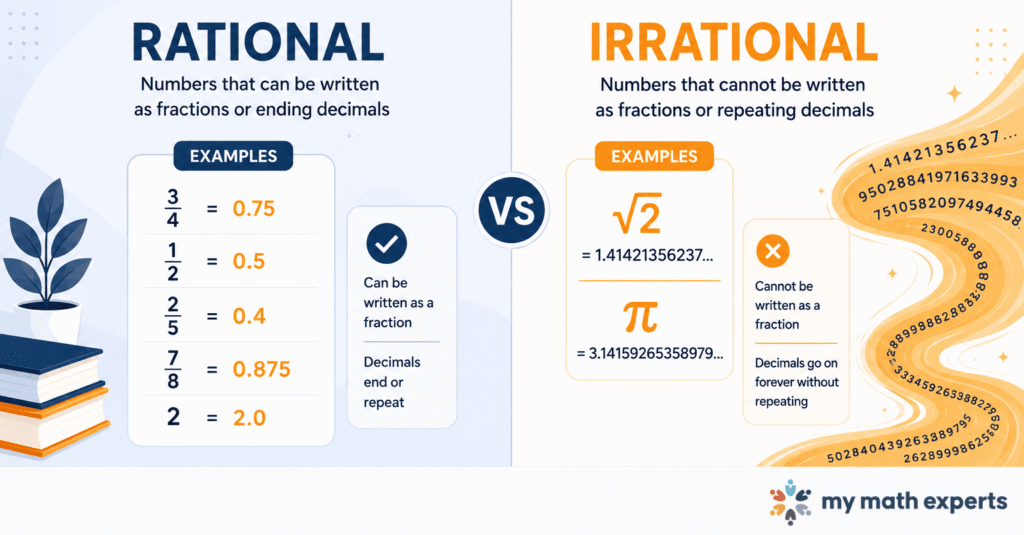
Comparing rational and irrational numbers with fraction and decimal examples, square root of 2, pi, and non-repeating decimals.
Where rational numbers fit in the number system
Think of the number system as a set of nested circles. At the center sit the natural numbers. Add zero and you get whole numbers. Add the negatives and you have integers. Widen the circle again to include every fraction p/q with a nonzero denominator, and now you have the rational numbers.
But the circle doesn’t stop there. Outside the rational numbers live the irrational numbers, the ones like the square root of 2 that refuse to become fractions. Combine rational and irrational numbers together and you get the real numbers, which is every point you could mark on a number line.
A lot of confusion comes from thinking these categories replace each other. They actually build on each other. When you learn about integers, you don’t stop using natural numbers. You’re just working in a bigger set. Rational numbers absorb everything that came before them and add the fractions and terminating and repeating decimals on top.
Arithmetic operations with rational numbers (add, subtract, multiply, divide)
The four arithmetic operations all work on rational numbers, and each has a rhythm worth practicing until it’s automatic.
Adding rational numbers and subtracting rational numbers require a common denominator. To compute 1/3 + 1/4, rewrite both over 12: 4/12 + 3/12 = 7/12. Subtraction follows the identical setup: 5/6 − 1/6 = 4/6, which reduces to 2/3.
Multiplying rational numbers is easier because there’s no shared denominator to find. Multiply numerator by numerator and denominator by denominator: 2/3 × 4/5 = 8/15.
Dividing rational numbers uses one clean trick. Flip the second fraction to its multiplicative inverse (its reciprocal) and multiply. So 2/3 ÷ 4/5 becomes 2/3 × 5/4 = 10/12 = 5/6. The multiplicative inverse of 4/5 is simply 5/4, because the two multiply to 1.
Division works this way because dividing by a number is the same as multiplying by its reciprocal, whether you’re working with whole numbers or fractions. This is exactly the kind of concept where working one-on-one with the same tutor each week pays off, since My Math Experts builds these operations up in order instead of leaving gaps. Reinforcing them with MME math worksheets between sessions helps the steps become second nature.
Properties of rational numbers
The properties of rational numbers describe how they behave when you combine them. They’re the quiet rules that make algebra later on feel predictable.
- Closure: add, subtract, or multiply two rational numbers and you always get another rational number.
- Commutative: order doesn’t matter for addition and multiplication. 2/3 + 1/4 equals 1/4 + 2/3.
- Associative: grouping doesn’t matter for addition and multiplication. (1/2 + 1/3) + 1/6 equals 1/2 + (1/3 + 1/6).
- Identity: adding 0 leaves a number unchanged; multiplying by 1 does the same.
- Inverse: every rational number has an additive inverse (its negative) and, if it isn’t zero, a multiplicative inverse (its reciprocal).
- Density: between any two rational numbers, you can always find another one.
That last property surprises students. There’s no “next” rational number after 1/2 the way 4 follows 3 in the integers, because you can always squeeze another fraction in between. Finding rational numbers between two numbers is as simple as averaging them: the midpoint of 1/2 and 3/4 is 5/8, which sits neatly between them.
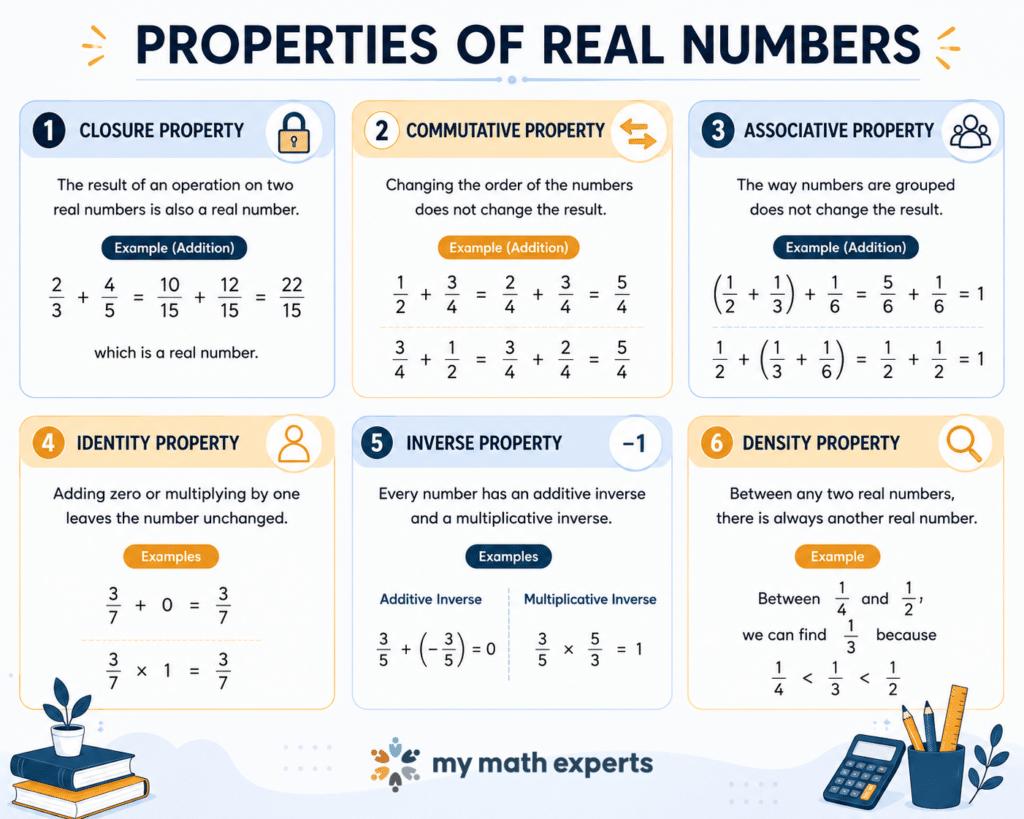
A visual guide to the six key properties of real numbers, with simple fraction examples for easier understanding.
Worked examples and practice problems
Nothing cements this like solved examples, so work through these slowly.
Example 1: Identify. Is 0.6 rational? Yes. It equals 6/10, which reduces to 3/5, a quotient of two integers.
Example 2: Standard form. Write -12/16 in standard form. Divide top and bottom by their common factor, 4, to get -3/4. That reduced version is the irreducible fraction, the simplest form where numerator and denominator share no common factor other than 1.
Example 3: Repeating decimal to fraction. Convert 0.444… Let x = 0.444…, so 10x = 4.444…. Subtract: 10x − x = 4, giving 9x = 4, so x = 4/9.
Example 4: Add. These solved examples on adding rational numbers show the pattern: 3/5 + 1/2 over a common denominator of 10 gives 6/10 + 5/10 = 11/10.
Try these yourself: Is √25 rational? Simplify 18/24. Find one rational number between 2/5 and 3/5. (Answers: yes, since √25 = 5; 3/4; and 1/2 works since it equals 5/10, which sits between 4/10 and 6/10.) If you’d rather watch a step worked out aloud, our library of math solution videos walks through problems just like these.
These examples of rational numbers cover the skills that show up on nearly every middle-grade test.
Everyday uses of rational numbers (why they matter)
Rational numbers aren’t a classroom abstraction. You use them before breakfast.
A recipe calling for 1/2 cup of flour and 3/4 teaspoon of salt is pure fraction arithmetic. Double it and you’re multiplying rational numbers. A 5% interest rate on a loan is really the fraction 5/100 doing quiet work every month. A carpenter reaching for a 3/8-inch bolt is reading a rational number off a measuring tape, and getting it wrong by 1/16 of an inch can ruin a cut.
Money itself is decimals, which are rational numbers: $4.75 is 475/100. Splitting a $60 dinner bill three ways means dividing rational numbers to land on $20 each. Sports stats, gas mileage, sale discounts, and cooking times all run on the same machinery.
The point for a struggling student is that these skills transfer. When fractions and decimals finally click, the confidence spills into ratios, percentages, and the word problems that used to feel like a foreign language. This is one of the clearest benefits of hiring a math tutor: a student stops seeing math as disconnected tricks and starts seeing it as a single, usable skill.
Common mistakes students make with rational numbers
A few errors show up again and again, and naming them helps students catch themselves.
- Forgetting the nonzero denominator. A fraction like 5/0 isn’t a rational number at all; it’s undefined.
- Adding denominators. Writing 1/2 + 1/3 = 2/5 is one of the most common slips. When adding rational numbers you combine the numerators only after finding a common denominator, never the denominators themselves.
- Assuming every square root is irrational. As covered earlier, perfect squares break that assumption.
- Skipping standard form. Leaving an answer as 8/12 instead of reducing to 2/3 costs points and hides mistakes.
- Confusing terminating and repeating decimals with random ones. A decimal that repeats is still rational; only non-terminating non-repeating decimals are irrational.
Most of these come from memorizing procedures without understanding why they work. A student who truly grasps that a fraction means “this many parts out of that many” rarely adds denominators, because it makes no physical sense. These are exactly the gaps that math tutors for middle school target first, since concept-first practice beats rote drilling for fixing these habits for good.

A teacher guides a student through common fraction errors with supportive feedback and step-by-step corrections.
How to build a strong foundation before advanced math
Rational numbers are the pivot point where arithmetic turns into algebra. A student who can fluently add, reduce, and convert them walks into Algebra 1 ready. One who can’t spend that year fighting the fractions inside every equation. Working with an online Algebra 1 tutor early can keep those fraction struggles from snowballing into full-blown algebra anxiety.
Building that foundation is less about doing hundreds of problems and more about closing the specific gaps. Maybe it’s common denominators. Maybe it’s converting repeating decimals. Maybe it’s just believing 0.75 and 3/4 really are the same. The fix is targeted work on the exact weak spot, not more of what already isn’t landing.
If your student is stuck on fractions, decimals, or the ideas underneath them, My Math Experts pairs each student with the same math tutor for every 1:1 online session and a plan built around their real gaps. We focus on understanding the rational numbers and operations underneath the struggle, not just finishing the worksheet.
Families interested in expert geometry tutoring can schedule a consultation with My Math Experts to discuss their child's goals, challenges, and learning needs. My Math Experts currently offers a 45-minute consultation for $15, 70% off the introductory rate, for those who wish to discuss the best tutoring method for their child, with flexible tutoring plans available to meet a variety of academic needs and goals.
Ready to Master Math with Confidence?
Don’t let challenges hold you back — our experts are here to guide you every step of the way. Book your personalized consultation today at My Math Experts and start turning confusion into clarity!
FAQs
Q1. What exactly makes a number rational?
A number is rational if it can be written as a fraction p/q, where p and q are integers and q is not zero. This includes integers like 7 (which is 7/1), fractions like 1/2, terminating decimals like 0.75, and repeating decimals like 0.333…
Q2. Can you give a simple example of a rational number?
The fraction 3/4 is a rational number because both 3 and 4 are integers. As a decimal it becomes 0.75, a terminating decimal, which confirms it belongs to the rational numbers.
Q3. Is 3.14 a rational number, and does that make pi rational too?
The number 3.14 is rational because it equals 314/100, a fraction of two integers. Pi (π) is different, however: its true value is 3.14159… with no repeating pattern that ends, so pi is irrational and 3.14 is only an approximation.
Q4. How do you turn a repeating decimal like 0.333… into a fraction?
Set x = 0.333…, then multiply by 10 to get 10x = 3.333… and subtract the first equation, which gives 9x = 3, so x = 1/3. You multiply by 10 raised to the number of repeating digits, then subtract to cancel the repeating part.
Q5. Does understanding rational numbers actually matter for later math?
Yes, because rational numbers are the foundation for fractions, ratios, algebra, and later work in calculus, where the density property (a rational number always exists between any two others) becomes important. Students who skip a solid grasp of them often hit walls in Algebra 1 and beyond.
Q6. My child keeps mixing up rational and irrational numbers:what helps?
Most of this confusion comes from memorizing rules instead of understanding why a decimal terminates or repeats. Step-by-step practice converting decimals to fractions, ideally with one-on-one support, usually clears it up faster than rote drilling.

Mr. Kemper is the founder and director of My Math Experts. He has taught and tutored thousands of math students in grades 1 - college over the last 20 years, in the classroom and in private education. Algebra is a special passion and Kemper believes that a solid Algebra foundation opens many doors. He has also trained and supported hundreds of teachers and continues to create and innovate in the math education world.