A student who breezed through Algebra 1 can hit pre-calculus and feel lost by week three. That’s not a red flag about ability. It usually means a few earlier skills never fully locked in. Pre-calculus is where it all comes together. This is the moment when many families start looking into pre-calculus tutoring, and it’s the right instinct. Below, we’ll break down what the course covers, why it trips up capable students, and how focused one-on-one support turns confusion into steady progress.
Key Takeaways
- Online 1:1 tutoring gives students flexible access to personalized instruction from home and works well for students who benefit from consistent, individualized support.
- Private tutoring targets individual learning gaps and gives students dedicated support tailored to their coursework and academic goals.
- Most pre-calculus struggles trace back to shaky algebra and trigonometry foundations, not a lack of ability.
- Steady practice on core skills like complex numbers, paired with step-by-step feedback, is what builds real improvement.

A closer look at the core concepts students encounter in pre-calculus, from functions and trigonometry to complex numbers and sequences.
What pre-calculus covers (functions, trigonometry, analytical geometry, sequences)
Pre-calculus is really a bridge course. It pulls together the algebra and geometry students already know and stretches them toward the ideas calculus depends on. Most of the year centers on functions: how to read them, transform them, and graph them without guessing.
From there, the topic list widens fast. Trigonometry shows up as unit circles, identities, and equations. Keeping a trig identities cheat sheet nearby can save a lot of frustration here. Students work through analytical geometry with conics like parabolas and ellipses. Then they move into sequences and series, complex numbers, polar coordinates, and parametric equations. Toward the end, many courses touch on limits and logarithms as a preview of what’s coming next.
Pre-calculus courses focus on modeling with functions and reasoning about how those functions behave, rather than simply memorizing formulas. That framing matters. A student who understands why a graph shifts or stretches can handle problems they’ve never seen before.
The pre-calculus curriculum covers a lot of ground in one year. That’s why gaps in earlier material show up here. Good pre-calculus help focuses on connecting these topics instead of treating each as a separate hurdle.
Why students find pre-calculus hard (common struggle points)
Here’s the pattern I see most: students aren’t struggling with pre-calculus itself. They’re struggling with algebra and trigonometry that never fully clicked. Now those weak spots show up in every problem.
This matters because pre-calculus assumes fluency. When a student still second-guesses how to factor or simplify a radical, they burn all their focus on the setup. That leaves nothing for the actual new concept. This is part of why educators stress procedural fluency alongside conceptual understanding. That’s how bright kids end up feeling like they “just don’t get math.”
Many parents assume their child hates math or isn’t a “math person.” In reality, most math frustration comes from missing building blocks, not from a lack of ability. The pace of a full classroom makes it worse. Teachers have to keep moving, so a student who’s confused on Monday is often more confused by Friday. This is where targeted pre-calculus helps close the gap.
The American Psychological Association notes that anxiety narrows attention and working memory. Their research on math anxiety in students shows how much this can affect performance, which is a real problem when a student needs both attention and working memory for a multi-step trig equation. Tricky concepts like complex numbers, polar coordinates, and function transformations feel impossible when a student is already tense before the problem starts.
How pre-calculus tutoring works (1:1 sessions, online classroom, whiteboard)
Online pre-calculus tutoring works better than most parents expect, mostly because of how we build the sessions. Every session at My Math Experts is 1:1 with the same certified math teacher. No re-explaining of the student’s situation each week, and no wasted time.
The tutor and student work together online through step-by-step instruction focused on the student’s coursework, learning gaps, and academic goals. Because the student works with the same tutor each week, sessions can build naturally on previous learning.
A strong session is simple: the tutor watches the student solve, catches the exact spot where the logic breaks, and fixes it with step-by-step instruction. That real-time feedback loop is hard to get in a classroom of thirty.

Learn trigonometry with real-time guidance, interactive whiteboards, and personalized support from an expert tutor.
Personalized/tailored pre-calculus tutoring programs
Generic tutoring treats every student the same. Personalized pre-calculus tutoring starts by figuring out what’s actually going wrong. Personalized pre-calculus tutoring begins by understanding the student’s current coursework, challenges, and learning needs. Tutors identify learning gaps through personalized instruction and adjust support as the student progresses. Families can begin with an initial consultation to understand where things stand and identify learning gaps.
After the first few sessions, families may receive a Personalized Success Plan tailored to the student’s needs, developed collaboratively with the teacher, student, and family. It gets reviewed as the student progresses, so it stays useful.
This is where consistency pays off. Because the student works with the same tutor weekly, that tutor knows exactly what was covered last time and where the student still wobbles. A pre-calculus tutoring program built on that continuity can build a strong foundation instead of jumping around.
The plan isn’t about rushing ahead. It’s about making sure each concept holds before stacking the next. For advanced students, that same structure means moving faster into deeper material rather than repeating what they’ve already mastered.
How tutoring helps struggling and advanced students
The same 1:1 model serves two very different students well. A student struggling with pre-calculus needs the pace slowed down and the gaps closed. An advanced student needs to be pushed further than the classroom allows. One-on-one support handles both because the session bends to fit the student, not the other way around.
For a student who’s behind, the tutor rebuilds the foundation first. That often means going back to algebra or trigonometry skills the course assumes, then reconnecting them to current material. Once foundational skills are reinforced, chapters that felt overwhelming often become more manageable. If you’re weighing options, it’s fair to ask whether a math tutor is worth it before committing.
For advanced students, expert pre-calculus tutors can layer in tougher problems, introduce ideas like parametric equations or sequences and series early, and sharpen problem-solving skills that pay off in calculus. The good news is that neither group has to compete for attention.
For example, a student struggling with the unit circle may discover that the underlying challenge is a gap in earlier trigonometry concepts. Addressing that foundation can help the student approach later topics with greater understanding and confidence. Results vary based on participation, consistency, and individual learning needs.
Homework help and assignment support
Homework is where math friction shows up loudest at home. A student stares at a problem set, gets stuck on question two, and the whole evening turns into a standoff. Homework help in a tutoring session breaks that cycle by working through the sticking points with the student instead of just handing over answers.
Here’s the thing though: homework help alone isn’t the goal. If a tutor only ever solves the assigned problems, the student never builds independent skill. That’s why sessions use homework as a starting point, then reinforce the concept underneath it so the next assignment goes more smoothly.
Sharing homework is easy. Parents can snap a photo and email it to the tutor, who uploads it into the online lesson space. Digital assignments can be screenshared directly. Tutors work with the student’s coursework and, when appropriate, reinforce concepts with carefully selected textbooks, practice problems, and other learning resources.
Better homework performance is usually a side effect, not the whole point. When a student understands the concept, the grades follow. You’ll receive session notes so you can see what was covered and where things are heading next.
Session scheduling, frequency, and availability
Most students see real progress with consistent weekly sessions. That rhythm matters more than cramming. Meeting once a week keeps momentum going, gives the student time to practice between sessions, and lets the tutor track improvement instead of guessing.
All sessions run online, so students can attend from home or anywhere with an internet connection. That flexibility solves a big logistics problem for busy families juggling sports, jobs, and other commitments. There’s no drive across town and no fixed center hours to work around. Families comparing options can review our tutoring plans and pricing to find a rhythm that fits their budget.
Weekly consistency works for a simple reason: math skills fade fast without use. Consistent weekly online tutoring gives students the continuity they need to reinforce concepts, build confidence, and make steady progress. My Math Experts provides 1:1 online tutoring so students can receive personalized support from home.
Life happens, so emergency sessions are available too and can be booked right up until the session start time. If a chapter suddenly stops making sense, additional support can help address the difficulty before it grows into a larger learning gap. The same tutor stays with the student throughout, so even a last-minute session picks up right where things left off.
How pre-calculus prepares students for calculus and college math
Pre-calculus serves as an important foundation for calculus and other advanced math coursework. Nearly every idea in a first calculus course – limits, derivatives, and integrals – sits on top of function fluency and trigonometry from this year. A student who leaves pre-calculus shaky doesn’t just struggle later; they struggle immediately.
The root cause is that calculus rarely tests the “new” calculus concept in isolation. A derivative problem might hinge on simplifying a trig expression or rewriting a logarithm. If those skills aren’t automatic, the calculus part never gets a fair shot. That’s why solid pre-calculus help isn’t only about surviving this year’s grade. Working through limits and logarithms, mastering graphs, and getting comfortable with complex numbers all build a strong foundation that college math assumes you already have. A strong understanding of pre-calculus concepts can help students approach calculus with greater confidence and readiness.
For high school students heading toward STEM majors, this stage is quietly one of the most important, and steady math tutoring makes the difference. Strengthening these building blocks now prevents painful catch-up later, when the pace is faster and the stakes are higher. The aim is long-term understanding, so a student can master pre-calculus in a way that actually holds up in the next course.
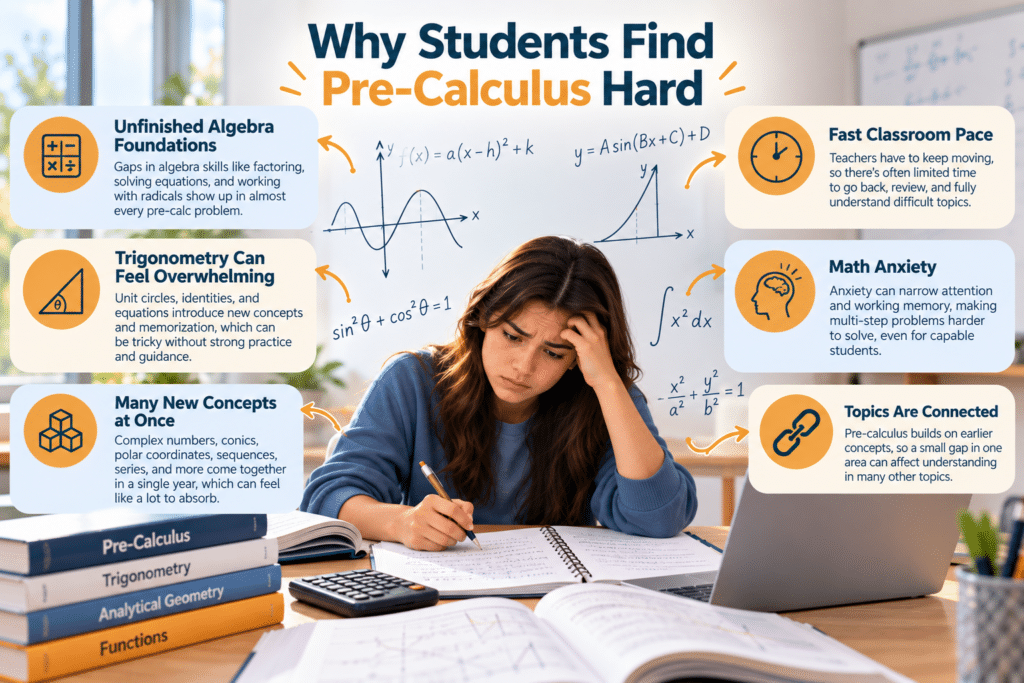
Pre-calculus can feel overwhelming when algebra gaps, challenging trigonometry, a fast classroom pace, and multiple new concepts all come together.
Building math confidence and reducing math anxiety
Confidence and skill grow together. A student who keeps getting stuck starts to believe they’re just bad at math, and that belief makes them freeze on problems they could actually solve. Breaking that loop is often the biggest thing tutoring does.
The fix isn’t a pep talk. It’s small, repeated wins. When a student solves something with step-by-step instructions that used to stump them, the story they tell themselves starts to change. Working with expert pre-calculus tutors 1:1 helps here, because the student stops feeling judged and starts asking the questions they were too embarrassed to raise in class.
That’s how tutoring helps students build confidence in a way that sticks. As the learning gaps close, the anxiety that came with them tends to ease too. A calmer student thinks more clearly, and clearer thinking means fewer careless mistakes.
None of this is about pretending math is easy. It’s about showing a student they can handle it with the right support. Once a student believes progress is possible, they engage more, practice more, and build confidence that carries into harder courses. If your student could use more structure, consistency, and personalized pre-calculus tutoring, My Math Experts provides 1:1 online tutoring with state-certified teachers and experienced math educators, with students working consistently with the same tutor each week.
Families interested in expert geometry tutoring can schedule a consultation with My Math Experts to discuss their child's goals, challenges, and learning needs. My Math Experts currently offers a 45-minute consultation for $15, 70% off the introductory rate, for those who wish to discuss the best tutoring method for their child, with flexible tutoring plans available to meet a variety of academic needs and goals.
Ready to Master Math with Confidence?
Don’t let challenges hold you back – our experts are here to guide you every step of the way. Book your personalized consultation today at My Math Experts and start turning confusion into clarity!
FAQs
Q1. What should I look for when choosing a pre-calculus online tutor?
Prioritize strong subject knowledge, patience, and the ability to adapt teaching to your learning style. Certified teachers who provide step-by-step explanations and track progress tend to build lasting understanding rather than short-term answers.
Q2. Is online tutoring or a group class better for pre-calculus?
Online 1:1 tutoring gives students dedicated instruction that adapts to their pace and focuses on specific learning gaps. This personalized approach allows the tutor to adjust explanations and practice based on the student’s needs.
Q3. Is pre-calculus really the hardest math class?
Pre-calculus feels hard for many students because it combines algebra, trigonometry, and new topics like complex numbers all at once. In reality, most of that frustration comes from shaky foundations in earlier courses, which is why step-by-step support usually makes it click.
Q4. How can I actually get better at pre-calculus?
Practice consistently, strengthen foundational skills, and work through challenging concepts step by step. Regular 1:1 support helps identify learning gaps, reinforce conceptual understanding, and build confidence over time.

Mr. Kemper is the founder and director of My Math Experts. He has taught and tutored thousands of math students in grades 1 - college over the last 20 years, in the classroom and in private education. Algebra is a special passion and Kemper believes that a solid Algebra foundation opens many doors. He has also trained and supported hundreds of teachers and continues to create and innovate in the math education world.