A student who breezed through math in seventh grade suddenly brings home a C on their first Algebra 1 test. Nobody at the dinner table knows exactly where things went sideways. That gap between “used to be good at math” and “now dreads it” is the most common reason families start looking for an Algebra 1 tutor online. The good news is that most of the struggle traces back to a handful of concepts that were never fully explained, and those are fixable. This article covers why students struggle with algebra, how online algebra tutoring works, what topics get covered, and what real grade improvement looks like.
Key Takeaways
- An online Algebra 1 tutor gives students personalized, step-by-step instruction that fills learning gaps faster than self-study alone.
- Online tutoring is usually 10-30% cheaper than in-person sessions and offers more flexible scheduling and tutor options.
- A free assessment or trial session helps families confirm tutor fit before committing to a plan.
- The fastest grade improvements come from structured, one-on-one online tutoring that targets a student’s specific weak spots with progress tracking.

A student celebrates a top algebra test score during an online tutoring session, reflecting the confidence and academic growth that personalized one-on-one math instruction can deliver.
Why students struggle with Algebra 1
Most math frustration comes from one place: the jump from arithmetic to abstraction. In pre-algebra, students work with real numbers and concrete steps. Then Algebra 1 asks them to solve for a letter, and suddenly the rules feel invisible. This is the single biggest reason why students struggle with algebra. The root cause is usually a missed concept two or three steps back, not a lack of ability.
Here’s why it matters: math builds on itself. If a student never fully understood how negative numbers behave, solving linear equations feels random. Then linear functions feel worse. According to the National Center for Education Statistics, average math scores for 13-year-olds have declined in recent assessments. This national data on student math performance lines up with what many math tutors see: students carrying learning gaps into higher-level courses.
Many parents assume their child simply “hates math.” In reality, students rarely hate a subject they understand. What they hate is feeling lost in a fast-moving classroom where they can’t ask enough questions. Math anxiety usually follows, not the other way around. When those foundational gaps get addressed one at a time, the resistance tends to fade with them.
How online Algebra 1 tutoring works
Online algebra tutoring happens over video, so the tutor and student can see and hear each other in real time. But it isn’t just a video call. Sessions run on a shared lesson space with a whiteboard both people can write on. The student can upload a worksheet or screenshare a digital assignment. The tutor can then mark it up, solve alongside them, and walk through each step live. Nothing is passive. These are dynamic, interactive sessions built around doing the math together.
For homework, families can snap a photo of an assignment and email it to the tutor before the session, or the student can screenshare it directly. That removes the “how do we even share the work” hurdle that stops many parents from trying an algebra 1 tutor online. If you’re still weighing whether hiring a math tutor is worth it, seeing how a live session actually runs often settles the question.
Research from the University of Chicago’s Education Lab has found that high-dosage, one-on-one tutoring produces some of the strongest academic gains of any intervention. The reason is simple: with online algebra tutoring, a student gets immediate feedback the moment they make a mistake, instead of days later on a graded quiz. That fast correction loop is what makes 1:1 online tutors so effective compared to watching a lesson alone.
Personalized/1:1 online tutoring approach and learning plans
A large classroom moves at the pace of the curriculum, not your child. Personalized algebra tutoring is built to fix that. With 1:1 online tutors, every minute targets the specific spot where a student got stuck.
At My Math Experts, students work in one-on-one online tutoring with the same tutor every week. This matters more than it sounds. The same tutor remembers what confused the student last month, notices patterns in their mistakes, and builds real momentum instead of restarting each session. Consistency turns scattered help into steady growth, which is why personalized algebra tutoring works.
After 2–4 sessions, families receive a Personalized Success Plan with specific goals, prescribed resources, and a long-term roadmap developed collaboratively by the tutor, student, and family. It’s a clear roadmap with specific goals based on the student’s needs, prescribed resources, and a long-term plan built together by the tutor, student, and family. It covers the material and helps them plan next steps.
These aren’t peer tutors or casual homework helpers. Every one of our algebra tutors is a state-certified teacher or experienced college-level math educator who specializes in mathematics. You can meet our certified math tutors to see the kind of educators students work with. That difference shows up in how they explain a concept, spot a learning gap, and adjust the approach until it finally clicks.
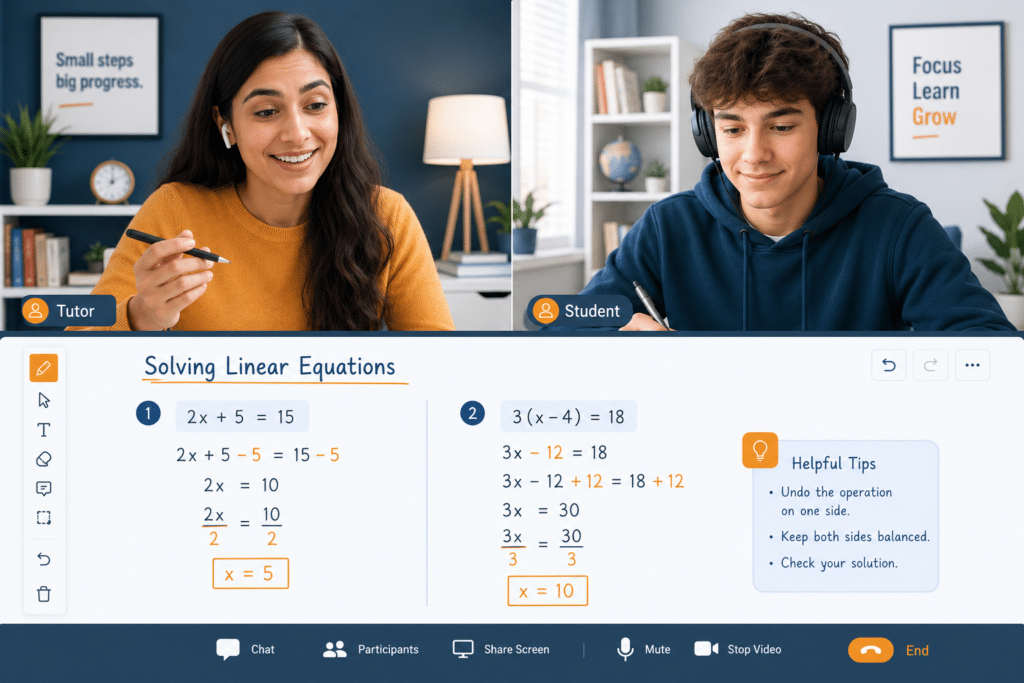
A patient math tutor guides a student through algebra during a live online session using a shared digital whiteboard, creating an engaging and supportive virtual learning experience.
Algebra 1 topics and curriculum covered
Algebra 1 topics follow a fairly predictable order across most schools, and each one leans on the one before it. A good tutor knows this sequence cold and can pinpoint where a student’s understanding breaks down.
The core algebra 1 topics usually include:
- Solving and graphing linear equations
- Working with inequalities and their number-line representations
- Understanding linear functions and slope
- Solving systems of equations using substitution and elimination
- Simplifying and factoring polynomial expressions
- Introducing quadratic functions and their graphs
Most students hit a wall somewhere in the middle. Linear equations feel manageable, then systems of equations arrive and require juggling two things at once. Quadratic functions often cause the next spike in frustration because they introduce curves after a semester of straight lines.
The goal in tutoring is understanding, not just getting the answer. Good algebra tutors don’t only show how to factor a polynomial expression. They explain why factoring works and where it shows up again in algebra 2. That concept-first approach reflects the importance of understanding over memorization, and it’s the best way to learn algebra, because each new topic reinforces the last instead of piling on memorization. Strong problem-solving skills come from seeing the logic, not copying steps.
Algebra 1 homework help and assignment support
Homework is where the tension usually shows up at home. A student stares at a problem, a parent tries to help, and within ten minutes everyone’s frustrated. The parent-child dynamic makes math coaching hard, even for parents who know the material. If you’ve wondered how to help my child with algebra 1, this is often the sticking point.
Algebra homework help through a tutor changes that. Instead of guessing, the student brings the actual assignment to the session and works through it with someone who teaches this every day. The tutor doesn’t just hand over answers. They use the homework as a live example to teach the underlying concept, so the next similar problem gets easier on its own.
But algebra 1 homework help is only part of what happens. My Math Experts tutors work through textbooks and, when appropriate, reinforce concepts with carefully selected learning resources tailored to the student’s needs. If a worksheet reveals a gap in linear functions, the tutor addresses that gap directly.
This is the difference between homework-answer services and actual algebra 1 tutoring. One gets tonight’s assignment done. The other builds the study habits and problem-solving skills that make future assignments manageable. Getting algebra homework help this way reduces homework stress at home too, since the student gains real independence.
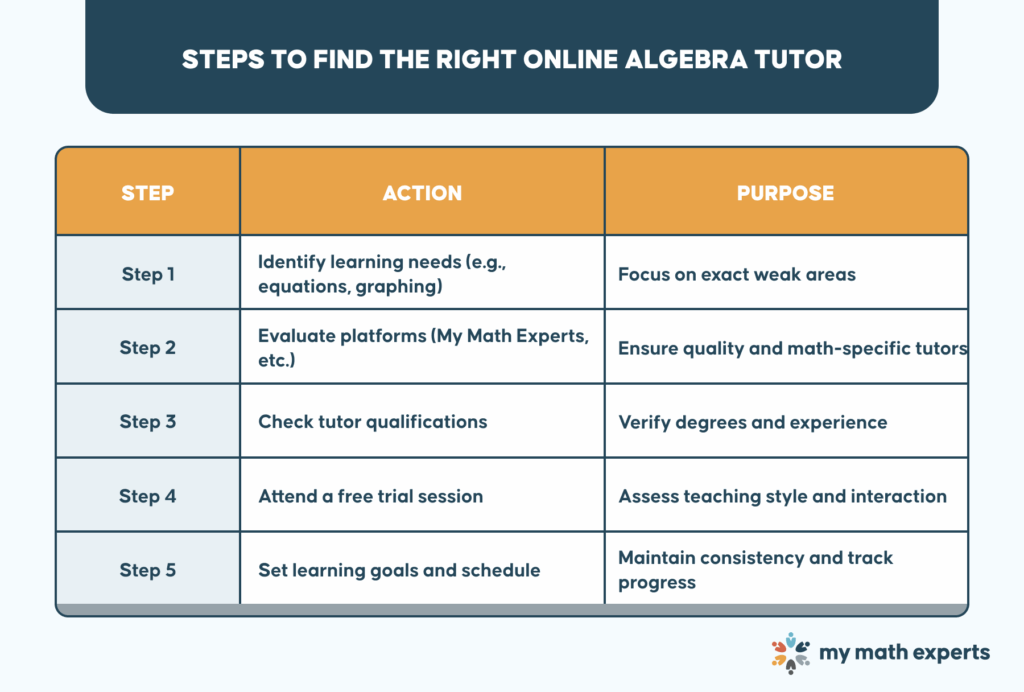
5 simple steps to find the right online algebra tutor — from identifying your learning needs to setting goals for consistent progress.
What grade is Algebra 1 taught / when students take it
Most students take Algebra 1 in eighth or ninth grade, though the timing varies more than parents expect. Students on an accelerated track often take it in eighth grade, while others take high school algebra as freshmen. Some districts split it across two years for extra support. Younger students still working toward this level often benefit from middle school math tutoring to build the pre-algebra foundation first.
Here’s why it matters: Algebra 1 is a gateway course. Success here shapes whether a student moves smoothly into geometry, algebra 2, and later math. A rocky Algebra 1 year doesn’t just affect one grade. It makes the next several courses harder because the foundation is shaky.
That’s why the transition from pre-algebra is worth watching closely. A student who coasted through middle school math can suddenly struggle when the abstraction ramps up. If you’re wondering how to help my child with algebra 1, the honest answer for most parents is to get a knowledgeable educator involved early, before small gaps become a pattern. Families with older students often choose to work with high school math tutors for exactly this reason.
Whether a student takes it early or on the standard timeline, the concepts are the same. What differs is the maturity and study habits they bring to it, which is exactly where consistent algebra 1 tutoring makes the biggest difference.
Algebra 1 vs Algebra 2 difficulty comparison
Parents often ask whether algebra 2 is just “more of the same.” It isn’t. Algebra 1 builds the toolkit: linear equations, basic functions, factoring, and an introduction to quadratic functions. Algebra 2 takes that toolkit and applies it to more complex material, like exponential functions, logarithms, and advanced polynomial expressions.
Many assume algebra 2 is harder simply because the numbers get uglier. In reality, the students who struggle in algebra 2 almost always have unresolved gaps from Algebra 1. If systems of equations never fully made sense, the more layered problems in algebra 2 feel impossible. The difficulty jump isn’t really about algebra 2 being brutal. It’s about carrying weak spots forward.
This is the strongest argument for solid algebra 1 help now. A student who genuinely understands linear functions, factoring, and quadratic functions walks into algebra 2 with real footing. A student who memorized their way through Algebra 1 tends to hit a wall. This is also why online algebra tutoring early pays off.
So the fair comparison isn’t “which is harder.” It’s whether the foundation was strong enough to support the next level. Good math tutors focus on that foundation precisely because it determines how hard the following two years of math will feel.
Free math assessment / diagnostic evaluation
You can’t fix a gap you can’t see. Identifying the root cause of a student’s challenges is an important part of effective tutoring. Rather than guessing, tutors continuously identify learning gaps through personalized instruction and adjust the learning plan as the student progresses. Guessing at where a student struggles wastes sessions and money. A diagnostic pinpoints the exact concepts that need work, so tutoring starts productive from day one.
Tutors focus on understanding which foundational concepts need additional support so that each tutoring session builds meaningful long-term progress. Every student can start with a free math assessment that reveals which algebra 1 topics are solid and which need attention. That result feeds a plan for online algebra tutoring, so nobody spends an hour reviewing skills the student already owns.
Many families discover that difficulties with advanced topics often stem from earlier foundational concepts. Addressing those underlying skills helps students build confidence and stronger mathematical understanding. A student struggling with quadratic functions frequently turns out to have a shaky grasp of factoring or linear functions from earlier in the year. The visible problem is rarely the actual root cause. A good math assessment traces the difficulty back to its source.
As tutoring progresses, families receive regular session notes and ongoing communication about student progress, making it easier to understand what concepts have improved and what still needs attention. Instead of promising results blindly, a diagnostic gives families concrete information about where their child stands and what a realistic plan looks like. Results vary based on student participation and consistency, but starting with real data beats starting with assumptions every time.
Proven results, grade improvement, and outcomes
What actually moves a grade? Consistency and targeting. The strongest studies on academic intervention keep pointing to the same combination: one-on-one tutoring, delivered regularly, by qualified educators, with a plan. That’s not a marketing angle. It’s what the research on tutoring effectiveness consistently finds.
My Math Experts is ranked the #1 academic tutoring company in Arizona and works with students across the U.S. through virtual sessions. The approach is built around that research-backed combination: the same state-certified teacher or experienced math educator every week, a structured plan, and progress tracking so families can see whether working with an online algebra tutor is paying off. Families who want to compare options can review the tutoring plans and pricing before deciding.
That progress tracking matters. You’ll receive session notes, so you’re never guessing about what happened or whether your child is moving forward. Watching a student go from dreading algebra to volunteering answers in class is the kind of outcome that keeps families coming back.
To be straight about it: results vary based on student participation, consistency, and effort. Tutoring supports school instruction; it doesn’t replace it. But when a student shows up consistently with an Algebra 1 tutor online, Students who participate consistently often develop stronger conceptual understanding, greater confidence, and improved academic performance. Results vary based on participation, consistency, and individual learning needs, and helping to improve your child’s grade is the whole point.

A confident student proudly displays a high-scoring algebra test while attending an online tutoring session, highlighting the progress and confidence that personalized math support can build.
Reducing math anxiety and building confidence
Math anxiety is real, and it does measurable damage. When a student is anxious, working memory shrinks. That means the exact resource they need to solve a problem is the one that shuts down under stress. So a capable student can freeze on a test and “prove” to themselves they’re bad at math, when the real issue was panic, not ability.
Building confidence is less about pep talks and more about small, repeated wins. When a student finally understands linear equations after weeks of confusion, something shifts. With step-by-step instruction, one clear explanation at a time, the sense of “I can’t do this” starts to erode.
Consistency plays a big role here. Working with the same tutor every week means the student isn’t re-explaining themselves to a stranger each session. That familiarity lowers the pressure, and lower pressure makes room for actual learning. A student who trusts their tutor asks more questions, and asking questions is how gaps close.
The goal isn’t just a better test score. It’s a student who no longer flinches when a math worksheet lands on their desk. That mindset shift often outlasts any single grade, carrying into algebra 2 and beyond. Consistent tutoring throughout the year helps students reinforce foundational skills and continue building confidence as new concepts are introduced.
The MME System and structured foundational learning
Casual tutoring tends to wander. A student shows up with whatever’s due, the tutor helps, and everyone hopes it adds up over time. It usually doesn’t. Structure is what turns effort into progress, and that’s the whole idea behind the MME System.
The MME System is built around personalized instruction that helps tutors identify learning gaps, develop long-term learning goals, and provide targeted support based on each student’s progress. Instead of reacting week to week, the tutor works through material deliberately. That closes foundational gaps in the right order, so each new concept has something solid to stand on. It’s the same structure whether the focus is high school algebra or catching up on earlier skills.
The point of all this structure is simple: real, long-term understanding instead of last-minute cramming. Certified teachers teaching conceptually, a plan that adapts as the student grows, and consistent weekly online sessions. That’s how Algebra 1 help turns into lasting academic growth rather than a temporary grade bump.
If your student could use more confidence, structure, and steady support in Algebra 1, it’s worth seeing whether this approach fits. You can get your free math assessment and talk with the My Math Experts team about a plan built around your child’s specific gaps and goals. No pressure, just a clear picture of where things stand and what real progress could look like.
Families interested in expert geometry tutoring can schedule a consultation with My Math Experts to discuss their child's goals, challenges, and learning needs. My Math Experts currently offers a 45-minute consultation for $15, 70% off the introductory rate, for those who wish to discuss the best tutoring method for their child, with flexible tutoring plans available to meet a variety of academic needs and goals.
Ready to Master Math with Confidence?
Don’t let challenges hold you back — our experts are here to guide you every step of the way. Book your personalized consultation today at My Math Experts and start turning confusion into clarity!
FAQs
Q1. How can an Algebra 1 tutor help if my child is only slightly behind?
Small gaps in Algebra 1 tend to compound quickly because later topics build directly on earlier ones. Addressing foundational concepts early through consistent one-on-one online tutoring helps students build confidence and long-term understanding.
Q2. What if we try online tutoring and it doesn't help my student improve?
Look for providers that offer experienced educators, consistent one-on-one instruction, structured progress tracking, and personalized learning plans. These factors help families evaluate whether tutoring is meeting the student’s needs.
Q3. How do I find a qualified online Algebra 1 tutor that fits my schedule?
Start by identifying your goal: grade recovery, exam preparation, or mastering a specific topic; then choose a platform that offers certified teachers and flexible scheduling. My Math Experts pairs students with certified teachers and builds custom learning plans around your availability.
Q4. Which online Algebra 1 service helps improve grades?
The results come from personalized online 1:1 tutoring that targets specific learning gaps rather than general review. Providers with structured, step-by-step programs and measurable progress tracking, such as My Math Experts and its MME System, tend to move students forward faster than self-paced tools alone.

Mr. Kemper is the founder and director of My Math Experts. He has taught and tutored thousands of math students in grades 1 - college over the last 20 years, in the classroom and in private education. Algebra is a special passion and Kemper believes that a solid Algebra foundation opens many doors. He has also trained and supported hundreds of teachers and continues to create and innovate in the math education world.