A student stares at a homework problem: 3/4 ÷ 2/5. They freeze. Then they remember one trick: flip the second fraction and multiply. The answer falls out in seconds. That flip is the point of understanding what a reciprocal is in math. It’s a small idea that quietly powers fraction division, equation-solving, and a surprising amount of algebra later on. This guide breaks it down from the ground up. You’ll get the definition, how to find it for every kind of number, the one exception that trips everyone up, and where it shows up in higher-level courses.
Key Takeaways
- A reciprocal in math is the number you multiply an original value by to get a product of 1, also known as its multiplicative inverse.
- To find the reciprocal of any fraction, you simply swap the numerator and denominator, turning 2/3 into 3/2.
- Whole numbers are treated as fractions over 1, so the reciprocal of 5 is 1/5, and the reciprocal of 8 is 1/8.
- Zero is the only real number without a reciprocal because dividing 1 by zero is undefined.
- Reciprocals make fraction division easier because dividing by a fraction is the same as multiplying by its flipped version.

Learn fraction reciprocals with clear, interactive online math lessons.
What is a reciprocal in math? (definition and basic meaning)
So what is a reciprocal, really? A reciprocal of a number is the value you multiply the original by to land on exactly 1. That’s the whole definition. Mathematicians call it the multiplicative inverse. When a number times its reciprocal equals 1, the two values have “undone” each other under multiplication. For a formal treatment, Wolfram MathWorld’s entry on the multiplicative inverse lays out the concept precisely.
Here’s the simplest way to see it. For any number that isn’t zero, the reciprocal is just 1 divided by the number. The reciprocal of 4 is 1/4, because 4 × 1/4 = 1. The reciprocal of 10 is 1/10. Nothing fancy is happening. You’re finding the partner that brings the product back to the multiplicative identity, 1.
Many people assume a reciprocal is the same as a negative or an opposite. In reality, those are different ideas, and the difference between reciprocal and inverse matters. A reciprocal flips a number under multiplication, while a negative changes its sign under addition. Keeping that straight saves confusion later. For a plain-language reference, the University of Cambridge NRICH project offers approachable explanations of foundational number concepts like this one, and if you want a dictionary-level clarification, the definition of reciprocal from Merriam-Webster spells it out too. Get the definition solid, and every reciprocal example that follows becomes routine.
How to find the reciprocal of a number (general step-by-step)
Learning how to find a reciprocal comes down to a repeatable process, not memorizing separate rules for each number type. The reason this matters: once students see that every case reduces to the same move, reciprocal math stops feeling like a pile of exceptions. It starts feeling like one idea. This kind of fluency with fractions ties directly into understanding rational numbers, the broader family that reciprocals belong to.
Here’s the general step-by-step instruction:
- Write the number as a fraction. Whole numbers sit over 1 (so 7 becomes 7/1). Convert decimals and mixed numbers to fractions first.
- Flip the fraction over. Swap the top and bottom, turning the number upside down.
- Check your work. Multiply the original by your answer. If the product is 1, you’re right.
That third step is the honest test. A number times its reciprocal equals 1, always, so it’s a built-in way to catch mistakes.
Another quick shortcut: for any single value, the reciprocal is 1 divided by the number. Both methods agree, because flipping a/b to b/a is the same as computing 1 ÷ (a/b). The Khan Academy library on multiplying and dividing fractions walks through this same logic with worked practice. Learn the process once, and writing the reciprocal for any input becomes automatic. To drill it further, our downloadable math worksheets give students plenty of practice problems to build that muscle memory.

A simple three-step process for flipping a fraction to find its reciprocal.
Reciprocal of a whole or natural number
The reciprocal of a whole number is the friendliest case to start with. Every whole number can be written as a fraction over 1. The number 6 is really 6/1. Flip it, and you get 1/6. So the reciprocal of 6 is 1/6, the reciprocal of 12 is 1/12, and so on. The same holds for a natural number, since natural numbers (1, 2, 3, and up) are just the positive whole numbers. This kind of number sense is central to the NCTM Number and Operations standards, which stress fluency across number types.
This is where “1 divided by the number” feels easiest, and it shows how to find a reciprocal without flipping. The reciprocal of 8 is 1/8, which is literally 1 ÷ 8. Check it: 8 × 1/8 = 8/8 = 1. Done.
One neat detail: the number 1 is its own reciprocal, because 1/1 is still 1, and 1 × 1 = 1. It’s the only positive number that works that way.
A few reciprocal examples to lock it in:
- The reciprocal of 3 is 1/3
- The reciprocal of 20 is 1/20
- The reciprocal of 100 is 1/100
Notice the pattern: the bigger the base, the smaller its reciprocal. That inverse relationship is exactly why the reciprocal of a whole number matters in later fraction operations.
Reciprocal of a fraction (flipping the fraction)
The reciprocal of a fraction is the case most students actually need, because fractions show up everywhere in real math. The rule is short: flip the fraction over. Swap the numerator and denominator, and you’re finished.
The reciprocal of 2/3 is 3/2. The reciprocal of 5/8 is 8/5. The reciprocal of 7/4 is 4/7. Every time, the top becomes the bottom, and the bottom becomes the top. Confirm with the built-in check: 2/3 × 3/2 = 6/6 = 1. That number times its reciprocal equals 1, exactly as the definition promises. Students who prefer a step-by-step worked example can use our math solution videos for a visual walkthrough.
This flip drives fraction division. Here’s the connection that makes everything click: dividing by a fraction is the same as multiplying by its reciprocal, because dividing by a/b asks how many groups of a/b fit into a number, and that count is exactly what multiplying by b/a returns. So 3/4 ÷ 2/5 becomes 3/4 × 5/2 = 15/8. Students who see why this works, rather than just memorizing “keep, change, flip,” handle harder problems with far less second-guessing.
Picture a student who has memorized “keep, change, flip” but never saw why. On a multi-step problem like (3/4 ÷ 2/5) × 1/3, they flip the wrong fraction, get 5/2 in the wrong spot, and their whole answer collapses. Understanding the mechanism, not the chant, is what keeps that from happening.
At My Math Experts, tutors focus on that conceptual link instead of the trick. This way, fraction operations and dividing fractions become skills a student can rebuild on their own, not steps they forget by next week.
Reciprocal of a mixed number
Finding the reciprocal of a mixed number takes one extra step, and skipping it is one of the most common mistakes. You cannot flip a mixed number as it sits. First, convert it to an improper fraction, then flip the numerator and denominator.
Take 2 1/3. To convert it, multiply the whole number by the denominator, add the numerator, and keep the same denominator. That gives (2 × 3 + 1)/3 = 7/3. Now flip the fraction over: the reciprocal of 2 1/3 is 3/7. Check it: 7/3 × 3/7 = 21/21 = 1.
The same routine handles any reciprocal of a mixed fraction. For 1 3/4, convert to 7/4, then flip to 4/7. For 3 1/2, convert to 7/2, flip to 2/7.
The usual error comes from treating the whole-number part and the fraction part separately. They aren’t separate. A mixed number is a single value, so it must become a single improper fraction before you turn the number upside down. Convert first, flip second, and the reciprocal of a mixed number stays simple.
Reciprocal of a decimal number
Finding the reciprocal of a decimal follows the same logic, just with a conversion up front. You have two clean options.
Option one: turn the decimal into a fraction, then flip. The decimal 0.25 is 1/4, so its reciprocal is 4/1, which is 4. The decimal 0.5 is 1/2, so its reciprocal is 2. Quick check: 0.25 × 4 = 1.
Option two: use “1 divided by the number” directly. The reciprocal of 0.2 is 1 ÷ 0.2 = 5. This is handy on a calculator, and it gives you the reciprocal as a decimal when the result isn’t a tidy whole number. For example, the reciprocal of 0.4 is 1 ÷ 0.4 = 2.5.
Sometimes you want the answer expressed as a decimal rather than a fraction, and that’s fine. Both forms describe the same value. The reciprocal of 8, written as a decimal, is 0.125.
Watch the decimal placement, because misreading the place value is where errors sneak in. Convert carefully or divide carefully, then confirm the product equals 1. That check catches nearly every slip with a decimal reciprocal.
Reciprocal of a negative number
The reciprocal of a negative number keeps its sign. This surprises many students, so it’s worth stating plainly. Flipping a fraction changes the size, not the sign. A negative stays negative.
Find the reciprocal of -3 the usual way. Write it as -3/1, then flip the fraction over to get -1/3. Check it: -3 × -1/3 = 3/3 = 1. A negative times a negative gives a positive, which is exactly why the product still lands on 1, as every reciprocal must.
More reciprocal examples with negatives:
- The reciprocal of -5 is -1/5
- The Reciprocal of -2/7 is -7/2
- The Reciprocal of -0.5 is -2
Here’s the difference between reciprocal and inverse that trips people up. A reciprocal (the multiplicative inverse) flips the number. The negative sign is a separate matter (that’s the additive inverse). So the reciprocal of -4 is -1/4, not +1/4 and not +4. Many assume the reciprocal should cancel the negative. In reality, only the value flips while the sign rides along unchanged. Keep those two operations in separate mental boxes, and negatives stop being a stumbling point.

Step-by-step guide to finding reciprocals of whole numbers, fractions, mixed numbers, decimals, and negative numbers
Where reciprocals show up in later math (algebra, precalculus, and real problem-solving)
Reciprocals aren’t a one-week topic you leave behind. They come back constantly. In algebra, solving an equation like (2/3)x = 8 is fastest when you multiply both sides by the reciprocal, 3/2, to isolate x in a single step. That’s the multiplicative inverse doing exactly what it’s built to do. Students who want targeted help mastering this move often benefit from online Algebra 1 tutoring that reinforces the reasoning behind each step.
They also drive rate-and-proportion work, unit conversions, and slopes of perpendicular lines, which use negative reciprocals. In precalculus and trig, the reciprocal functions (secant, cosecant, cotangent) are defined directly as the reciprocals of cosine, sine, and tangent. As these ideas resurface in online Algebra 2 tutoring, a solid grasp of reciprocals pays off again and again. Even the reciprocal of a reciprocal earns a mention. Flip a number twice, and you’re back where you started, since the reciprocal of 1/5 is 5.
A couple of edge ideas round out the picture. The reciprocal of infinity is treated as approaching 0, which connects back to why zero has no reciprocal and why the reciprocal of 0 stays undefined. That symmetry, tiny numbers pairing with huge ones, is the heart of what is reciprocal in math and why zero has no reciprocal at all.
The takeaway for problem-solving skills: students who own the reciprocal in math move through algebra with less friction, because the same flip keeps solving new problems. The Nation’s Report Card in mathematics reports show how many students struggle when these foundational skills stay shaky.
If reciprocals are the spot where your student stalls, that’s usually a sign of a foundational gap worth addressing directly rather than pushing past. My Math Experts pairs each student with the same tutor every week for one-on-one online math tutoring, so concepts like this get taught until they actually click. Ranked the #1 academic tutoring company in Arizona and working with students across the US through virtual sessions, our team builds a Personalized Success Plan after the first few sessions. Talk to an expert about your student’s math goals to see if it’s the right fit. Results vary based on student participation, consistency, and academic needs.
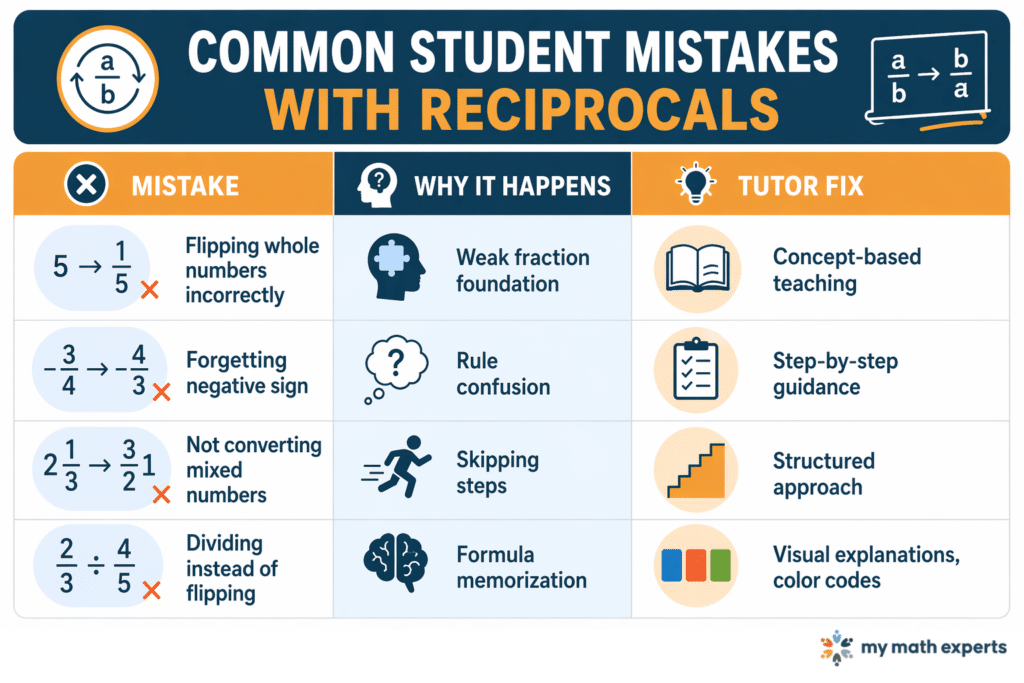
Common student mistakes with reciprocals and simple tutor strategies to fix them effectively.
How My Math Experts Help Students Master Reciprocals
At My Math Expert, our sessions are fully interactive and individually designed to support your child’s long-term educational progress.
Reasons Why Families Trust My Math Experts
Always 1:1 with the same teacher
Students work with one dedicated teacher every week, allowing for consistency, stronger communication, and measurable academic progress
State-certified teachers and math experts
Sessions are led by experienced educators who specialize in math, ensuring concepts like reciprocals are taught with clarity and precision
Targeted gap identification and support
Teachers identify exactly where the student is struggling, whether in fractions, division, or number relationships, and address those gaps directly
Concept-first teaching approach
Students learn the reasoning behind reciprocals, helping them apply the concept across equations and problem-solving with confidence
Consistent weekly sessions
Regular sessions reinforce understanding, improve retention, and support steady progress over time
Flexible online scheduling
Students can attend sessions from anywhere, with scheduling options that fit into busy routines
Personalized Success Plan after 2–4 sessions
Families receive a structured plan with clear goals, recommended material, and next steps to support long-term improvement. Upon identifying gaps, tutors reinforce core math concepts and guide students from confusion to clarity.

A focused online math lesson helps students solve algebra equations using reciprocals.
Explore our flexible plans and pricing to find the right fit for your learning goals and schedule. Whether you need one-on-one support or ongoing math tutoring, our options are designed to help you master concepts like reciprocals with confidence.
Families interested in expert geometry tutoring can schedule a consultation with My Math Experts to discuss their child's goals, challenges, and learning needs. My Math Experts currently offers a 45-minute consultation for $15, 70% off the introductory rate, for those who wish to discuss the best tutoring method for their child, with flexible tutoring plans available to meet a variety of academic needs and goals.
Ready to Master Math with Confidence?
Don’t let challenges hold you back – our experts are here to guide you every step of the way. Book your personalized consultation today at My Math Experts and start turning confusion into clarity!
FAQs
Q1. What does reciprocal mean in math?
The reciprocal of a number is the value you multiply it by to get 1, which is why it’s also called the multiplicative inverse. For any non-zero number x, the reciprocal is 1/x, so the reciprocal of 4 is 1/4 because 4 × 1/4 = 1.
Q2. How do you find the reciprocal of a fraction?
Swap the numerator and denominator to flip the fraction. For example, the reciprocal of 2/3 is 3/2, and the reciprocal of 3/5 is 5/3.
Q3. What is the reciprocal of 5, 8, and other whole numbers?
Write the whole number as a fraction over 1, then flip it, so the reciprocal of 5 is 1/5 and the reciprocal of 8 is 1/8. This works for any whole number: the reciprocal is simply 1 divided by that number.
Q4. How do you find the reciprocal of a mixed number or decimal?
Convert it to an improper fraction first, then swap the numerator and denominator. For instance, 2 1/3 becomes 7/3, and its reciprocal is 3/7.
Q5. Does zero have a reciprocal?
No, zero is the one number that has no reciprocal because 1/0 would require dividing by zero, which is undefined in math. Every other real number has a valid reciprocal.
Q6. Why does multiplying a number by its reciprocal always equal 1?
Because the reciprocal is defined as the exact value needed to reach 1, which mathematicians call the multiplicative identity. For example, 3/4 × 4/3 = 12/12 = 1, and this holds true for every non-zero number.
Q7. Is understanding reciprocals actually important, or just a memorization exercise?
It’s genuinely useful because dividing by a fraction means multiplying by its reciprocal, such as 3/4 ÷ 2/5 = 3/4 × 5/2 = 15/8. Students who understand this connection handle fraction division and equation-solving far more confidently than those who only memorize steps.
Q8. What if my child keeps confusing reciprocals with negatives or inverses?
This is a common mix-up, since a reciprocal flips a number (multiplicative inverse) while a negative changes its sign (additive inverse). Working through step-by-step examples with a certified tutor helps students separate the two and apply each correctly.

Mr. Kemper is the founder and director of My Math Experts. He has taught and tutored thousands of math students in grades 1 - college over the last 20 years, in the classroom and in private education. Algebra is a special passion and Kemper believes that a solid Algebra foundation opens many doors. He has also trained and supported hundreds of teachers and continues to create and innovate in the math education world.