
A sixth grader who never quite mastered fractions hits ratios in seventh grade and suddenly “hates math.” It’s rarely about ability. The gap was there all along, hidden until a new topic exposed it. That’s exactly where middle school math tutors earn their keep. They find the missing piece and rebuild it before it sinks the next three years of coursework. This article walks through how those gaps form, the concepts that trip kids up most, and what separates effective tutoring from the kind that wastes everyone’s time.
Key Takeaways
- Math tutors for middle school students are most effective when they offer 1:1, personalized instruction tied to a student’s specific learning gaps.
- Middle school is a pivotal window for tutoring because math transitions from arithmetic to pre-algebra and algebra during grades 6-8.
- Research from 2024 and 2015 studies shows that one-on-one tutoring produces measurable gains in math, especially for students who are falling behind.
- The strongest tutors focus on long-term understanding and study habits rather than memorization or quick fixes.

A student participates in a one-on-one online math tutoring session, following the tutor’s explanations on a laptop while solving problems independently in a comfortable home learning environment.
What learning gaps are and how they form in middle school math
A learning gap is a concept the student never fully grasped, even if the test grade looked fine at the time. Math builds on itself. When one idea doesn’t click, the next one feels harder, and the one after that feels impossible. Most frustration comes from this chain reaction, not from a lack of ability.
Here’s what actually happens in middle school. Classrooms move on a fixed schedule. A teacher with 30 students can’t pause for two weeks because eight kids didn’t lock in long division or place value. So the class advances, and the student who missed a foundational piece carries that hole into pre-algebra. The root cause is timing. Middle school math compresses arithmetic into abstract reasoning fast, and gaps that were survivable in elementary school become roadblocks. Targeted middle school math support at this stage can stop a single gap from compounding into years of struggle.
The reason this matters is cumulative. Many parents assume their child just needs to “try harder.” In reality, the student usually needs someone to provide backup, identify the missing concept, and rebuild it before moving forward. My Math Experts provides personalized 1:1 online math tutoring that identifies and closes these learning gaps before they grow.
Core middle school math topics tutors help with (fractions, ratios, pre-algebra, etc.)
Middle school math has a few predictable choke points, and good middle school math tutors know exactly where to look first. Fractions and ratios top the list. A student who can’t fluidly convert, compare, and operate with fractions and ratios will struggle with proportions, percentages, and eventually the slope of a line in algebra.
The other common trouble spots:
- Fractions and ratios turning into proportional reasoning and percentages
- Pre-algebra concepts like variables, expressions, and solving for the unknown
- Integers and the number line, especially negative numbers and order of operations
- Geometry basics, including area, volume, and the coordinate plane
These topics aren’t random. They’re the bridge from arithmetic to advanced math, and the standards behind them are public. You can review the Common Core math standards to see how grade-level expectations stack year over year. Professional organizations like the National Council of Teachers of Mathematics also publish guidance on how these concepts should be sequenced and taught. Understanding when students typically take Algebra 1 helps explain why the foundations of pre-algebra matter so much during the middle grades.
Strong math tutors for middle school don’t just reteach the current chapter. They map each new struggle back to its foundation. If a student bombs a unit on solving equations, the issue is often shaky fraction skills from two grades earlier. This root-cause work also pays off on standardized tests, where weak foundations quietly drag scores down. Fixing the root, not the symptom, produces long-term understanding instead of another temporary patch.
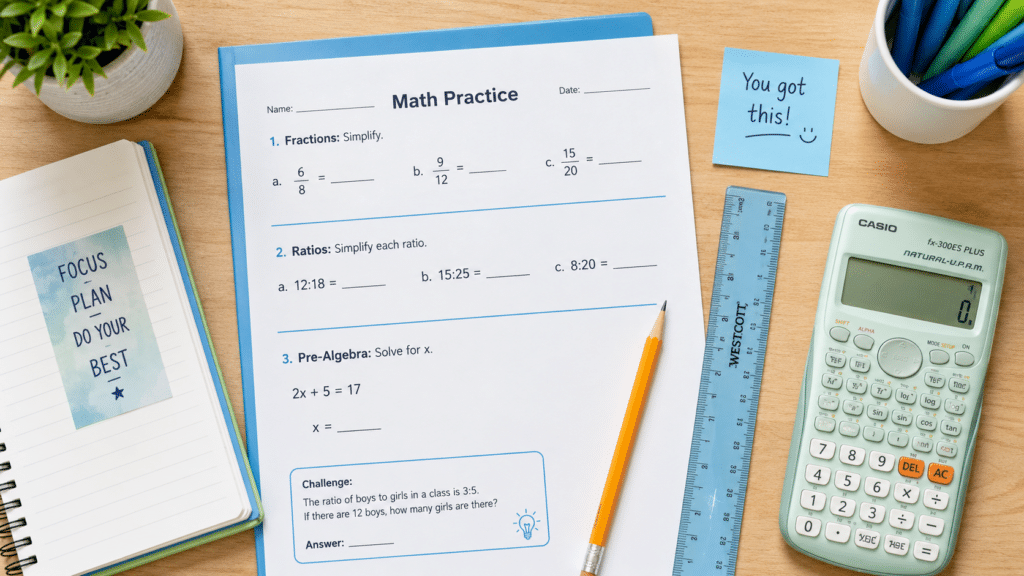
A clean, well-organized math workspace designed for middle school learners, featuring essential study tools and practice problems covering fractions, ratios, and introductory algebra concepts.
Building confidence and reducing math anxiety
Plenty of middle school students walk into a session already convinced they’re “bad at math.” That belief does more damage than any single missing concept. Math anxiety narrows working memory. An anxious student literally has fewer mental resources available to solve the problem in front of them. The fear becomes self-fulfilling.
The good news is that math confidence is rebuildable, and it usually grows from the same place the anxiety came from: understanding. When a student finally sees *why* a method works instead of memorizing steps they don’t trust, the dread starts to fade. One small win at a time, the story changes from “I can’t do this” to “I just hadn’t been shown clearly.”
1:1 support matters here in a way a crowded classroom can’t match. A student embarrassed to raise their hand in front of peers will ask the question privately, and that single question often unlocks a whole unit. Many parents focus only on grades and assume confidence is a soft bonus. In reality, math confidence and grades go hand in hand. A student who believes they can improve engages more, practices more, and improves more. Reducing math anxiety isn’t a feel-good extra. It’s part of the mechanism that produces real progress.
Helping students who are behind, on level, or advanced
Not every student who needs a tutor is struggling with math. The same personalized learning approach works across three very different situations, and good middle school math tutors adjust accordingly.
For students who are behind, the priority is closing learning gaps. The tutor identifies which foundational math concepts are missing, then rebuilds them with step-by-step instruction. The student can catch up in math without feeling rushed or judged.
For students on grade level, tutoring is about consistency and deeper mastery. These students often have the grades but not the confidence, or they want to stay ahead of the next tough unit. Individualized support keeps small gaps from turning into big ones, and the same one-on-one support helps students close learning gaps.
For advanced students, the goal shifts to challenge and stretch. A student ready for advanced math benefits from harder problems, real problem-solving skills, and an early look at concepts that prepare them for algebra and beyond. I’ve worked with a seventh grader whose parents thought she was “fine” because she had an A. Two sessions in, the assessment showed she was guessing on anything involving multi-step ratios. We caught it before pre-algebra turned that guesswork into a falling grade. On-level kids need attention too, not just the ones already struggling with math.
Homework help and grade improvement
Math homework is where the daily friction lives. Many families fall into the same nightly pattern. The student is stuck; the parent tries to help; the explanation doesn’t match how the teacher taught it; and the table turns into a standoff. The parent-child dynamic makes helping with math at home genuinely hard, even for parents who are good at math.
Real homework help does more than supply answers. A tutor uses math homework as a window into what the student actually understands. If a kid keeps missing the same type of problem, that’s a diagnostic signal, not just a bad night. Good middle school math tutors fix the underlying concepts so the next assignment goes more smoothly on its own.
That said, homework help alone isn’t a full plan. The goal is bigger than finishing tonight’s worksheet. My Math Experts pairs it with a customized learning plan, so tutors aren’t only chasing the assignment of the week. Combining homework support and customized learning plans keeps the focus on the bigger picture. They’re working through textbook material and building toward grade-level or individualized goals. Better grades follow, but they follow understanding rather than the other way around. Memorizing how to get tonight’s answer right doesn’t transfer to the test. Conceptual understanding does.
How to choose and what to look for in a middle school math tutor
Cheap tutoring and homework-answer services tend to leave families exactly where they started. When you’re choosing among middle school math tutors, a few things separate the ones who produce real progress from the ones who fill an hour.
Look for these:
- Certified teachers or experienced educators, not peer tutors or casual generalists who happen to be good at math
- A real assessment before instruction starts, so the plan targets actual learning gaps
- Consistency, meaning the same tutor each week to build trust and track progress
- A focus on understanding over memorization and quick homework completion
- Clear communication you can follow, including session notes that tell you what happened
Be skeptical of platforms that rotate a different tutor through every session. Consistency isn’t a luxury. A tutor who knows your child’s history can connect this week’s struggle to a gap from a month ago, which a stranger can’t. Whether you prefer online or in-center tutoring, structured oversight keeps the plan on track throughout a full semester. That means leadership actually reviews student progress and the quality of tutoring.
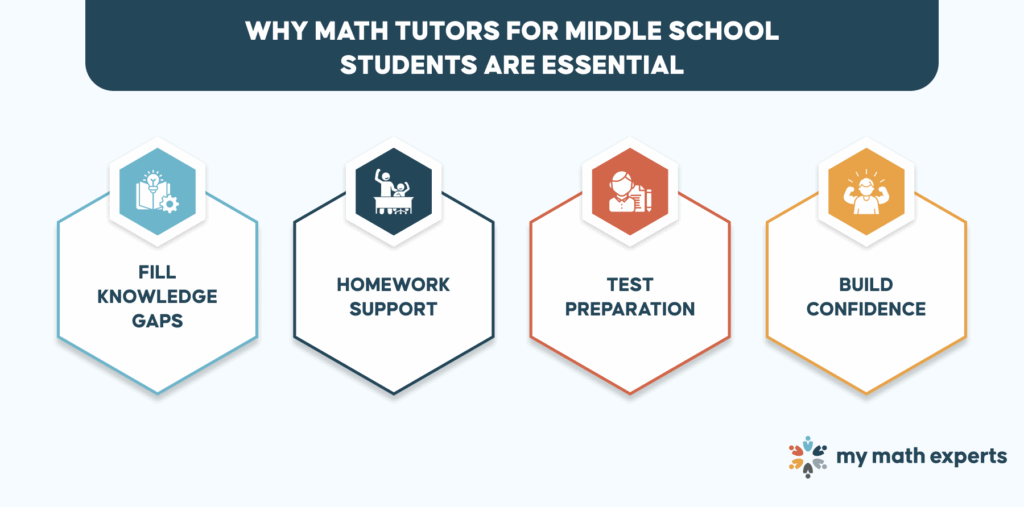
Math tutors for middle school students provide fill knowledge gaps, homework support, test preparation and build confidence.
Assessing whether your child is on grade level
Report card grades hide a lot. A B in middle school math can mean a solid understanding, or it can mean a student who memorizes well enough to pass while the foundation underneath stays shaky. Grades alone won’t tell you where your child stands, and neither do passing scores on standardized tests.
A few practical signals worth watching: homework that takes far longer than it should, a student who can do problems with help but freezes alone, frustration that spikes around specific topics like fractions and ratios, and a habit of saying “I just don’t get math.” Each of those points to a possible gap rather than a lack of effort.
The cleaner way to know is through a grade-level assessment that checks specific math concepts rather than overall scores. My Math Experts starts every student with a free assessment that pinpoints exactly which foundational skills are solid and which need work. If you’re weighing the broader value, the research on how tutoring improves outcomes makes the case that an early, accurate baseline drives the strongest results. Keep in mind that grade-level standards and how schools measure them vary by state, so check your state’s math standards or ask your child’s teacher how the curriculum is sequenced. An honest baseline beats guessing and tells you whether the issue is a one-unit problem or a deeper foundation issue.
Personalized learning plans and certified-teacher instruction
Generic tutoring treats every student the same. Personalized learning starts from the opposite assumption: this specific student has this specific set of gaps, goals, and pace. That’s the whole point of a customized plan, and it’s why 1:1 support outperforms a worksheet handed to a room full of kids.
At My Math Experts, every tutor is a certified teacher or experienced college-level educator, and math is their specialty, not a side skill. After the first few sessions, families receive a Personalized Success Plan: clear goals based on the student’s needs, prescribed resources including a textbook, and a long-term plan built by the tutor, student, and family. Whether through online sessions, in-center tutoring, or seasonal summer math programs, instruction remains 1:1 with the same certified teachers each week and is flexible enough to fit a busy schedule and any test-prep deadlines.
What this produces is academic growth you can actually see. Step-by-step individualized support from someone who teaches for a living, combined with consistent weekly sessions, builds both the math concepts and the study habits that carry forward. It sharpens problem-solving skills along the way. If you’re still weighing whether a math tutor is worth the investment, the steady, compounding nature of this kind of support is what tips the scales. Results vary with participation, but the structure is designed for long-term understanding and steady academic growth, not a one-time grade bump. That’s the difference between a tutor and an answer service.
If your student could use more math confidence, structure, and personalized math help, My Math Experts offers certified, consistent, 1:1 online math tutoring from real math tutors for middle school, built around your child’s actual learning gaps. Ranked the #1 academic tutoring company in Arizona two years running and working with students across the US through virtual sessions, the team focuses on real understanding and long-term growth, not quick fixes.
Families interested in expert geometry tutoring can schedule a consultation with My Math Experts to discuss their child's goals, challenges, and learning needs. My Math Experts currently offers a 45-minute consultation for $15, 70% off the introductory rate, for those who wish to discuss the best tutoring method for their child, with flexible tutoring plans available to meet a variety of academic needs and goals.
Ready to Master Math with Confidence?
Don’t let challenges hold you back—our experts are here to guide you every step of the way. Book your personalized consultation today at My Math Experts and start turning confusion into clarity!
FAQs
Q1. Is online math tutoring actually worth it for middle schoolers?
Research supports this: a 2024 study by Kraft and Lovison found that one-on-one online tutoring produced significant gains in math compared to small-group sessions, and a 2015 study by Chappell et al. showed measurable score improvements among low-achieving middle schoolers. The key factor is consistent, personalized 1:1 instruction rather than the online format itself.
Q2. What should I look for when choosing a middle school math tutor?
Prioritize tutors with real experience teaching middle school math, the ability to adapt to your child’s learning style, and patient, clear communication. A good tutor explains concepts multiple ways and focuses on understanding rather than memorization.
Q3. What if my child has tried tutoring before and it didn't help?
Many students don’t improve with generic tutoring because the sessions never identified their specific learning gaps. A structured 1:1 plan that starts with an assessment and targets foundational weak spots tends to produce more lasting progress.
Q4. How does one-on-one tutoring help middle schoolers improve?
One-on-one tutoring lets a tutor pinpoint exactly where a student struggles and adapt lessons to their pace and learning style. This builds both stronger comprehension and better study habits over time, which group settings often can’t provide.

Mr. Kemper is the founder and director of My Math Experts. He has taught and tutored thousands of math students in grades 1 - college over the last 20 years, in the classroom and in private education. Algebra is a special passion and Kemper believes that a solid Algebra foundation opens many doors. He has also trained and supported hundreds of teachers and continues to create and innovate in the math education world.