A student who breezed through high school Algebra II sits down for the first college algebra exam and freezes. The pace is faster. The problems stack functions on top of functions. The arithmetic they never quite nailed in middle school suddenly matters again. So is college algebra hard? For many students, yes, but rarely for the reason they assume. If you’re wondering how to prepare for college algebra, this guide covers what the course actually involves, why it trips people up, and the steps that make it manageable.
Key Takeaways
- College algebra is hard for many students not because of ability, but because of gaps in earlier math, like fractions and arithmetic, which compound as topics build on each other.
- It sits between high school Algebra II and precalculus, revisiting familiar functions with more depth while adding matrices, conics, and combinatorics.
- College algebra is generally less abstract than calculus, but strong algebra skills are what make later calculus courses manageable.
- High failure and withdrawal rates often trace back to prerequisite weaknesses and course pace, not impossible material.
- Reviewing pre-algebra fundamentals, practicing regularly, and getting one-on-one support are the most reliable ways to pass college algebra.

College algebra is a branch of mathematics that focuses on solving equations, understanding functions, working with graphs, and analyzing mathematical relationships.
Is college algebra hard? A direct, honest answer
Here’s the honest version. College algebra is hard for some students and very doable for others. The difference usually has nothing to do with being “a math person.” Is college algebra difficult? It can be, mostly because it moves quickly and assumes you already have a strong foundation from earlier courses. The material itself is not exotic. You’ll work with linear equations and functions, exponents and polynomials, and factoring and rational expressions, most of which you’ve seen before.
What actually happens is that small learning gaps from pre-algebra and Algebra I resurface. If fractions and decimals were never solid, rational expressions feel brutal. So when students ask is college algebra difficult, the honest root cause of most frustration is a shaky foundation, not any single new idea. For a deeper look, see a student’s guide to mastering College Algebra with confidence.
The stakes are real. According to the National Center for Education Statistics, a large share of incoming students are placed into remedial math on a math placement test. That costs time and tuition without earning credit. Many assume it means they’re bad at math. In reality, it usually means a few earlier concepts never fully clicked, and the right support can fix that.
Picture a student who scored well all through high school, then places into remedial math their first semester because a decimals-and-fractions gap never got caught. They lose a full term of tuition on a no-credit course, and their confidence takes a hit before the real coursework even starts. The gap was small, but the cost was not.
Why college algebra feels difficult for many students
The pace is the first shock. A single college algebra lecture can cover what a high school teacher spent a full week on. That speed leaves no room to quietly patch up shaky skills. Anyone carrying learning gaps in fractions and decimals or basic order of operations falls behind fast.
Then there’s the abstraction. College algebra asks you to compose functions, analyze asymptotes, and reason about behavior rather than just crank out an answer. That shift from “solve for x” to “explain what happens as x grows” is where math anxiety kicks in for many students. The American Psychological Association’s research on math anxiety and performance points to stress itself undermining problem-solving ability. This matters because memorizing steps stops working. You have to understand why a method works to apply it to an unfamiliar problem.
Word problems add another layer, forcing you to translate messy real-world sentences into expressions and equations. The American Mathematical Society has long emphasized that conceptual understanding, not rote drilling, is what makes higher math stick.
Many students believe struggling now means they’ll always struggle. In reality, confidence climbs quickly once the underlying gaps close and each new topic finally connects to the last.

Why College Algebra Feels Hard: Common Challenges and Practical Solutions for Student Success
Common struggles and roadblocks in college algebra
Ask any group of students about the common struggles in college algebra, and the same short list comes up every time. These are the roadblocks worth naming early so you can watch for them:
- Factoring and rational expressions: simplifying, adding, and canceling terms trip up students who never mastered fractions.
- Radicals and quadratics: the quadratic formula, completing the square, and simplifying roots feel like a lot of moving parts at once.
- Systems of equations: solving for two or three unknowns using substitution, elimination, or matrices.
- Word problems: translating a paragraph into expressions and equations, then checking whether the answer even makes sense.
- Exponents and polynomials: rules for negative and fractional exponents that were skimmed in earlier courses.
A common pattern: a student aces the graphing unit, then bombs the rational expressions test because a division-of-fractions gap from years ago finally caught up. The material didn’t get harder in isolation. An old crack in the foundation just met a topic that leaned on it.
Among the common struggles in college algebra, a missing rule rather than a missing chapter is frequent too. When one prerequisite skill is weak, several later topics wobble at once because each builds directly on that skill. That’s why the course can feel like it’s collapsing all at once instead of one hard unit at a time. This is exactly where 1:1 support with the same tutor pays off: someone who tracks which single rule keeps tripping you up across different units can fix it once instead of watching it resurface test after test.
Core topics you need to know to be ready
College algebra readiness comes down to a handful of skills you should be comfortable with before day one. If these feel automatic, the course becomes far less intimidating.
- Fractions and decimals: adding, multiplying, and dividing them without a calculator.
- Integers and order of operations: handling negatives and following PEMDAS reliably.
- Linear equations and functions: solving, graphing, and interpreting slope and intercepts.
- Exponents and polynomials: applying exponent rules and multiplying or dividing polynomials.
- Factoring and rational expressions: breaking expressions apart and simplifying them.
- Radicals and quadratics: simplifying roots and solving quadratics several ways.
Notice how many of these trace straight back to pre-algebra. That’s not an accident. College algebra readiness is built on the same skills a strong pre-algebra course covers, and gaps there quietly limit understanding of everything that follows. These core areas also align closely with the Mathematical Association of America’s College Algebra guidelines, which stress a foundation-first approach. So if you ask How do I prepare for college algebra, start with these.
If you’re in dual enrollment or heading into your first year as a college freshman, a quick self-check on this list tells you where to focus. My Math Experts starts every student with a diagnostic to pinpoint exactly which foundations need reinforcing before the harder material arrives. Knowing your weak spots early is the difference between calm review and mid-semester scrambling.
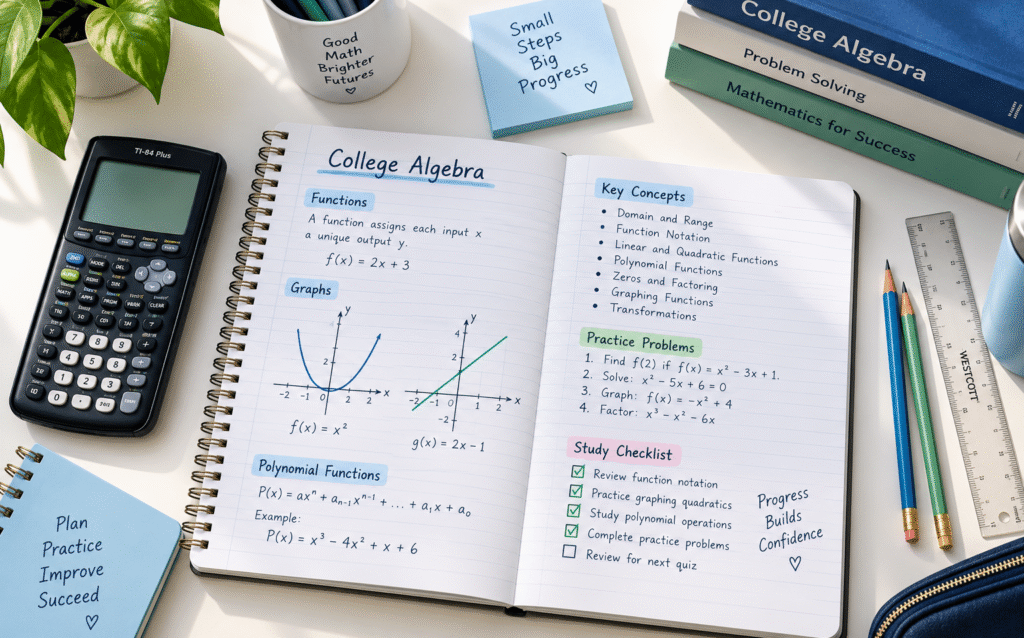
An organized college algebra study setup featuring function graphs, polynomial equations, a calculator, and essential study tools.
Tips and study habits to make college algebra easier
The best tips for making college algebra easier are unglamorous, and they work. If you’re asking how to prepare for college algebra, start with your prerequisites. Before the semester picks up, spend a week reviewing pre-algebra basics: fractions, integers, and exponents. Closing those learning gaps first pays off in every unit afterward.
Then build consistent study habits instead of cramming. Short, regular practice beats one long panic session. Algebra is a problem-solving skill you develop by doing, not by watching. Daily practice works better than marathon sessions because spacing the effort forces your brain to retrieve the method repeatedly, which is what makes it stick. Work a few problems every day, and always redo the ones you miss until the method feels natural.
A few habits that reliably help:
- Rework missed homework problems from scratch, not just the ones assigned.
- Explain a solution out loud, which exposes gaps memorization hides.
- Keep a running list of formulas for radicals and quadratics you tend to forget.
- Tackle word problems by writing the expressions and equations before touching numbers.
The goal is understanding, not just the answer, and these tips for making college algebra easier build lasting study habits. When you can explain *why* a step works, you’ve built something that survives the next test. That’s how confidence grows, and it drives real progress rather than a temporary grade bump. Small, steady effort compounds the same way the gaps did, just in your favor this time.
How 1:1 tutoring helps you pass college algebra
Here’s where a big classroom fails struggling students: it can’t stop for you. If your gap is factoring and rational expressions, the lecture keeps moving whether it clicked or not. That’s exactly the problem 1:1 math tutoring solves.
Working one-on-one means the whole session targets your specific weak spots. Our expert College Algebra tutors can watch you work a problem, spot the exact moment your reasoning breaks, and give step-by-step instruction right at that point. That’s very different from casual or peer help, which often just hands over an answer without fixing the skill.
My Math Experts pairs students with the same tutor every week, so your tutor knows your history and builds a personalized approach around it. Working with the same tutor session after session matters because they remember which rule tripped you up last week and can connect it to this week’s topic, something a rotating cast of helpers can’t do. The pattern holds: consistency plus expertise plus a plan beats scattered help.
Online math tutoring makes this practical. Sessions run over video with a shared whiteboard where you and your tutor write, upload homework, and work problems together in real time. You’ll receive session notes after each meeting, and flexible tutoring packages and session rates let families choose the cadence that fits. After the first few sessions, families receive a Personalized Success Plan mapping out goals and next steps. Ranked the #1 academic tutoring company in Arizona two years running, My Math Experts works with students across the US to remove math friction from family life.
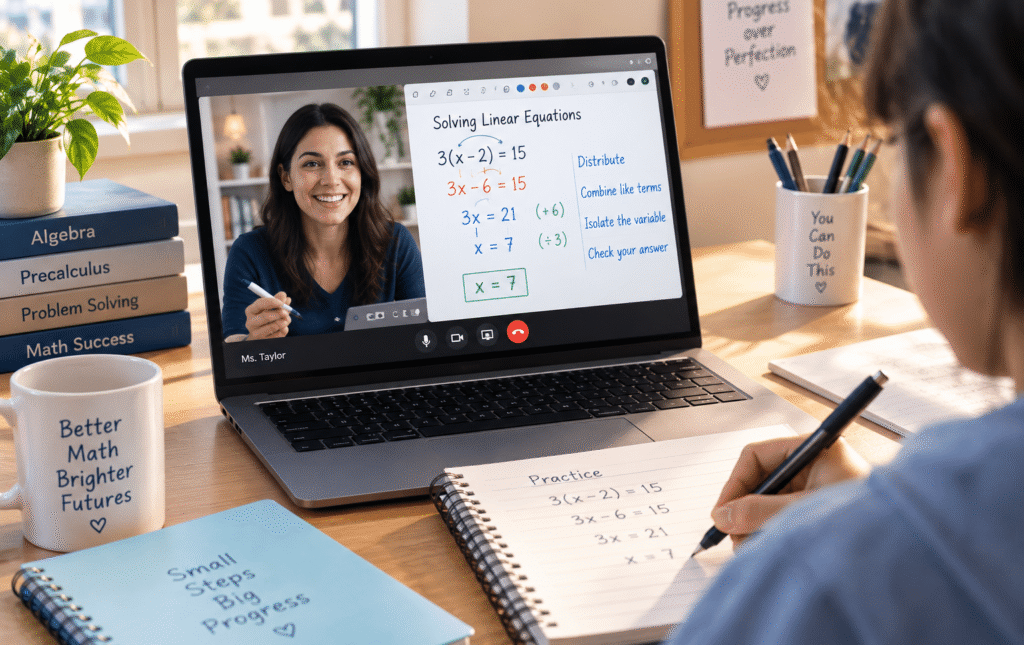
A personalized online math tutoring session where a student works alongside a tutor through a shared digital whiteboard.
How My Math Experts Can Help You Excel
Whenever college algebra students struggle and seek help only from generic resources, those resources rarely yield sufficient solutions. That’s the reason My Math Experts differentiates itself.
Why My Math Experts Works
Ranked as the #1 academic tutoring company in Arizona, My Math Experts works with students across the US through virtual sessions. Their goal is to help remove the math friction from families’ lives through structured, personalized instruction.
- Always 1:1 with the Same Teacher: Students work with the same dedicated math teacher every week, creating consistency, accountability, and long-term academic support.
- State-Certified Teachers & Math Experts: Every instructor is a certified math teacher or college-level educator with deep subject expertise. Sessions are led by experienced educators, not peer tutors or general homework helpers.
- Consistent Weekly Sessions: Weekly instruction helps students build momentum, strengthen foundational skills, and stay aligned with current coursework and long-term goals.
- Personalized Success Plan (PSP): After the first 2-4 sessions, families receive a PSP with targeted goals, recommended resources, and clear next steps based on the student’s learning needs.
- Personalized Assessments and Learning Plans: Students begin with a custom assessment designed to identify skill gaps, strengthen understanding, and create a targeted learning approach.
- More Than Homework Help: Sessions focus on conceptual learning, mathematical reasoning, and long-term progress, not just completing assignments.
- Online and Flexible: All sessions are conducted online with flexible scheduling, including emergency sessions when additional support is needed.
Structured 1:1 instruction can help students improve confidence, strengthen understanding, and approach challenging math courses with greater clarity.
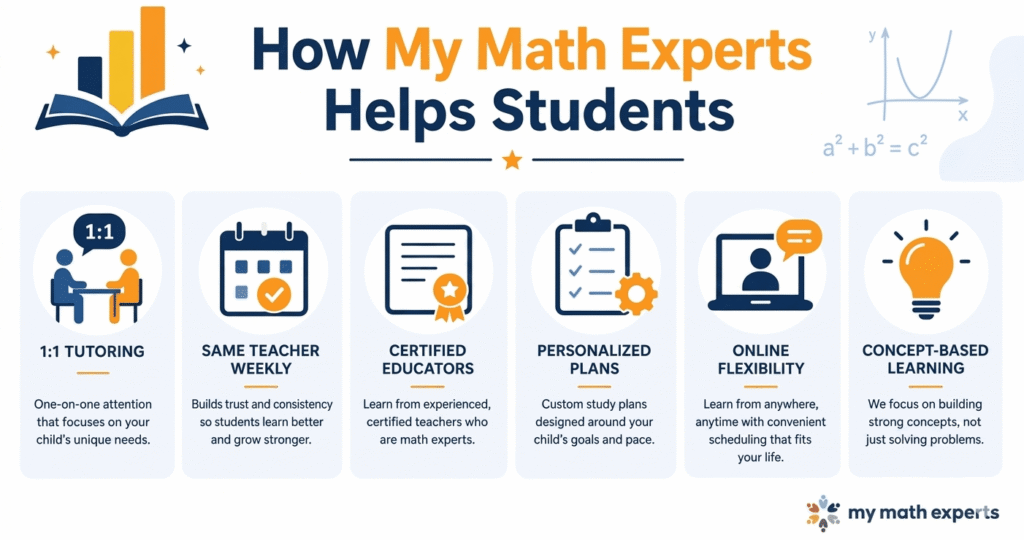
How My Math Experts Helps Students Through Personalized and Flexible Online Learning
Diagnostic assessment: check your readiness before you start
You can’t fix a gap you can’t see. That’s the whole point of starting with a diagnostic. A math assessment shows exactly which prerequisite skills are solid and which need work before college algebra picks up speed. You spend study time where it counts instead of guessing.
The assessment covers the foundations that matter most: fractions and decimals, integers, exponents and polynomials, and basic factoring and rational expressions. If your results flag weak spots in, say, radicals and quadratics or systems of equations, you’ll know before those topics show up on a test. That honest picture, plus a plan to close the gaps and calm any math anxiety, is what real college algebra readiness looks like and how to prepare for college algebra with confidence.
From there, My Math Experts builds a personalized approach around your results. Every student begins with a custom grade-level assessment that generates a learning plan. Expert math tutors then use step-by-step instruction to build the strong foundation the course leans on, working 1:1 with the same tutor throughout. Results vary based on participation and consistency, but starting with data beats starting blind every time.
Families interested in expert geometry tutoring can schedule a consultation with My Math Experts to discuss their child's goals, challenges, and learning needs. My Math Experts currently offers a 45-minute consultation for $15, 70% off the introductory rate, for those who wish to discuss the best tutoring method for their child, with flexible tutoring plans available to meet a variety of academic needs and goals.
Ready to Master Math with Confidence?
Don’t let challenges hold you back – our experts are here to guide you every step of the way. Book your personalized consultation today at My Math Experts and start turning confusion into clarity!
FAQs
Q1. How hard is college algebra compared to high school algebra?
College algebra revisits familiar topics like functions, polynomials, and logarithms but treats them with more depth and rigor, adding areas like matrices, conic sections, and combinatorics. It also moves faster and expects more independent study, which is why many students find it a step up from Algebra II.
Q2. What level of math is college algebra?
College algebra sits above high school Algebra II but below precalculus and calculus. It’s typically a foundational or general-education course that serves as a prerequisite for statistics, precalculus, math, and many STEM classes.
Q3. Is college algebra harder than calculus?
Most students find calculus harder because it introduces new abstract concepts like limits, derivatives, and integrals. College algebra is less abstract and proof-heavy, but weak algebra skills often make later calculus much more difficult.
Q4. How common is it to fail college algebra?
College algebra has notably high failure and withdrawal rates at many schools, often driven by gaps in prerequisite skills rather than ability. Research links success closely to a student’s grasp of rational numbers and basic arithmetic, so hidden foundational gaps are a common cause.
Q5. What's the easiest math course to take in college?
Courses like quantitative reasoning, liberal arts math, or introductory statistics are often considered easier than college algebra because they rely less on abstract manipulation. The right choice depends on your major, since some programs specifically require college algebra as a prerequisite.
Q6. Is college algebra worth taking if I'm bad at math?
It can be worth it if your major or planned coursework requires it, since it opens the door to statistics, precalculus, and many science courses. If you have flexibility, check whether an alternative like quantitative reasoning satisfies your requirement before enrolling.

Mr. Kemper is the founder and director of My Math Experts. He has taught and tutored thousands of math students in grades 1 - college over the last 20 years, in the classroom and in private education. Algebra is a special passion and Kemper believes that a solid Algebra foundation opens many doors. He has also trained and supported hundreds of teachers and continues to create and innovate in the math education world.