Many students reach precalculus only to discover that earlier math concepts never truly clicked. What looked like solid grades in Algebra II suddenly feels shaky when functions, trigonometry, and analytical geometry demand fluency with foundational skills. The good news is that working with an online precalculus tutor can close those learning gaps before they compound in calculus, giving students the targeted support they need exactly when they need it most.
Precalculus sits at a critical juncture. It’s the last chance to strengthen problem-solving habits, rebuild confidence, and master the mathematical foundation that calculus assumes you already have. When struggling students work with expert online precalculus tutors who understand where learning gaps form and how to address them, precalculus becomes an opportunity, not an obstacle. This transition course reviews essential algebra and trigonometry skills and introduces the analytical thinking higher mathematics demands.

A focused learning environment where students build confidence in trigonometry through interactive online lessons, visual graphs, and hands-on practice.
Key Takeaways
- Working with an online precalculus tutor provides 1:1, step-by-step instruction that addresses individual learning gaps and builds confidence through personalized attention.
- Students work with certified math teachers, not peer tutors or generalists.
- Sessions cover functions and properties, trigonometry, analytical geometry, polar coordinates, parametric equations, vectors, complex numbers, sequences and series, and other essential topics.
- Flexible scheduling allows students to book consistent weekly sessions, plus emergency help, right up until each session’s start time.
- Online tutoring removes the commute and gives students access to specialized educators nationwide.
How Online Precalculus Tutoring Works
Online precalculus tutors deliver instruction in a virtual classroom built for education, not just video calls. Students and tutors can see and hear each other via videoconference. Both share an interactive whiteboard where they upload images, documents, and homework assignments, then write and solve problems together in real time. This technology creates an environment where mathematical notation, graphs, and diagrams can be manipulated and annotated as naturally as on a physical whiteboard, while also saving every session’s work for future review.
If homework is digital, students can screen-share directly. If it’s on paper, parents can snap a photo and email it to the tutor, who uploads it into the session space. Because My Math Experts focuses on long-term academic growth, tutors identify learning gaps through ongoing assessment and provide targeted instruction. When appropriate, they recommend resources, including a textbook, and create a personalized learning plan supported by supplemental worksheets.
Tutoring sessions are dynamic and interactive. Tutors don’t lecture students or watch videos together. They work through problems, ask questions, and guide students toward understanding the logic behind each step. The goal is conceptual clarity, not just getting the right answer. This direct engagement forces students to articulate their reasoning, which exposes misunderstandings immediately rather than letting them hide behind memorized procedures. For example, when working through a problem involving function composition, the tutor might ask, “Why did you substitute that expression there?” or “What does the domain restriction tell us about this problem?”
When a student hesitates on a problem, the tutor doesn’t move on. They dig into what’s causing the confusion, whether it’s a gap from two years ago or a misread instruction today. That real-time diagnosis is what separates effective precalculus tutoring from passive homework help. A student might struggle with rational functions not because they don’t understand asymptotes, but because they never fully grasped how to factor polynomials in Algebra I.
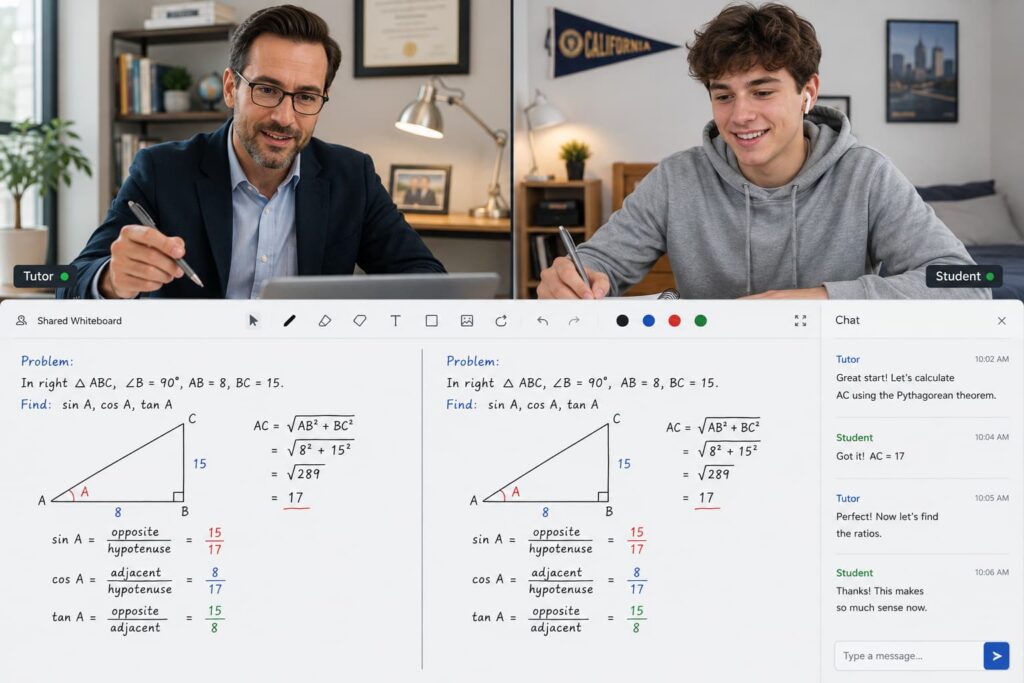
Personalized online tutoring makes challenging trigonometry problems easier to understand through real-time guidance and collaboration.
Benefits of 1:1 Personalized Precalculus Instruction
Large classrooms move at one speed. Struggling students fall behind, and advanced students wait. Personalized tutoring removes that constraint. Every session adapts to the student’s needs that day, whether it’s reviewing a concept from two years ago or moving ahead into new material. In a typical classroom, a teacher might spend one day on logarithmic properties before moving to exponential equations. With 1:1 tutoring, that student can spend an entire session or three sessions on logarithms until the concept is fully solidified.
Consistency matters. Students work with the same tutor every week, which builds trust and allows the tutor to track progress over time. That relationship makes it easier to identify patterns, anticipate trouble spots, and adjust the plan as the student grows. When a tutor notices that a student always understands concepts better when they’re connected to real-world applications, they can adjust their teaching style accordingly, perhaps introducing parametric equations through projectile motion examples rather than abstract definitions.
Customized learning also means the tutor can shift focus based on what’s coming next. If a calculus exam is six months away, the tutor can prioritize the precalculus topics that matter most for calculus preparation. If the student is preparing for a unit test, tutoring sessions zero in on that material. A student preparing for an upcoming classroom assessment may need additional practice with function transformations, while another preparing for calculus may focus on strengthening trigonometric identities and advanced functions.
According to the National Bureau of Economic Research, high-dosage tutoring with consistent instructors improved student outcomes significantly more than generic academic support. In fact, personalized tutoring consistently improves outcomes across diverse learning environments and student populations. Students who receive personalized instruction demonstrate not only improved test scores but also increased persistence when facing challenging problems.
Specific Precalculus Topics Covered by Online Tutors
Precalculus isn’t one concept. It’s a collection of advanced topics that prepare students for calculus and college-level math. Expert tutors provide pre-calculus help across all major areas:
- Functions and properties: domain, range, transformations, inverses, composition, and behavior analysis.
- Trigonometry: unit circle, identities, graphs, solving equations, and applications in triangles and modeling.
- Analytical geometry: conic sections (parabolas, ellipses, hyperbolas), distance, midpoint, and graphing.
- Polar coordinates and parametric equations: converting between coordinate systems, graphing, and interpreting motion.
- Sequences and series: arithmetic, geometric, summation notation, and convergence.
- Vectors: operations, dot product, applications in physics and geometry.
- Complex numbers: operations, polar form, and roots.
- Exponential and logarithmic functions: properties, solving equations, and real-world modeling.
- Polynomial and rational functions: factoring, graphing, asymptotes, and end behavior.
- Systems of equations and matrices: solving linear systems, determinants, and applications.
Tutors don’t just work through homework problems. They teach the reasoning behind each topic, connect concepts to what students already know, and build the problem-solving skills that calculus demands. This approach aligns with mathematics education standards that emphasize conceptual understanding alongside procedural fluency.
Many students assume trigonometry is just memorizing formulas. In reality, the unit circle is a visual tool that makes every trig identity logical rather than arbitrary. When tutors explain why the identities work instead of just listing them, students stop forgetting them under pressure. Consider the Pythagorean identity: when students see it derived directly from the unit circle definition of sine and cosine, it transforms from a random equation to memorize into an inevitable consequence of the circle’s geometry.
Scheduling Flexibility and Availability
Online learning removes the commute. Students attend from home, which saves time and makes it easier to fit sessions into busy schedules. My Math Experts offers flexible scheduling with consistent weekly sessions that build momentum and keep students on track. For families juggling multiple children’s activities, sports schedules, and work commitments, eliminating a 30-minute drive each direction can be the difference between sustainable tutoring and an arrangement that collapses after a few weeks.
If something urgent comes up, emergency sessions can be booked right up until the scheduled session start time, helping students get support when they need it most. That flexibility matters when a test is tomorrow or a concept suddenly doesn’t make sense the night before an exam. A student might realize at 7 PM that they’re completely lost on a problem set due the next morning. With online tutoring, they can often secure a session that same evening, getting the help they need exactly when the pressure is highest.
Parents don’t have to worry about driving across town or rearranging their evening. Students don’t lose an hour to traffic. The session starts on time, focuses entirely on learning, and ends without logistical friction. My Math Experts helps remove the math friction from families’ lives while making regular support actually sustainable.
Homework Help and Ongoing Academic Support
Tutors assist with homework, but the goal is always bigger than finishing the assignment. Homework becomes a tool for identifying learning gaps, practicing new skills, and tracking whether concepts are sticking. When a student brings homework to a session, the tutor views it as diagnostic information: which problems did the student attempt? Where did they get stuck?
When a student struggles with a homework problem, the tutor doesn’t just give the answer. They walk through the logic, ask guiding questions, and help the student rebuild the steps independently. That process builds confidence and teaches habits that carry over beyond a single worksheet. This methodology draws on cognitive development research demonstrating the effectiveness of scaffolded instruction. For instance, if a student is stuck on solving a trigonometric equation, the tutor might ask, “What’s the first thing we need to isolate?” or “Which identity could simplify this expression?”
Ongoing academic support includes working through textbooks, completing practice exercises, and implementing personalized learning strategies tailored to the student’s needs. When additional practice is beneficial, tutors provide targeted worksheets and carefully selected resources to reinforce conceptual understanding.
A student who finishes homework quickly but still bombs tests has a retention problem, not a completion problem. Tutors catch that distinction and adjust the session structure accordingly, adding review cycles and retrieval practice that homework alone doesn’t provide.
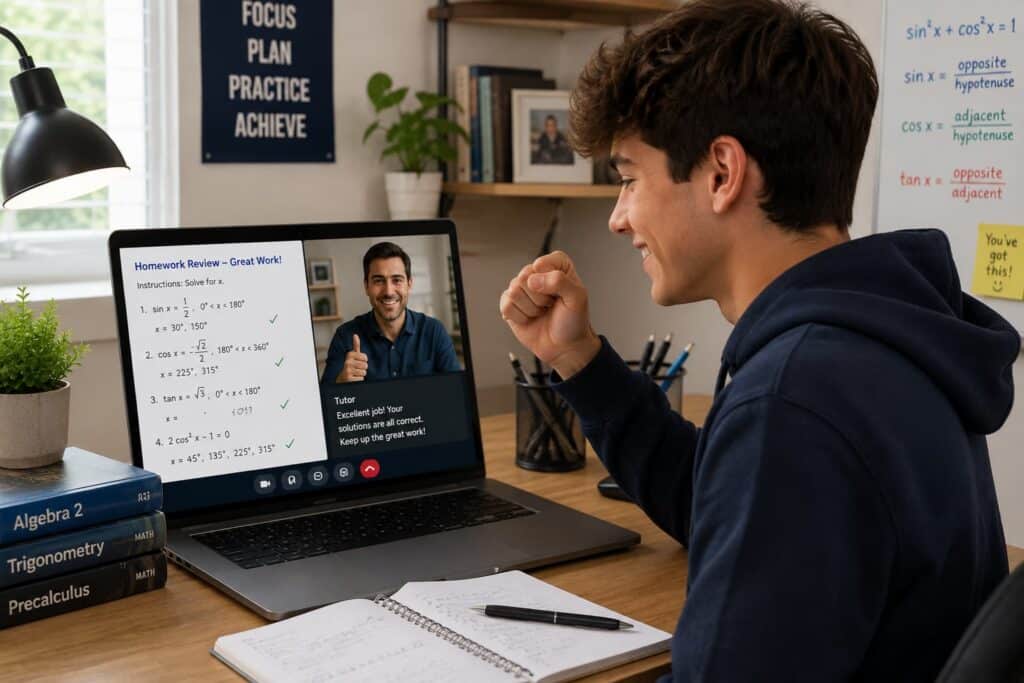
From challenging problems to confident solutions—personalized feedback helps students understand their work and keep improving.
Student Testimonials and Success Outcomes
Students who work with My Math Experts report improvements in both grades and confidence. One parent shared, “My daughter went from dreading precalculus to actually understanding what she was doing. Her tutor didn’t just help her pass; he helped her see that she could handle calculus next year.”
Another student said, “I thought I was just bad at math. Turns out I had gaps from Algebra I that no one ever caught. Once we fixed those, everything started making sense.” This student’s experience is remarkably common. Many students who believe they lack mathematical ability actually have specific, identifiable gaps that, once addressed, unlock their potential.
These outcomes aren’t accidents. They’re the result of consistent weekly sessions, personalized planning, and certified teachers with deep subject expertise. My Math Experts is ranked the #1 academic tutoring company in Arizona and works with high school students and college students nationwide through online tutoring.
The pattern repeats across students: initial frustration gives way to small wins, which build into sustained confidence. That confidence-building matters as much as the grade improvement because it changes how students approach future challenges.
Why Precalculus Creates Foundational Gaps That Compound Over Time
Math builds on itself. When one concept doesn’t click, the next one feels even harder. Precalculus assumes fluency with algebra, graphing, and basic trigonometry. If those math skills are shaky, students spend more energy compensating than learning new material.
Most math frustration comes from unresolved learning gaps, not lack of ability. A student might have passed Algebra II with a B, but if they memorized formulas without understanding the logic, precalculus will expose that gap. Functions, transformations, and trigonometric identities all demand conceptual clarity, not just pattern recognition. Many students who struggled with Algebra 2 find that precalculus magnifies those earlier challenges.
The longer those gaps persist, the more they compound. By the time a student reaches calculus, they’re not just learning derivatives. They’re also re-learning algebra under pressure. That’s why online precalculus tutors provide the ideal intervention.
Here’s the mechanism: each new precalculus topic assumes automatic recall of prior skills. When a student has to pause to think through basic algebra while also processing a new trigonometric concept, their working memory becomes overloaded. Closing those foundational gaps frees up mental bandwidth for actual new learning. Cognitive science research shows that working memory has limited capacity. When it’s consumed by basic computations, there’s no room left for understanding new concepts.
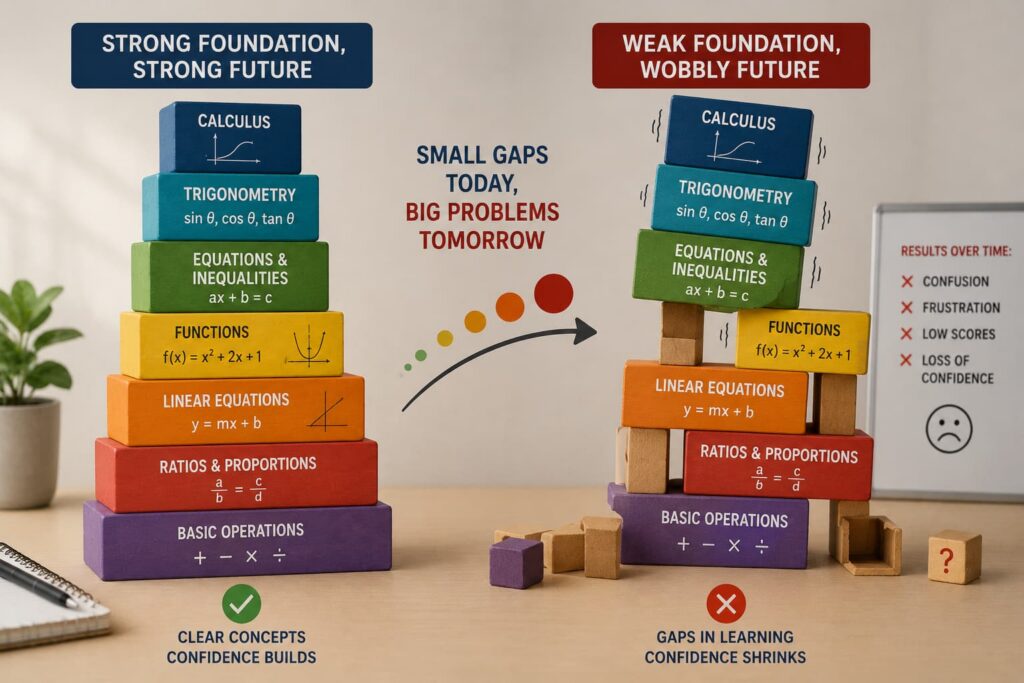
Small gaps in foundational math concepts can grow into bigger challenges. Building a strong foundation early helps students approach advanced math with confidence.
Preparing for Calculus and College-Level Math Through Precalculus Mastery
Calculus doesn’t start with limits. It starts with whether you can manipulate functions, interpret graphs, and apply trigonometry fluently. Students who master precalculus enter calculus with the mathematical foundation they need to focus on new ideas rather than reviewing old ones.
College preparation means more than passing the course. It means developing the study habits, math skills, and confidence to handle rigorous coursework independently. A quality math tutoring program builds those habits through consistent practice, structured feedback, and step-by-step instruction that emphasizes understanding over memorization.
The National Center for Education Statistics reports that students who complete precalculus with strong conceptual understanding are significantly more likely to succeed in college-level math courses. When choosing the right tutor, families should prioritize those who provide thorough high school math support that extends beyond immediate homework help. The statistics are striking: students who earn an A or B in precalculus have a 75% success rate in Calculus I, while those who earned a C have only a 40% success rate.
Working with a precalculus tutor online gives students access to state-certified teachers and math experts who provide consistent, personalized 1:1 instruction focused on conceptual understanding and long-term academic success. Whether the student needs homework help, long-term planning, or mastery of foundational skills, expert online tutors provide rigorous instruction and tailored plans to support real progress. My Math Experts offer exactly this kind of structured, individualized support for students preparing for calculus and beyond.
If your student could use more confidence, structure, and personalized support in precalculus, now is the time to address learning gaps before they compound. Working with an online precalculus tutor gives students the individualized attention and expert guidance they need to master foundational concepts and prepare for success in calculus.
Families interested in expert geometry tutoring can schedule a consultation with My Math Experts to discuss their child's goals, challenges, and learning needs. My Math Experts currently offers a 45-minute consultation for $15, 70% off the introductory rate, for those who wish to discuss the best tutoring method for their child, with flexible tutoring plans available to meet a variety of academic needs and goals.
Ready to Master Math with Confidence?
Don’t let challenges hold you back – our experts are here to guide you every step of the way. Book your personalized consultation today at My Math Experts and start turning confusion into clarity!
FAQs
Q1. Can I learn precalculus on my own without a tutor?
Some students can, but most benefit from expert tutors who identify learning gaps and explain concepts in ways that finally make sense. Self-study works best when foundational skills are already strong. A student might read the same textbook explanation five times without understanding, while a skilled tutor can recognize the specific point of confusion and offer a different approach that makes everything clear.
Q2. Is paying for a precalculus tutor actually worth the cost?
When precalculus tutoring is consistent, personalized, and led by certified teachers, the long-term value is significant. Students gain confidence, close learning gaps, and enter calculus prepared, which reduces future struggles and costs. Consider the alternative: students who struggle through precalculus often need remedial courses in college, delaying graduation and adding thousands of dollars in tuition costs.
Q3. What if my student has already fallen behind in precalculus?
With the right pre-calculus help, students can rebuild their confidence and strengthen the skills they need to move forward. My Math Experts create a Personalized Success Plan after 2-3 tutoring sessions to address specific learning gaps and get students back on track. Even students who are significantly behind can catch up with intensive, targeted support that addresses root causes rather than just current symptoms.
Q4. Is precalculus harder than other high school math courses?
Precalculus is more abstract and assumes fluency with earlier math concepts. High school students often find it harder because unresolved learning gaps from algebra or geometry become more visible. The course also introduces multiple new topics simultaneously (trigonometry, advanced functions, analytical geometry), creating a cognitive load that exceeds earlier courses.
Q5. How quickly can a student see improvement with online tutoring?
Many students notice improved confidence and understanding within the first few weeks of consistent tutoring. Progress varies based on each student’s starting point, learning goals, and level of engagement. Students who attend sessions regularly, complete recommended practice, and actively engage during tutoring typically see grade improvements within 6 to 8 weeks.
Q6. What qualifications should I look for in an online precalculus tutor?
Look for certified tutors or college-level educators with deep subject expertise in math tutoring. My Math Experts employ state-certified teachers and math experts, not peer tutors or generalists. The ideal tutor has both content mastery and pedagogical training. Knowing mathematics deeply and knowing how to teach it effectively are distinct skills.
Q7. Does online tutoring work for students who need only occasional help?
Online tutoring works best with consistent weekly sessions that build momentum and allow tutors to track progress over time. Students seeking only occasional help may not experience the same depth of improvement, as addressing foundational gaps requires sustained attention rather than sporadic intervention.

Mr. Kemper is the founder and director of My Math Experts. He has taught and tutored thousands of math students in grades 1 - college over the last 20 years, in the classroom and in private education. Algebra is a special passion and Kemper believes that a solid Algebra foundation opens many doors. He has also trained and supported hundreds of teachers and continues to create and innovate in the math education world.