A student walks into precalculus with a solid B in algebra. Three weeks in, they hit a wall when trig functions and function transformations show up in the same problem. That drop isn’t about intelligence; it’s about foundation. The precalculus help that actually works fills the algebra gaps hiding beneath the new material while teaching the new concepts on top of it. This article walks through the core precalculus topics students wrestle with. It also covers how certified-teacher tutoring targets the real problem and what a smoother path into calculus looks like.
My Math Experts provides personalized 1:1 online math tutoring with state-certified teachers who help students strengthen foundational concepts, build confidence, and prepare for long-term success. Students meet with the same teacher each week, allowing lessons to build naturally over time rather than focusing solely on immediate homework questions.
Key Takeaways
- Effective precalculus help combines consistent independent study with targeted support that fills gaps from earlier math courses.
- Many students find precalculus tougher than Calculus-I because it blends algebra, geometry, and trigonometry.
- A strong foundation in algebra is the single biggest factor in how difficult precalculus feels.
- Focusing early on functions, the unit circle, and trigonometric identities sets up a smoother path into calculus.
Core precalculus topics overview (functions, polynomials, rational functions)
Precalculus lives and dies on function concepts. Everything else builds on your ability to read, evaluate, and work with functions, so this is where strong precalculus lessons start. You’ll work through domain and range, piecewise functions, and the behavior of different function families before anything gets more advanced.
Quadratic functions are usually the gentle on-ramp, since most students met parabolas back in algebra. From there, polynomial functions raise the stakes with higher degrees, end behavior, and multiple roots to track. Then rational functions introduce asymptotes and holes, and this is where many students first feel lost. Here’s why that matters: rational functions force you to combine factoring, domain restrictions, and graphing all at once. Any weakness in earlier algebra shows up right away. Students who have already faced the challenges of Algebra 2 often recognize these pressure points immediately.
Many assume precalculus is just “harder algebra.” In reality, it’s the course where several strands of math finally come together, which is exactly why it feels heavier.
Exponential and logarithmic functions
Exponential functions describe anything that grows or shrinks by a constant factor: populations, savings accounts, radioactive decay. Logarithmic functions are their mirror image, the tool you reach for when you need to solve for an exponent. Students often treat these two as separate, unrelated topics. In reality, they’re inverse functions of each other, and once that clicks, half the confusion disappears.
The most common precalculus problem here is students memorizing log rules without understanding what a logarithm is asking. A log is just the question “what power do I raise this base to?” When you understand logarithms that way instead of drilling rules blindly, solving equations gets far less mysterious. The College Board’s AP Precalculus framework treats exponential and logarithmic functions as central pillars because they model real rates of change that lead directly into calculus. If you want a clearer picture of college readiness and math course expectations, the College Board lays out exactly where these skills fit.
A student in an AP Precalculus class recently came to us stuck on compound-interest problems. The concept wasn’t hard for them; they’d just never truly understood what a logarithm did. Two focused sessions on the inverse relationship, and the whole unit opened up. That’s the pattern with exponential functions and logarithmic functions: understanding beats memorization every time.

A close-up classroom whiteboard shows exponential and logarithmic curves mirrored across a diagonal reference line, with handwritten annotations highlighting their inverse relationship.
Function transformations, inverses, and concepts
Once students understand basic function families, the course pivots to manipulating those functions. Function transformations (shifts, stretches, reflections) are one of the most useful precalculus skills you can build. They let you graph almost anything without plotting dozens of points. Shift a parent function up, slide it left, flip it over the x-axis, and you can predict a graph in seconds.
Inverse functions trip up more students than almost any other topic. The root cause is that inverses require thinking backward: you’re swapping inputs and outputs, and the graph is reflected across the line y = x. Many assume finding an inverse is just “solve for x.” In reality, you also have to check whether the function is one-to-one, or the inverse won’t actually be a function.
Solid function concepts here separate students who breeze through calculus from those who stall. Function transformations reappear when you shift and scale trig graphs. Inverse functions come back the moment you meet inverse trig or the tie between exponential functions and logarithms. The good news is these ideas are highly visual, which makes them a great fit for step-by-step explanations and lessons that show the movement.
Practice problems and diagnostic assessment
You can watch someone solve a rational function all day and still freeze on your own paper. Precalculus is a doing subject, and the only way to build real fluency is working practice problems until the steps become automatic. But volume alone isn’t the answer. Practicing the wrong things or gaps you can’t see wastes hours.
That’s where a diagnostic assessment earns its keep. A good assessment doesn’t just produce a grade; it pinpoints exactly which precalculus topics are shaky and which earlier concepts, often from algebra, are quietly causing trouble. Every student who starts with us takes a free math assessment to pinpoint learning gaps. That assessment then shapes a personalized learning plan tailored to their specific learning gaps, rather than generic worksheets.
From there, adaptive practice keeps students working at the edge of their ability: harder when they’re ready, more support when they’re not. Reviewing mistakes with clear explanations helps students strengthen their understanding and avoid repeating the same errors. That combination, targeted assessment plus focused repetition, is what builds genuine exam-ready confidence rather than the shaky kind that evaporates under pressure. This kind of steady, mastery-based practice is also one of the most reliable ways to reduce pressure-driven mistakes that show up under test conditions, a pattern that research on math anxiety and student confidence consistently links to how prepared a student actually feels.
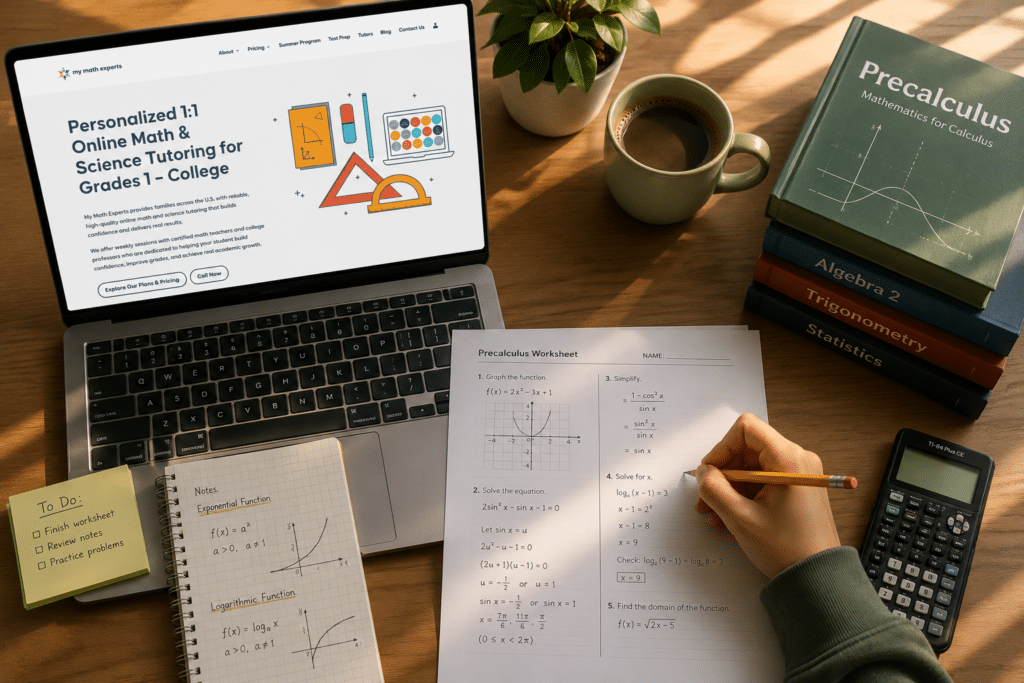
A photorealistic flat-lay of a productive study workspace featuring a completed precalculus worksheet, a laptop displaying the My Math Experts tutoring platform, and a warm cup of coffee in natural afternoon light.
Radical expressions, rational exponents, and roots
Radical expressions and rational exponents are two ways of writing the same idea. Students who don’t see that connection make life harder than it needs to be. A square root is a one-half power. A cube root is a one-third power. Once you can fluently switch between radical form and rational exponents, simplifying expressions and solving equations gets much cleaner.
The trouble usually starts with the rules for combining and simplifying roots, especially when variables and negative numbers come into play. In reality, a small algebra habit, like forgetting to check for extraneous solutions after squaring both sides, produces wrong answers even when the method is right. This is a classic spot where precalculus help focuses less on new theory and more on tightening up shaky skills from earlier.
Roots also connect directly to polynomial functions, since solving for roots is how you find where a graph crosses the x-axis. That link is worth emphasizing. Rational exponents aren’t an isolated topic; they’re the same machinery you use to analyze functions and, later, to handle derivatives in calculus. Clean, consistent step-by-step explanations here prevent the sloppy sign errors that follow students all the way into college math.
Systems of equations and inequalities
A system of equations asks a simple question: where do these relationships meet? Whether you’re solving by substitution, elimination, or graphing, the goal is finding the point or points that satisfy every equation at once. Precalculus pushes this further with larger systems and nonlinear combinations, where a line might intersect a parabola or two curves cross at multiple points.
A system of inequalities shifts the thinking from points to regions. Instead of a single solution, you’re shading the area where all the conditions overlap. Many students find this jump confusing because the answer isn’t a number; it’s a space on the graph. This matters because regional thinking shows up constantly in later math and in real applications like optimization, where you need every constraint satisfied at once.
A common precalculus problem with systems of equations is losing track of which method fits. Substitution is cleanest when one variable is already isolated; elimination shines when coefficients line up neatly. Knowing which tool to grab is a skill that comes from working through varied practice problems, not from memorizing a single approach. This is another area where one-on-one support pays off, and it’s part of why quality math tutoring for high school students makes such a difference. A certified teacher can watch a student work and correct the decision-making in real time, not just the arithmetic.
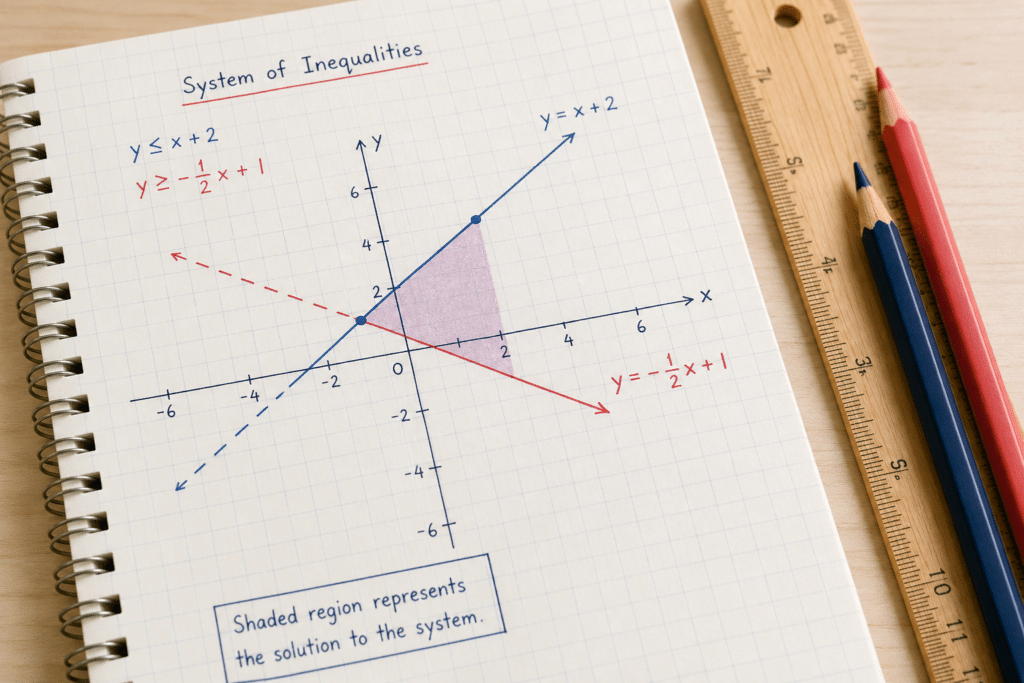
A close-up of a neatly drawn system of inequalities on grid paper, highlighting the shaded solution region alongside study tools for precise graphing.
How 1:1 certified-teacher precalculus tutoring works
Most tutoring problems come down to two things: the wrong person teaching, and no plan behind the sessions. My Math Experts fixes both. Every student works 1:1 with the same certified math teachers who lead every session, not a rotating cast of peer tutors or generalists. These state-certified math teachers and college-level educators know precalculus deeply, so they spot learning gaps a casual helper would miss.
Sessions run as online math tutoring through an interactive virtual space, so students attend from home anywhere in the U.S. The tutor and student can see and hear each other, share a whiteboard, and solve math problems in real time. Parents can photograph homework and email it in, or students can screen-share a digital assignment directly. There’s always something concrete to work on.
After the first 2–4 sessions, families receive a Personalized Success Plan that outlines learning goals, recommended resources, and next steps. You’ll also receive session notes so progress stays clear throughout the tutoring journey. You also receive session notes, so progress is never a mystery. If you’re still weighing whether hiring a math tutor is worth it, this structure is exactly what makes the investment pay off. This is why My Math Experts was ranked the #1 academic tutoring company in Arizona for two consecutive years. Consistent 1:1 online support from certified teachers turns scattered effort into real progress, and it’s the difference between generic tutoring and personalized learning that actually sticks.
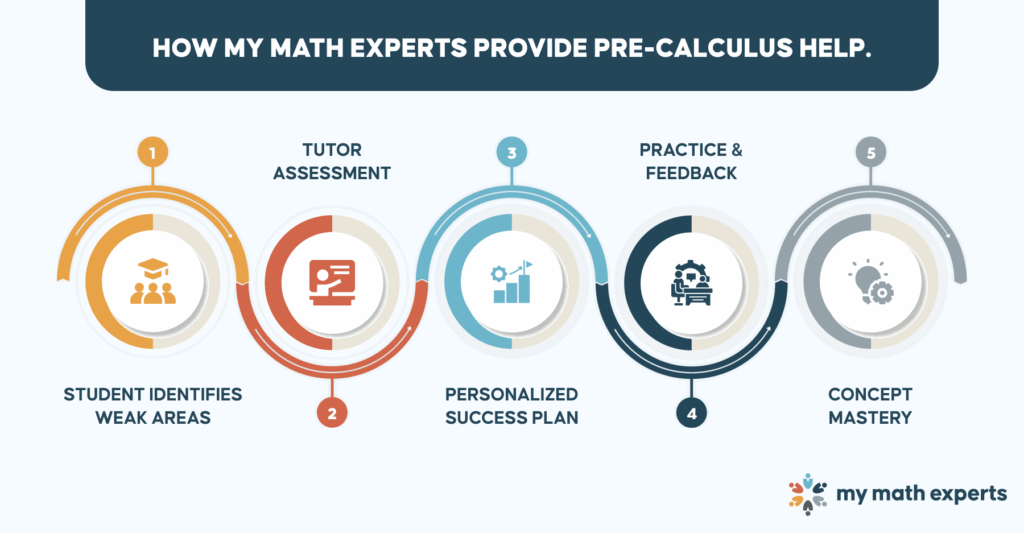
Step-by-Step Pre-Calculus Support: How My Math Experts guide students from weak areas to concept mastery.
How precalculus prepares students for calculus and college math
Precalculus isn’t a hoop to jump through. It’s the toolkit you’ll use every single day in calculus. Function transformations, inverse functions, exponential functions, and logarithmic functions all reappear right away. Rates of change, the central idea of calculus, begin to appear in precalculus through slopes and average rates. Students who truly master these functional concepts walk into calculus with a real head start rather than playing catch-up.
The connection is mechanical, not vague. Derivatives require you to work with polynomial and quadratic functions and rational functions fluently. Integration leans on your comfort with radical expressions and rational exponents. Keeping a handy trig identities cheat sheet nearby helps too, since those relationships resurface constantly in calculus. If those precalculus skills are shaky, calculus doesn’t just feel hard; it becomes a series of small algebra errors piling up on top of genuinely new material.
This is why building strong foundations now matters more than a single grade. A student who understands why a logarithm undoes an exponential, rather than memorizing the rule, carries that understanding straight into college math and beyond. That’s the whole point of good precalculus lessons: not surviving one course, but building the long-term understanding that makes the next three easier, whether that means calculus, advanced math courses, or future college-level study. Solid precalculus help today is an investment in every math course that follows.
If your student could use more structure, clearer explanations, and consistent one-on-one support in precalculus, My Math Experts pairs them with the same certified teacher each week and builds a plan based on their actual learning gaps. You can talk to an expert about your child’s math goals to see whether the program is a good fit. Results vary based on student participation, consistency, and academic needs, and course requirements can differ by school and state, so it’s always worth confirming your specific curriculum with your teacher or school.
Families interested in expert geometry tutoring can schedule a consultation with My Math Experts to discuss their child's goals, challenges, and learning needs. My Math Experts currently offers a 45-minute consultation for $15, 70% off the introductory rate, for those who wish to discuss the best tutoring method for their child, with flexible tutoring plans available to meet a variety of academic needs and goals.
Ready to Master Math with Confidence?
Don’t let challenges hold you back—our experts are here to guide you every step of the way. Book your personalized consultation today at My Math Experts and start turning confusion into clarity!
FAQs
Q1. How do I actually pass precalculus without cramming?
Class time alone usually isn’t enough, so plan on studying independently one to two hours per session, several times a week. The exact amount depends on how quickly each concept clicks, but consistent weekly practice matters more than last-minute cramming.
Q2. Is precalculus harder than calculus?
Many students actually find precalculus more challenging than Calculus I because it combines algebra, geometry, and trigonometry all at once. The difficulty often depends more on the quality of instruction than the subject itself, which is why clear, step-by-step teaching makes such a difference.
Q3. Is it normal to struggle with precalculus?
Yes, struggling is very common, and it usually isn’t about ability. Most students hit trouble because of gaps in earlier courses like algebra, so filling those foundational gaps often clears up the confusion.
Q4. What if my algebra is weak? Can I still handle precalculus?
You can, but weak algebra is one of the biggest reasons precalculus feels hard, since it builds directly on those skills. Strengthening algebra foundations alongside new topics is usually the fastest way to catch up and stay on track.
Q5. Which topics should I focus on first in precalculus?
Start with functions and their properties, including domain, range, and types like polynomial, exponential, and logarithmic functions. From there, move into trigonometry using the unit circle, plus trigonometric identities and complex numbers.

Mr. Kemper is the founder and director of My Math Experts. He has taught and tutored thousands of math students in grades 1 - college over the last 20 years, in the classroom and in private education. Algebra is a special passion and Kemper believes that a solid Algebra foundation opens many doors. He has also trained and supported hundreds of teachers and continues to create and innovate in the math education world.