A student who aced Algebra 2 walks into precalculus and hits a wall by the third week. Trig identities, function transformations, and logarithms pile up fast. Suddenly, a kid who felt fine about math starts calling themselves “bad at it.” The best precalculus tutors see this pattern over and over, and it almost never comes down to ability. This article covers how online precalculus tutoring works, the topics it focuses on, and how to find the right one for a high school student.
Key Takeaways
- Most precalculus struggles trace back to earlier gaps in algebra and trigonometry rather than a lack of ability.
- Online tutoring can match in-person results for motivated high school students while adding scheduling flexibility and lower cost.
- The best tutors combine strong subject knowledge with clear, patient explanations and a structured plan that tracks progress.
- Personalized 1:1 tutoring helps identify learning gaps, strengthen foundational concepts, and support long-term academic improvement.

A high school student works through precalculus problems during an online tutoring session, using a digital whiteboard and handwritten notes.
How online precalculus tutoring works (session flow and steps)
People picture online tutoring as a student passively watching someone talk. That’s not how a good session runs. Real online precalculus tutors use videoconferencing built for teaching. The tutor and student see and hear each other. They share a whiteboard where both can write, upload homework photos, and work the same problem in real time. If a student has a digital assignment, they screen-share it, and the tutor marks it up live. Sessions are interactive from start to finish.
A typical flow starts with a math assessment to find where the learning gaps actually sit. Families can start with a free math assessment before any tutoring begins. From there, precalculus tutoring sessions follow a predictable rhythm. First, a quick review of the last topic. Then direct step-by-step instruction on the current concept. Then guided practice, where the student works while the tutor watches for exactly where the reasoning breaks down. You’ll receive session notes afterward so families stay in the loop.
This structure works because individual attention exposes the exact step at which a student’s reasoning breaks down, something a group class can’t do. For high school students juggling packed schedules, this online format also eliminates drive time and makes maintaining weekly consistency far easier. It’s also worth reviewing National Center for Education Statistics data on math coursework to understand how central these advanced courses have become for high school students.
Precalculus topics tutors help with (functions, trigonometry, analytic geometry, sequences)
Precalculus is really several units stacked into one course. That’s why it overwhelms students who were coasting before. Good precalculus tutors break the precalculus curriculum into pieces and work each one until it clicks.
The core precalculus topics include:
- Functions and their properties: domain, range, composition, inverses, and transformations of graphs and equations.
- Trigonometry: the unit circle, identities, and solving trig equations, which trips up more students than any other unit.
- Analytical geometry: conic sections, plus polar coordinates and parametric equations.
- Sequences and series: arithmetic, geometric, and the summation notation that later shows up in calculus.
- Advanced algebra topics: limits and logarithms, exponential models, and complex numbers.
Trigonometry causes so much trouble because it demands both memorization and reasoning simultaneously. A handy trig identities cheat sheet can ease the memorization side while tutors focus on the reasoning. Students who never truly understood functions and their properties have no stable ground to build on. Analytical geometry raises the same challenge, since conic sections and parametric equations reward students who grasp the underlying logic. That’s the mechanism behind most precalculus frustration: a shaky foundation, not low intelligence.
The College Board’s course framework outlines what students are expected to master. You can review the official AP Precalculus course description to see the full scope. Tutors use this framework to prioritize the concepts that matter most for classroom success and long-term mathematical understanding. Tutors use this to prioritize which precalculus topics need the most attention for AP precalculus prep and regular coursework alike.
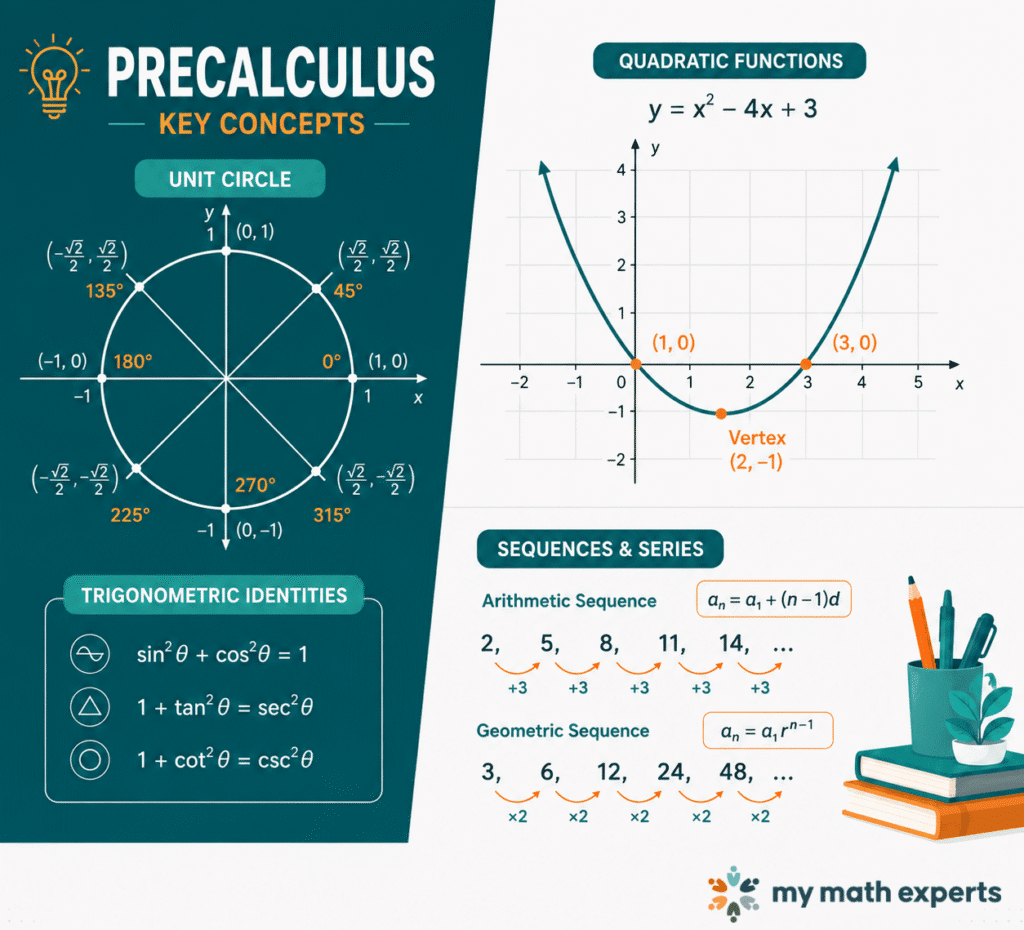
A visual overview of essential precalculus concepts, including the unit circle, trigonometric identities, quadratic functions, and sequences.
Personalized 1:1 precalculus tutoring approach
Group classes move at the pace of the curriculum, not the student’s. That’s the core problem personalized precalculus tutoring solves. When a student is struggling with precalculus, a large classroom can’t stop and rewind to the exact function rule they missed in Algebra 2.
With My Math Experts, students work 1:1 with the same tutor every week. That consistency matters more than most families expect. The tutor learns how the student thinks, remembers where the last session left off, and adjusts the pace accordingly. These are 1:1 online tutors who are state-certified teachers or experienced college-level math educators, not peer tutors or casual homework helpers. You can meet our math tutors to see the kind of expertise behind each session.
After 2–4 sessions, families receive a Personalized Success Plan that includes specific goals, prescribed resources, and a long-term roadmap developed collaboratively by the tutor, student, and family. It includes prescribed resources, such as one textbook per semester. It lays out a long-term plan built together by the tutor, student, and family. Tutors continuously identify learning gaps and adjust instruction to meet each student’s needs. When additional practice is beneficial, they provide carefully selected worksheets and learning resources to reinforce key concepts.
What actually happens with personalized precalculus tutoring is simple. Instruction targets the exact gaps that hold a student back, rather than reteaching material they already know. That’s how tutoring builds a strong foundation and helps students work toward their math goals rather than just surviving the next quiz.
Helping struggling students build confidence in precalculus
Confidence in math isn’t a nice bonus. For most struggling students, it’s the actual blocker. A student who believes they’re “just bad at math” stops trying before they even read the problem. That mindset does more damage than any single missed concept.
Many parents assume motivation can’t be changed. In reality, confidence usually returns once the student begins to understand the material, not before. The order matters. A tutor breaks trigonometry down into steps a student can follow. The student solves a problem they couldn’t touch last week. The story they tell themselves starts to shift.
One student who struggled with function transformations regained confidence after several weeks of consistent one-on-one tutoring that strengthened foundational algebra skills. Results vary based on participation, consistency, and individual learning needs.
Real progress rebuilds confidence in math, and results vary with participation and consistency. The goal is understanding, not just getting the answer. Expert precalculus tutors focus on the reasoning behind each step, because a student who understands *why* stops fearing the next problem.
Homework help and assignment support
Homework is where the tension usually shows up in a household. A student stares at a trig problem for 40 minutes. A parent tries to help and can’t, because the parent-child dynamic makes math help harder, not easier. The evening turns into an argument. That’s the daily reality precalculus homework help is meant to end.
Getting an assignment to a tutor is straightforward. A parent can snap a photo of the worksheet and email it, and the tutor uploads it into the online lesson space. For digital assignments, students just screen-share. But precalculus homework help through My Math Experts goes past finishing tonight’s problems.
Tutors work through the student’s coursework and, when appropriate, reinforce concepts with textbooks, practice problems, and additional learning resources tailored to the student’s needs. So there’s always meaningful material to work on, even during a light homework week. The point isn’t to hand over answers; it’s to teach the reasoning so the student can do the next set on their own.
This is the difference between a homework-answer service and real tutoring. Copying a solution gets tonight’s grade. Working through the logic builds the problem-solving skills that carry into the next unit and into calculus. Tutors track which concepts keep resurfacing as trouble spots and fold those back into future tutoring sessions.
Session frequency, scheduling, and availability
Consistency is the quiet ingredient most families underestimate. One-off cram sessions before a test rarely fix anything. Weekly precalculus tutoring with the same tutor builds momentum. Each meeting picks up where the last one ended and reinforces material before it fades.
Weekly matters because of how memory works. Spaced, repeated practice moves concepts into long-term retention far better than a single marathon session. That’s why online precalculus tutors who see a student every week produce steadier academic growth than sporadic help.
Scheduling online removes the usual friction. Sessions happen from home, or anywhere with an internet connection. That makes it realistic to keep the same weekly slot even during busy sports seasons or exam weeks. When something urgent comes up, like a surprise test tomorrow, emergency sessions can be booked right up until the session start time.
For families comparing formats, both online tutoring and in-center tutoring can work. Online simply removes travel and makes it easier to protect a consistent schedule. Whether a family searches for “precalculus tutors near me” or wants nationwide online tutoring, the priority should be the same: a regular time, the same tutor, and enough frequency to keep the material fresh between meetings. Families weighing options can compare math tutoring pricing and plans to find a frequency that fits their budget.
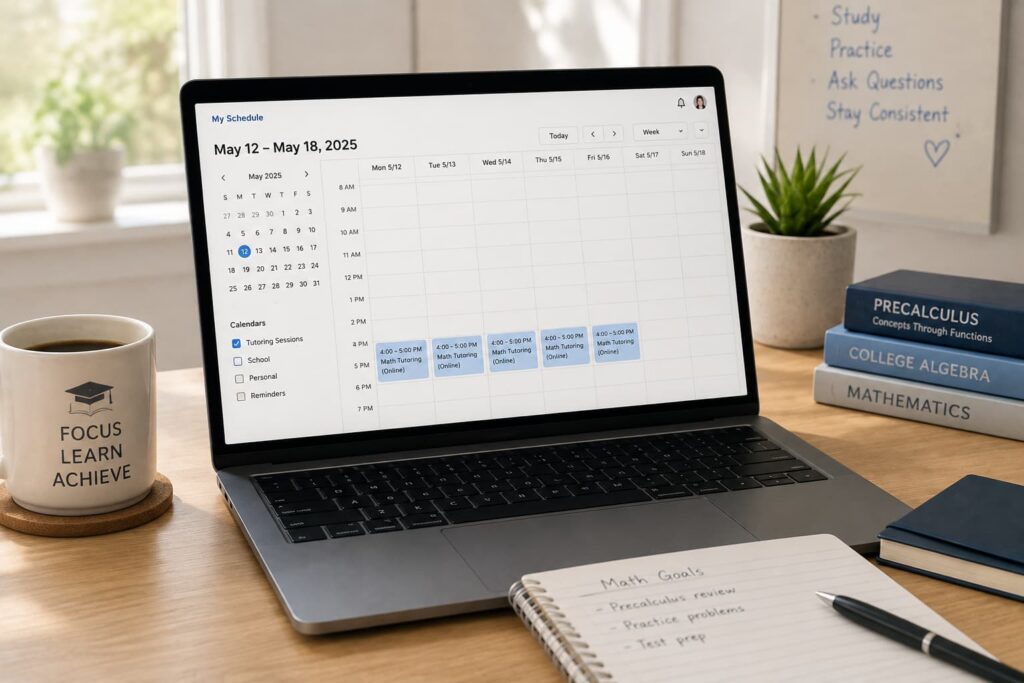
A well-organized weekly schedule with recurring online math tutoring sessions helps students build a consistent learning routine.
How to choose the right precalculus tutor (certification and quality)
Not all tutoring is the same, and the gap between a great tutor and a mediocre one is wide. Start with credentials. The best expert precalculus tutors are certified teachers (state-certified) or experienced college-level educators with real depth in mathematics. Not generalists who tutor five subjects and happen to remember precalculus. Our high school math tutors fit that profile, with specialized expertise in courses such as precalculus.
Subject knowledge alone isn’t enough, though. A tutor can know trigonometry cold and still fail to explain it, because clear teaching is a separate skill. Look for someone who breaks concepts down into step-by-step instructions, checks for understanding, and remains patient when a student is frustrated.
Ask these questions before committing:
- Is the tutor a certified teacher or a college-level educator?
- Will my student work with the same tutor every week?
- Does the tutor identify learning gaps and adjust instruction based on the student’s progress?
- Does the tutor track progress and share session notes?
- Is there a structured plan, or just ad-hoc homework help?
Consistency deserves its own mention. Rotating tutors reset the relationship every session and lose the thread of what a student has already covered. That’s why 1:1 online tutors who stay with the same student matter for long-term academic success. Quality also comes from oversight: leadership reviewing progress keeps tutoring accountable rather than casual.
How precalculus connects to calculus readiness and long-term math success
Precalculus earns its name honestly. Nearly everything in a first calculus course leans on it. Limits build directly on functions and their properties. Derivatives lean on trigonometry and algebraic manipulation. The graphs and equations students sketch in precalculus become the objects they analyze in calculus. Weak precalculus foundations don’t stay hidden; they surface the moment a student hits advanced mathematics.
That’s the mechanism behind so many struggles with college calculus. Students who memorized their way through precalculus, rather than understanding it, find that memorization stops working when the problems get layered. A strong foundation in sequences and series, logarithms, and complex numbers makes the jump to calculus feel manageable rather than overwhelming.
This is also why mastering precalculus pays off well beyond a single course. Students who truly understand the material carry those problem-solving skills into calculus, physics, statistics, and engineering coursework.
Framing precalculus as one step in a longer arc changes how a student approaches it. It’s not a hurdle to clear and forget. It’s the material a student uses for years, and tutors help them plan next steps toward whatever advanced mathematics comes after. If you’re still on the fence, it helps to think through whether hiring a math tutor is worth it for your family’s situation.

Strong precalculus foundations help students progress step by step toward more advanced calculus concepts.
If your student is struggling with precalculus or just wants a stronger footing before calculus, structured one-on-one help can make the difference. My Math Experts pairs students with certified precalculus teachers for consistent, personalized weekly sessions with the same tutor. Contact My Math Experts to learn how personalized 1:1 online precalculus tutoring can help your student strengthen foundational concepts, build confidence, and prepare for long-term success in higher-level math.
Families interested in expert geometry tutoring can schedule a consultation with My Math Experts to discuss their child's goals, challenges, and learning needs. My Math Experts currently offers a 45-minute consultation for $15, 70% off the introductory rate, for those who wish to discuss the best tutoring method for their child, with flexible tutoring plans available to meet a variety of academic needs and goals.
Ready to Master Math with Confidence?
Don’t let challenges hold you back — our experts are here to guide you every step of the way. Book your personalized consultation today at My Math Experts and start turning confusion into clarity!
FAQs
Q1. Is precalculus really the hardest math class?
Precalculus isn’t necessarily harder than calculus or other higher-level math, but it can feel difficult because it combines algebra, trigonometry, and functions all at once. Most of the struggle comes from earlier learning gaps that were never fully resolved, which is why a step-by-step review of foundational concepts makes the biggest difference.
Q2. Are online precalculus tutors as effective as in-person ones?
Online tutoring can be just as effective as in-person sessions for many high school students while providing greater scheduling flexibility and consistent access to experienced educators.
Q3. What should I look for when hiring a precalculus tutor?
Look for strong subject knowledge, clear communication, and patience in explaining concepts without judgment. A good tutor should also follow a structured plan and track progress over time, rather than just helping with one assignment at a time.
Q4. Can online precalculus tutoring improve understanding and academic performance?
Yes. Regular weekly tutoring helps students strengthen conceptual understanding, improve problem-solving skills, and build confidence. Academic improvement varies based on participation, consistency, and individual learning needs.
Q5. What makes My Math Experts stand out from other math tutors?
The difference is that My Math Experts focus solely on math, assign you the same tutor each week, produce a Personalized Success Plan, and work with state-certified teachers and experienced math educators.

Mr. Kemper is the founder and director of My Math Experts. He has taught and tutored thousands of math students in grades 1 - college over the last 20 years, in the classroom and in private education. Algebra is a special passion and Kemper believes that a solid Algebra foundation opens many doors. He has also trained and supported hundreds of teachers and continues to create and innovate in the math education world.