A sophomore who aced Algebra 1 last year can hit Algebra 2 and suddenly feel lost. The reason usually isn’t the current chapter. It’s a gap from eighth grade that nobody caught, and now it compounds every week. This is the quiet problem high school math tutors are built to fix: not just tonight’s homework, but the missing foundation underneath it. This article covers how those gaps form, how a tutor finds and closes them, what subjects get covered, and how to actually get started.
Key Takeaways
- A diagnostic assessment before tutoring begins helps identify the actual learning gap instead of just addressing current homework struggles.
- Online 1:1 tutoring can produce results comparable to in-person sessions when it’s structured and consistent, with some programs showing nearly half a standard deviation improvement in grades.
- Matching a tutor’s expertise to the exact course- Algebra 2, Precalculus, or AP Calculus- matters more than finding someone who teaches ‘all levels of math.’

A high school student works with an expert math tutor to understand algebra equations and solve quadratic problems through personalized instruction.
What learning gaps are and how they form in high school math
A learning gap is a concept the student never fully understood but was pushed past anyway. Math builds on itself, so when fractions or negative exponents don’t click in middle school, every later topic that depends on them feels harder than it should. The student isn’t “bad at math.” The foundation just has a hole.
Most learning gaps form from pace, not ability. A classroom of 30 moves at one speed. When a student misses a few days or loses a concept mid-unit, the class keeps going without them. The gap gets buried under new material, and struggling students reaching algebra or geometry often find the original issue is three topics back and nearly invisible.
This matters because math anxiety often starts here. A student who keeps hitting walls assumes the problem is them, when really it’s a traceable gap in foundational knowledge. The U.S. Department of Education’s National Center for Education Statistics tracks math performance trends across grade levels, and national math achievement data from the National Assessment of Educational Progress consistently show how early gaps carry forward. Catching them means looking backward, not just forward. A diagnostic assessment is often the fastest way to find exactly where that backward look needs to start.
How a high school math tutor identifies and closes specific gaps
Good tutoring starts with a question the classroom rarely asks: where did this actually break? Instead of drilling tonight’s worksheet, a strong tutor works backward from the error. A student missing systems of equations in algebra might really be stuck on isolating variables, a skill from a year earlier. Fix that, and the current unit often falls into place.
Effective sessions rely on step-by-step instruction that rebuilds the chain while offering real math homework help, not just answers. The tutor identifies the missing concept, teaches it with direct, step-by-step instruction, then connects it to the coursework the student is graded on. This is why private tutoring closes learning gaps faster than a crowded classroom. There’s no waiting, and the pace matches the student.
Many assume tutoring means getting answers faster. In reality, the goal is understanding, so the student can solve the next problem alone. Research summarized by the Annenberg Institute at Brown University found that consistent, high-dosage tutoring produces some of the strongest academic gains of any intervention, a conclusion echoed by the What Works Clearinghouse research on tutoring from the Institute of Education Sciences. My Math Experts, one of the area’s trusted high school math tutors, builds each tutoring plan around this idea: teach conceptually and track progress so gaps close instead of resurfacing next semester.

A certified math tutor guides a student through a step-by-step algebra solution using an interactive digital tablet.
Subjects and courses covered (Algebra, Geometry, Precalculus, Trig, Statistics, Calculus)
High school math isn’t one subject; it’s a sequence, and each course leans on the one before it. My Math Experts covers the full range through its high school math tutoring programs: Algebra 1 and 2, Geometry, Precalculus, Trigonometry, Statistics, and Calculus, plus college-level courses like Linear Algebra and College Algebra for students who move ahead early.
Each subject fails in its own way. Algebra stumbles usually trace back to arithmetic and the rules of operations. Geometry trips up students who can compute but struggle with proofs and spatial reasoning. Precalculus and trigonometry demand fluency with functions and the unit circle, and without that, calculus becomes a wall. Statistics asks for a different kind of thinking: interpreting data rather than solving for x.
This is why matching matters. A tutor strong in algebra isn’t automatically right for a student fighting AP Calculus limits. The underlying math concepts differ, and so does the way you teach them. Pairing a student with someone who knows the exact course, its pitfalls, and its pacing beats hiring a generalist who “does all math.” Deep subject focus turns a confusing unit into math concepts that finally make sense.
One-on-one online tutoring with the same tutor every time
Group help and casual homework assistance have a ceiling. One tutor splitting attention across several students can’t rebuild a specific foundation, and a peer who happens to be good at math can’t diagnose why a concept isn’t landing. That’s the difference between getting an answer and actually learning with professional, expert-led instruction.
My Math Experts is 1:1 with the same tutor every week. That consistency isn’t a scheduling detail; it’s the mechanism. When a student works with the same tutor session after session, the tutor remembers last week’s sticking point, adjusts pacing, and builds a real picture of how that student thinks. Personalized learning and truly individualized attention work only when someone knows the learner, which is why My Math Experts matches tutors by subject rather than assigning them at random.
The tutors focus specifically on math, not generalists juggling ten subjects. After the first two to three sessions, families receive a Personalized Success Plan: specific goals, prescribed resources including a textbook for the semester, and a long-term plan shaped together by the tutor, student, and family. This kind of private tutoring does more than patch grades or build study habits. It gives the student steady structure, often exactly what was missing in a fast-moving classroom.

Building confidence and reducing math anxiety
Math anxiety is real, and it does measurable damage. A student convinced they’re “just not a math person” freezes on tests, skips solvable problems, and avoids practice, which widens the very gaps causing the stress. The feeling becomes the cause.
Breaking that cycle isn’t about pep talks. It’s small, repeated wins that build confidence over time. When a student finally understands why a quadratic factors the way it does, instead of just memorizing steps, the anxiety starts to loosen. Confidence comes from competence, not the other way around. Each concept that clicks is proof the student can do this.
One-on-one online support helps here in a way a classroom can’t. There’s no fear of asking a “dumb” question in front of peers, and the same tutor can move at a pace that doesn’t overwhelm. Over weeks, this steady structure replaces panic with momentum, and personalized learning plans help students build confidence instead of dreading the subject. Students stop bracing for failure and start expecting to figure things out, a shift that often shows up in better grades, though confidence under pressure is the bigger win.
How to get started: steps to begin tutoring and match with a tutor
Getting started is simpler than most families expect. The first step is a conversation about where the student is struggling and what the goals are, whether that’s one tough unit or long-term support across several courses.
From there, the process follows a clear order:
- Share the student’s current course, grade level, and specific pain points.
- Complete a grade-level diagnostic to pinpoint where the foundation broke.
- Get matched with a tutor who knows that exact subject.
- Begin consistent weekly 1:1 online sessions with the same tutor.
- After two to three sessions, receive a Personalized Success Plan with goals and resources.
All sessions are online, so students can attend from home anywhere in the US, and they can book emergency sessions right up to the start time when a test sneaks up. Tutor matching is the step families underrate most. The right pairing on subject and teaching style sets the tone for everything after, and families can simply book a call to start, then review tutoring plans and pricing to find the right fit. My Math Experts handles matching directly for all its tutoring plans, so a Precalculus student lands with a Precalculus specialist, not whoever’s free.

A mother and daughter explore the free first-session booking option on the My Math Experts website to get started with personalized online math tutoring.
Expected outcomes and results (better grades, real progress)
Realistic expectations matter, so here’s the honest version: results vary based on how consistently a student shows up and engages. Tutoring works alongside school instruction, not in place of it, and nobody can promise a specific grade. What good tutoring reliably does is sharpen problem-solving skills and close learning gaps so the next unit isn’t built on sand, building the problem-solving skills students carry into later coursework.
When sessions are structured, consistent, and 1:1 with the same tutor, real progress becomes clear. Struggling students who were lost mid-chapter start keeping pace. Homework stops being a nightly standoff. Gains often show up first as understanding, then as better grades a marking period later, since math takes time to compound in the right direction.
The deeper outcome is long-term understanding, not a one-time rescue. A student who learns why a method works carries that forward into the next course. That’s the whole point of treating tutoring as ongoing academic growth instead of an emergency patch. Picture a student entering Precalculus two units behind: with weekly targeted sessions through the semester, the gap closes, and Calculus becomes approachable the following year. This kind of progress comes from steady work, not shortcuts, and that consistency makes the difference.
Diagnostic assessment to pinpoint gaps before starting
Jumping straight into tutoring without knowing where the real problem lives is how families waste months treating symptoms. A student failing Algebra 2 tests might actually be missing a Pre-Algebra skill. Tutoring the current chapter won’t fix that. Finding the actual break will.
That’s what a diagnostic assessment is for. My Math Experts starts every student with a custom grade-level assessment that maps exactly which foundational knowledge is solid and which isn’t. The results feed directly into a personalized learning plan, so the first sessions target the real gap instead of guessing.
This step also sets honest expectations for parents. Instead of a vague “we’ll see how it goes,” families get a concrete picture of where the student stands and what comes next. Course sequences and graduation math requirements vary by state and district, so confirm your student’s specific requirements with their school counselor, along with any tutoring plan. A diagnostic gives the tutor a starting map, and that map-first approach is what makes focused online math tutoring possible from day one.
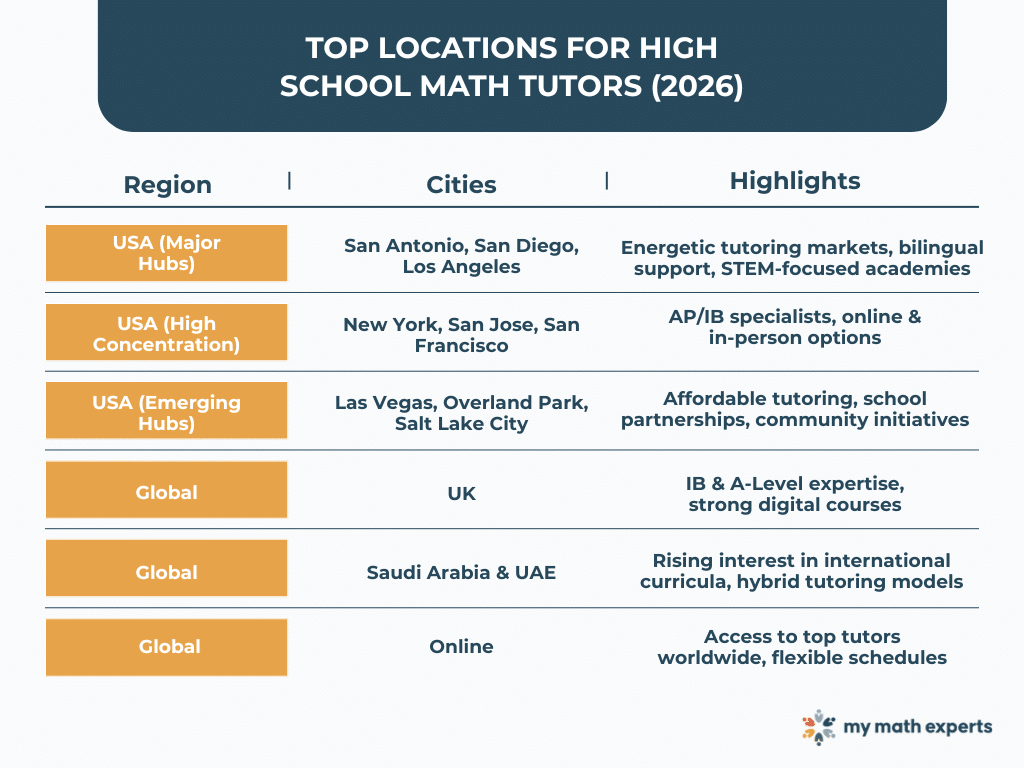
Where Math Tutoring Thrives in 2026: From U.S. hubs to global markets, My Math Experts highlights the regions leading the way in personalized learning.
If your student could use more structure, confidence, and real one-on-one support in math, talk to an expert at My Math Experts to explore your options and see whether the program is a good fit. My Math Experts pairs students with the same high school math tutor every session for consistent 1:1 math tutoring built around long-term progress. The goal is simple: remove the math friction from family life and help students understand the material and plan next steps with confidence.
How to Get Started with My Math Experts
Step 1: Book a Consultation Call
You can book a private online session with a qualified tutor at your student’s level, during which your questions are answered.
Step 2: Fill Out the Enrollment Form
Once the consultation call is over, please complete the brief online enrollment form we will send to you via email or text. Your learner will then be able to hold off-the-record meetings with their assigned tutor.
Step 3: Receive a Personalized Success Plan
After two to three sessions, your tutor will evaluate your skills and objectives to develop a customized success plan. Essentially, this plan is gradually improved as the journey progresses and feedback is received.
Achieving Math Success with My Math Experts
At My Math Experts, each of our tutors has years of teaching experience and brings it to every session. We can prove all this with the help of the AP Calculus, IB Math, and Advanced Math tracks, while Algebra 1 and Geometry are kept at a high level. Submit a request to your tutor to use diagnostic-driven plans, clear feedback loops, and track your child’s progress in both skills and confidence. Our promise is easy: success in math and enrichment of schoolwork are our priorities.
No matter if you are in San Antonio, New York, or are taking an online course from any place, the thoughtful pairing of a tutor can not only change the math class but also the student’s confidence in solving the problems that were once avoided.
Families interested in expert geometry tutoring can schedule a consultation with My Math Experts to discuss their child's goals, challenges, and learning needs. My Math Experts currently offers a 45-minute consultation for $15, 70% off the introductory rate, for those who wish to discuss the best tutoring method for their child, with flexible tutoring plans available to meet a variety of academic needs and goals.
Ready to Master Math with Confidence?
Don’t let challenges hold you back – our experts are here to guide you every step of the way. Book your personalized consultation today at My Math Experts and start turning confusion into clarity!
FAQs
Q1. What should I actually check before choosing a tutor for my teen?
Look for someone with deep knowledge of the exact course your student is in: Algebra 2, Geometry, Precalculus, or AP Calculus, rather than a generalist. Also ask whether they start with a diagnostic assessment to find foundational gaps, since skipping that step often means tutoring addresses symptoms instead of the actual problem.
Q2. What if my student only needs help with one topic, not the whole course?
Targeted, short-term tutoring on a specific unit (like trigonometric identities or quadratic equations) is common and doesn’t require a long-term commitment. Many programs, including homework support plans, are built for exactly this kind of focused help rather than a full-semester package.
Q3. Is online math tutoring reliable for a student with math anxiety, or does in-person work better?
Online 1:1 sessions can work well for anxious students because the lower-pressure setting and consistent pacing with the same certified tutor help rebuild confidence gradually. What matters more than format is whether the student gets the same tutor session to session, so trust and structure can build over time.
Q4. What is the highest math class a student can take in high school?
Most US high schools offer AP Calculus BC or multivariable calculus as the highest standard offerings, with some students reaching linear algebra or differential equations through dual enrollment. Students aiming for these advanced tracks typically need solid footing in Algebra 2 and Precalculus first.
Q5. How do I know if a tutor is actually qualified to teach calculus or algebra?
Ask whether the tutor has a degree in math, engineering, or a related field, plus direct experience teaching the specific course: Algebra 1/2 or AP Calculus are not interchangeable skill sets. Request references or examples of past students’ grade improvements before committing to a plan.
Q6. What makes My Math Experts’ 1:1 online tutoring different from other options?
Each and every one of our tutors is either a state-certified teacher or a college professor, delivering one-to-one instruction tailored to address each student’s skills and weaknesses. The students are actively engaged in our fully interactive web-based classes, which keep their interest and help them acquire a true understanding.

Mr. Kemper is the founder and director of My Math Experts. He has taught and tutored thousands of math students in grades 1 - college over the last 20 years, in the classroom and in private education. Algebra is a special passion and Kemper believes that a solid Algebra foundation opens many doors. He has also trained and supported hundreds of teachers and continues to create and innovate in the math education world.