A sixth grader who aced elementary math can hit a wall the moment fractions turn into ratios, and pre-algebra shows up. The classroom moves on. The student doesn’t, and a small gap quietly becomes a year of “I’m just bad at math.” That’s exactly the moment middle school tutoring is built for. It catches the missed concepts before they compound, rebuilds confidence, and gives students the step-by-step instruction a 30-kid classroom can’t. This article covers what tutoring does, who it helps, the subjects it targets, and how to spot when your child needs it.
Key Takeaways
- Middle school tutoring supports students with personalized, step-by-step instruction that strengthens subject comprehension, study habits, and confidence.
- Research shows tutoring produces a meaningful learning gain of about 0.37 standard deviations, with many middle schoolers improving math scores after just eight weeks.
- Struggling students often see the greatest gains because tutoring targets specific learning gaps that classroom instruction may have missed.

A middle school student works through a math lesson during an online tutoring session in a bright, organized home study space.
What Middle School Tutoring Is and Who It Helps
Middle school tutoring focuses on academic support for students in grades 6 through 8. These are the years when math stops being arithmetic and starts demanding real reasoning. Pre-algebra, ratios, integers, and early geometry build on each other fast. When one concept doesn’t click, the next one feels impossible. That’s where learning gaps form, often without anyone noticing until grades slip.
The students who benefit most fall into a few groups. Some kids are struggling with math and feel convinced they’re “not math people.” Others are solid students who just need homework help and someone to keep them accountable. And some are advanced learners, ready to move beyond their grade level into more challenging material. Our middle school math support serves all of them through personalized instruction tailored to each student.
What actually happens is simple but powerful. A tutor identifies the specific spot where understanding broke down and rebuilds from there. That tells you that classroom pace alone leaves many behind. Many parents assume their child just needs to “try harder.” In reality, most math frustration comes from a foundation that was never solid, and middle school math tutors fix that far better than more worksheets ever could.
Benefits of Personalized 1:1 Middle School Tutoring
The single biggest advantage of 1:1 tutoring is attention. A classroom teacher splits focus across dozens of students. A tutor watches one student work, catches the exact moment confusion sets in, and adjusts on the spot. That one-on-one support is personalized learning in practice, not theory. If you’re weighing the costs and outcomes, it helps to think through whether a math tutor is worth the investment before committing.
Middle school math tutoring tends to show results quickly because the subject is cumulative. Fix one foundational concept, and several later topics suddenly make sense.
Beyond grades, personalized learning builds something harder to measure: math confidence. When a student finally understands why a method works instead of memorizing steps, the whole subject feels less threatening. The National Council of Teachers of Mathematics emphasizes that conceptual understanding, not rote memorization, is what builds durable math skills. Sessions also strengthen study skills that carry into every class, building the time management and personal organization middle schoolers need as their workload grows.
The goal of good middle school tutoring is never just a better test next week. It’s real, long-term academic growth, and a student who trusts their own problem-solving skills.
Common Subjects Covered
Middle school covers a lot of ground, but a few subjects drive the most stress for families. Math leads the list. Middle school math tutors most often work on pre-algebra, the bridge year in which students first encounter variables, negative numbers, and multi-step equations. Algebra concepts start appearing here, and shaky foundations show up loudly. It helps to understand when students typically take Algebra 1 so you can plan support around that transition. Early geometry, ratios, percentages, and fractions round out the core topics where students tend to stumble.
Subject-specific tutoring matters because these math concepts aren’t interchangeable. A student who struggles with algebra needs different support than one who’s lost on geometry proofs. Good tutoring diagnoses the difference rather than treating “math” as a single generic blob.
Science tutoring is the next most common request, especially for the math-heavy parts of middle school physical science, where formulas and unit conversions trip kids up. Many families also seek help with writing and reading comprehension as assignments become longer and more analytical.
Signs Your Child Needs a Tutor
Parents usually sense something is off before they can name it. Here are the clearest signs your child needs tutoring.
- Grades are slipping in one subject, especially math, even though effort seems steady.
- Homework turns into a nightly battle, with tears, avoidance, or hours spent on a single assignment.
- Your child says things like “I’m just bad at math” or “I don’t get it and I never will.”
- Test scores keep coming in lower than the homework grades suggest they should.
- They’ve stopped asking questions in class because they feel behind their grade level.
Any one of these is worth watching. Two or three together is usually the signal to act.
Here’s why this matters. Middle school math builds on itself relentlessly. A student who never solidified fractions will struggle with ratios, then with algebra, then with everything that follows. These learning gaps don’t close on their own. They widen. Picture a seventh grader who scrapes by in a ratios unit by copying examples without understanding them; by the time proportional equations show up a month later, the homework that took 20 minutes now takes two frustrating hours, and the avoidance starts. The “I’m bad at math” talk often signals something deeper: research on math anxiety in students shows that when a student feels anxious about math, that stress can crowd out working memory and make them perform below what they’re actually capable of.
One more sign families miss: a capable student who’s quietly bored. Advanced learners who finish early and tune out can lose engagement just as easily as struggling students. Recognizing the signs your child needs tutoring early, in either direction, prevents a small problem from becoming a long one.

A student works through a challenging math assignment at home while a parent remains nearby, offering quiet support in the background.
Qualities to Look For in a Middle School Tutor
Not all tutoring is equal, and the difference usually comes down to who’s actually doing the teaching. The most important quality is real teaching credentials. Certified teachers and experienced college-level educators understand how middle school students learn. They know how to break down a concept in several ways and how to spot a misconception before it spreads. That’s a different skill than simply knowing the math. You can review the certified teachers who lead each session to see the credentials that make the difference.
Watch out for the peer-tutoring trap. A high schooler who’s good at algebra can offer quick homework help on a single problem. But they can’t diagnose why a student keeps making the same mistake or build a plan to fix it. Expert-led, 1:1 tutoring is a different category entirely.
Consistency is the next thing to look for. Working with the same tutor every week builds trust, and that trust lets a kid admit, “I actually don’t understand this.” That continuity also makes a real customized learning plan possible, because the tutor remembers where the student was last month.
Finally, look for a focus on understanding over answers. The goal is conceptual learning and stronger problem-solving skills, not just finished homework. A good tutor also delivers a customized plan built around the student’s actual learning gaps and study skills, plus clear session notes so parents know what’s happening.
Support for Struggling and Advanced Learners
Tutoring isn’t only for kids who are behind. It works on both ends of the spectrum, and the approach shifts depending on the student.
For students struggling with math, the work starts with finding the foundation that is cracked. A free assessment helps pinpoint exactly which math concepts are missing. Then sessions rebuild from there with one-on-one support and step-by-step instruction. The good news is that struggling students often post the biggest gains. Targeted academic support addresses the specific learning gaps that classroom instruction raced past. Research from Old Dominion University on low-achieving middle schoolers found statistically significant improvements in math from consistent, focused tutoring.
Advanced learners need the opposite challenge. A student who’s bored at grade level can accelerate into harder material, work ahead in algebra or geometry, and start real high school prep before they ever set foot in ninth grade. Without that stretch, capable students coast and lose momentum.
My Math Experts begins with a custom grade-level assessment for every student, which produces a customized learning plan, whether the goal is to close gaps or to push ahead. Families can also review our transparent session pricing to plan ahead with confidence. The same structure serves both: identify where the student actually is, then build deliberately from there. That’s how academic growth happens for struggling and advanced learners alike, and how high school prep starts well before high school.

A comparison between independent paper-based math practice and personalized online tutoring, illustrating how guided instruction can help students build confidence and tackle more advanced concepts.
How Certified Teachers Make a Difference
Here’s the part most tutoring services gloss over: the person teaching matters more than the platform, the app, or the marketing. Certified teachers bring training in how kids actually learn, not just subject knowledge. They know that when a student misses an algebra problem, the real issue might trace back to fractions from two grades ago. And they know how to teach it three different ways until one clicks.
The root cause of most middle school math struggles isn’t ability. It’s a foundation that was built too fast. Certified teachers are trained to find that weak spot and rebuild it. That’s the whole mechanism behind why expert-led tutoring outperforms casual help. A homework-answer service gets a student through the night. A trained educator gets them through the year while building the study skills that last.
Consistency multiplies the effect. When the same certified teacher works with a student every week, they track progress, adjust the plan, and build the kind of trust that makes a kid willing to say, “I’m lost.” In our experience, that combination of certified teachers, subject-specific tutoring, and long-term planning is consistently what produces the most durable progress.
If your student could use more confidence, structure, and personalized support in math, you can talk to an expert at My Math Experts to see whether the program is a good fit. Ranked the #1 academic tutoring company in Arizona two years running, and working with students across the U.S. through online tutoring, My Math Experts pairs every student with a certified teacher and a plan built around their actual needs. Results vary based on student participation, consistency, and academic goals, but the approach is built for real, long-term progress rather than quick fixes.
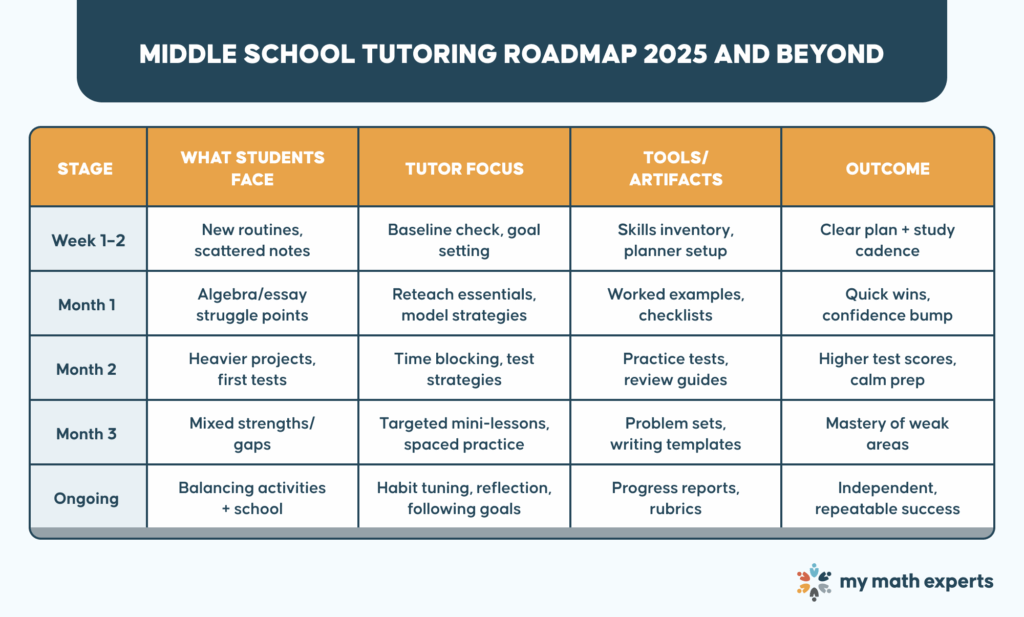
Middle School Tutoring Roadmap: Guiding students step by step toward lasting academic success.
Families interested in expert geometry tutoring can schedule a consultation with My Math Experts to discuss their child's goals, challenges, and learning needs. My Math Experts currently offers a 45-minute consultation for $15, 70% off the introductory rate, for those who wish to discuss the best tutoring method for their child, with flexible tutoring plans available to meet a variety of academic needs and goals.
Ready to Master Math with Confidence?
Don’t let challenges hold you back—our experts are here to guide you every step of the way. Book your personalized consultation today at My Math Experts and start turning confusion into clarity!
FAQs
Q1. What is middle school tutoring, and how does it work?
Middle school tutoring is structured academic support for students in grades 6 through 8 (roughly ages 11 to 14), focused on building subject comprehension, study habits, and organizational skills.
Q2. Does middle school tutoring actually improve grades?
Research supports this: a major meta-analysis found that tutoring yields a pooled effect size of about 0.37 standard deviations on learning outcomes. One study showed middle school students improved math scores in 78 percent of cases after eight weeks of weekly sessions, with gains also seen in attendance and English Language Arts.
Q3. Is tutoring worth it for a student who is really struggling?
For struggling students, tutoring is often where the biggest gains appear, since personalized instruction targets the specific learning gaps that hold a student back. Studies, including ODU’s research on low-achieving middle schoolers, found statistically significant improvements in math from consistent, focused tutoring.

Mr. Kemper is the founder and director of My Math Experts. He has taught and tutored thousands of math students in grades 1 - college over the last 20 years, in the classroom and in private education. Algebra is a special passion and Kemper believes that a solid Algebra foundation opens many doors. He has also trained and supported hundreds of teachers and continues to create and innovate in the math education world.