Key Takeaways
- Algebra 1 is usually a 9th-grade subject, but there are situations where an advanced student can take it in 8th grade, or even younger.
- The decision to take the course will also hinge on the student’s math skills and the school’s norms.
- If a student has been somewhat exposed to pre-algebra concepts, Algebra I will likely be less complicated and more understandable. We would never recommend a student jump into Algebra I without a good understanding of pre-algebra.
- Students can avail themselves of online math tutoring services from anywhere, to become proficient in algebra so they can succeed in advanced math courses.
At a significant point students may inquire, “Generally at what grade level is Algebra 1 being studied?” In the United States, Algebra I is basically a brand new idea taught at the next level, that is, 9th grade or the first year of high school. However, it is still possible to allow a student to study this subject in the 8th grade and also give them the option to do it in the 10th grade, given variations in the school system and pre-algebra journey.
This article delves into the differences in grade placement for the Algebra course, the topics covered in Algebra I, and the importance of taking it at the right time, which can determine a student’s entire math track, leading to AP Statistics, Computer Science, Calculus, and other advanced math classes.
Understanding the School System and Math Progression
Math content often changes from one district or state to another. Most of the time, Algebra 1 can be found in the public school curriculum immediately after pre-algebra, which is normally taught in the seventh or eighth grade.
Students might be able to take an Algebra course in 8th grade and thus get a high school credit early. Other students who complete pre-algebra in the eighth grade will study Algebra I in the ninth grade, which is their first year of high school.
Generally, the curriculum of a private school tends to be more flexible, and students can speed up their learning by joining the Honors Algebra or Algebra 1 Honors classes, which are specially designed for gifted students.
Typical Grade Levels for Algebra I
Each district has a different math program that varies slightly, but the overall breakdown is as follows:

The Role of Pre-Algebra in Preparing Students for Success
Typically, a pre-algebra course is considered as the next step before Algebra 1 and is mainly taught in the 7th or 8th grade. The main goal of this class is to familiarize students with topics like linear functions, rational exponents, and square roots.
Students learn how to understand the coordinate plane, function notation, and number lines; all of which will be needed for thinking through Systems of equations and Quadratic functions.
By having a solid conceptual grasp of these ideas and concepts, it will be beneficial in guiding students through Algebra I, where they will still engage and learn significant amounts, including Exponential Functions, linear inequalities, and eventually graphing the functions.
If a 7th or 8th grader is struggling with fractions or negative numbers (integers), a little extra practice or online algebra tutoring may establish the correct foundation so they can proceed.
What Students Learn in Algebra I
Core Algebra Topics
Typically, in an Algebra I or Honors Algebra course, students delve into the language and logic of math. Some of the core topics are:
- Linear functions and linear inequalities
- Systems of equations and their number of solutions
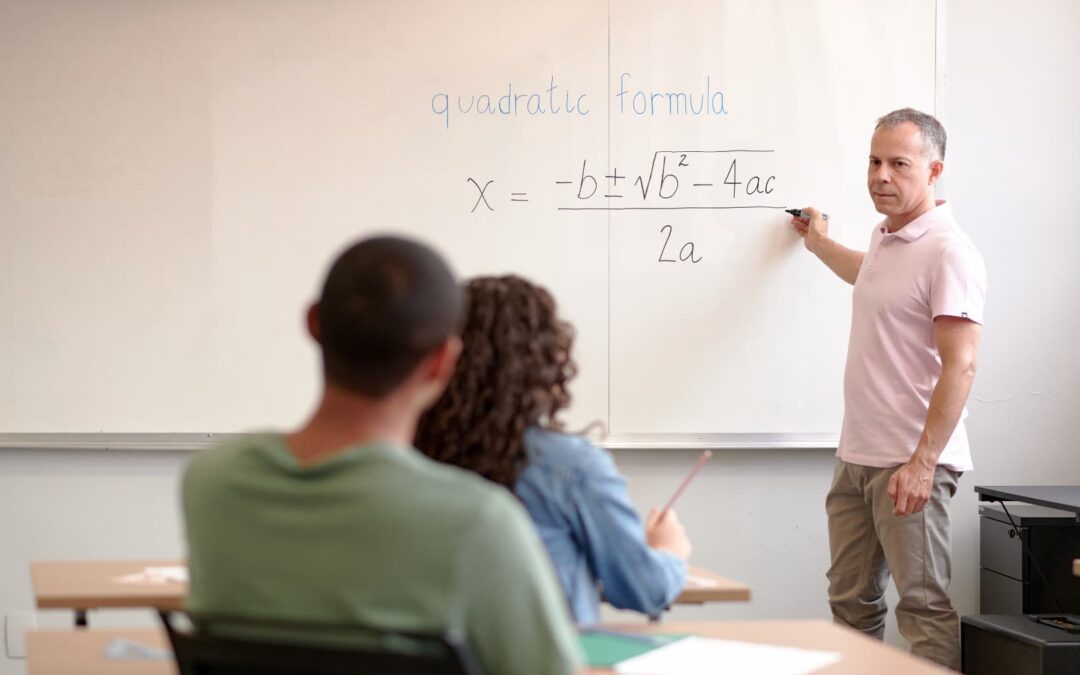
- Quadratic functions and solving quadratic equations
- Function notation, inverse functions, and vertex form
- Exponential Functions and Data Collection through Scatterplots
Through these lessons, students learn to recognize patterns, use reasoning, and model relationships, all of which are necessary skills for advanced math and science courses.
Real-World Connections
To make algebra concepts more relatable to students’ lives, teachers frequently employ word problems or linear models. For instance, graphing functions may involve plotting savings over time, whereas quadratic equations can be used to determine the trajectory of a basketball shot.
The math skills built in Algebra I will also be helpful in other subjects, such as Chemistry and Physics, which require a thorough understanding of variables and logical systems.
Why 9th Grade Is the Ideal Time for Algebra I
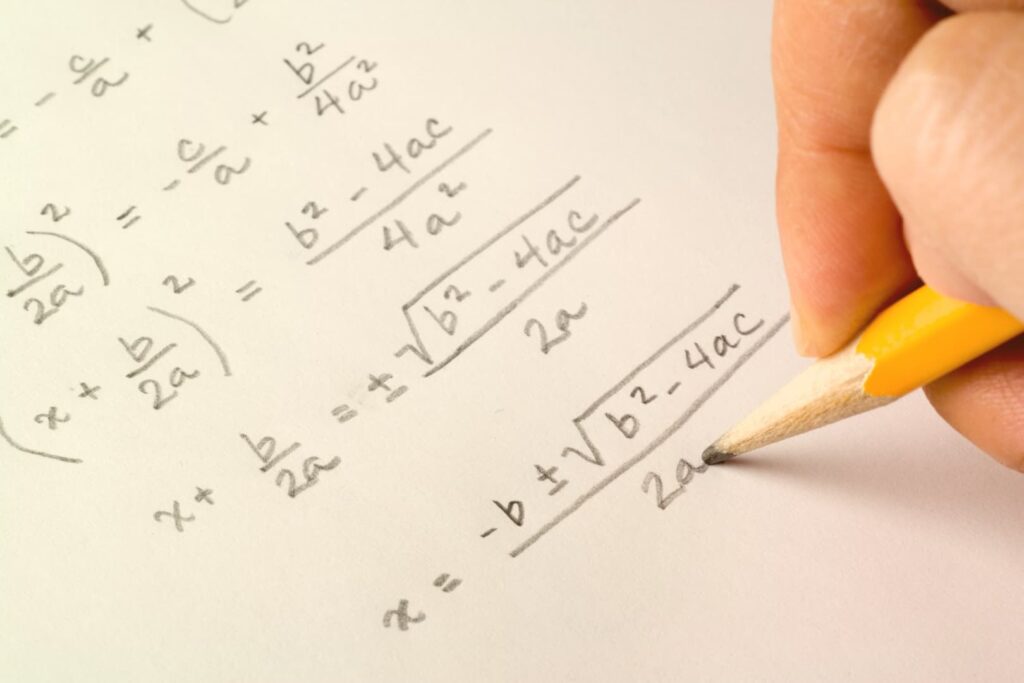
Suppose students take Algebra I in ninth grade. In that case, they can proceed with the regular high school math courses — Geometry, Algebra II, and Precalculus — before tackling Advanced Placement classes like AP Statistics or AP Calculus.
Such an order of studies not only prepares students for college-level courses but also enhances their college admissions profiles. It is beneficial when a student shows advanced math scores and consistent mastery of practice problems, but completing Algebra I too early (like in 7th or 8th grade) does not always bring much additional advantage.
How the Department of Education and Common Core Influence Placement
The Department of Education and Common Core State Standards have set general goals for mathematics education at each level. These standards serve as a framework for students across the country to achieve the same educational outcomes; however, district school boards are free to schedule learning according to their local needs.
Where some states allow 8th graders to take Algebra for a quick high school credit, others hold it off until 9th grade to better prepare students.
In the end, the objective is to help every math learner gain a solid understanding of algebra concepts such as square roots, function notation, and solving quadratic equations, rather than to speed through the topics.
Online Tutoring: A Smart Way to Master Algebra I
Even the most ambitious of 9th and 8th graders can struggle with Algebra 1, which is why My Math Experts is here to provide you or your student with expert help.
An online tutoring session in Algebra 1 is based on one-on-one instruction that is flexible and customized, and can be used as a support for school instruction or if you want to catch up after a class. If necessary, tutors will utilize practice problems, test preparation, and word problems for a student who is able to comprehend standard linear inequalities and quadratic functions at his/her own pace. Often, we focus on homework and study guides and provide the student’s specific curriculum to their dedicated tutor so they can use the sessions to help the student excel in their classwork specifically.
If you or your student is simply catching up on pre-algebra or planning to finish Algebra ahead of time, online help is the greatest way to ensure that you acquire math skills and that you remain confident.
The Long-Term Impact: Setting the Stage for Higher-Level Math
Beginning Algebra I early might be a way to get into more advanced math classes like Precalculus, AP Statistics, and Computer Science. If someone takes it in the 10th grade or later, they can still succeed in college-level math with a tutor and strong study habits.
At the end of the day, really being good at Algebra 1 is less about which school year the course was taken and more about grasping the general concept of mathematical thinking. This skill extends beyond the final year of high school and can be used to solve problems throughout life.
Conclusion: Strengthen Algebra Skills with My Math Experts

It does not matter if you are a 7th grader getting ready for pre-algebra or a 9th grader working on Algebra 1; the right help can change everything.
The certified math teachers at My Math Experts make a personalized learning plan for each student that focuses on understanding, applying, and gaining confidence. Students turn into masters of any concept they choose, from Systems of equations to Quadratic functions, as they go through the material one step at a time, with the aid of flexible scheduling, experienced tutors, and instant feedback.
Why not begin your excursion today? Book your first Algebra 1 tutoring session – we offer a 30-minute free trial – with My Math Experts and get the skills that will make you successful not only in high school but also in life.
FAQs
1. What grade is Algebra 1 normally taken?
Algebra 1 is mainly taken in the 9th grade, although some advanced students may take it in the 8th grade or even earlier.
2. Are 8th-grade students allowed to take Algebra 1 for high school credit?
Yes. If 8th graders meet the requirements for placement, many public schools will grant them a high school credit for Algebra I.
3. What do students study in high school after Algebra 1?
The majority of students are enrolled in Geometry, Algebra II, and then Precalculus or AP Statistics.
4. How might tutoring be beneficial for Algebra I?
By means of online tutoring, students can get help with difficult topics in algebra by doing additional practice problems, getting assistance with lessons, and receiving continuous professional feedback and support.

Mr. Kemper is the founder and director of My Math Experts. He has taught and tutored thousands of math students in grades 1 - college over the last 20 years, in the classroom and in private education. Algebra is a special passion and Kemper believes that a solid Algebra foundation opens many doors. He has also trained and supported hundreds of teachers and continues to create and innovate in the math education world.