A student who cruised through Algebra 1 can hit a wall three weeks into Algebra 2. They stare at a logarithm problem that seems to have nothing to do with anything they’ve learned. That wall usually isn’t about the new material. It’s about a small gap from a year ago that nobody caught. Choosing the right online Algebra 2 tutor is less about finding someone who “knows math” and more about finding someone who can spot where the confusion started and rebuild from there. This guide walks through what Algebra 2 actually demands, how to vet a tutor, and the questions that separate real help from casual homework answers.
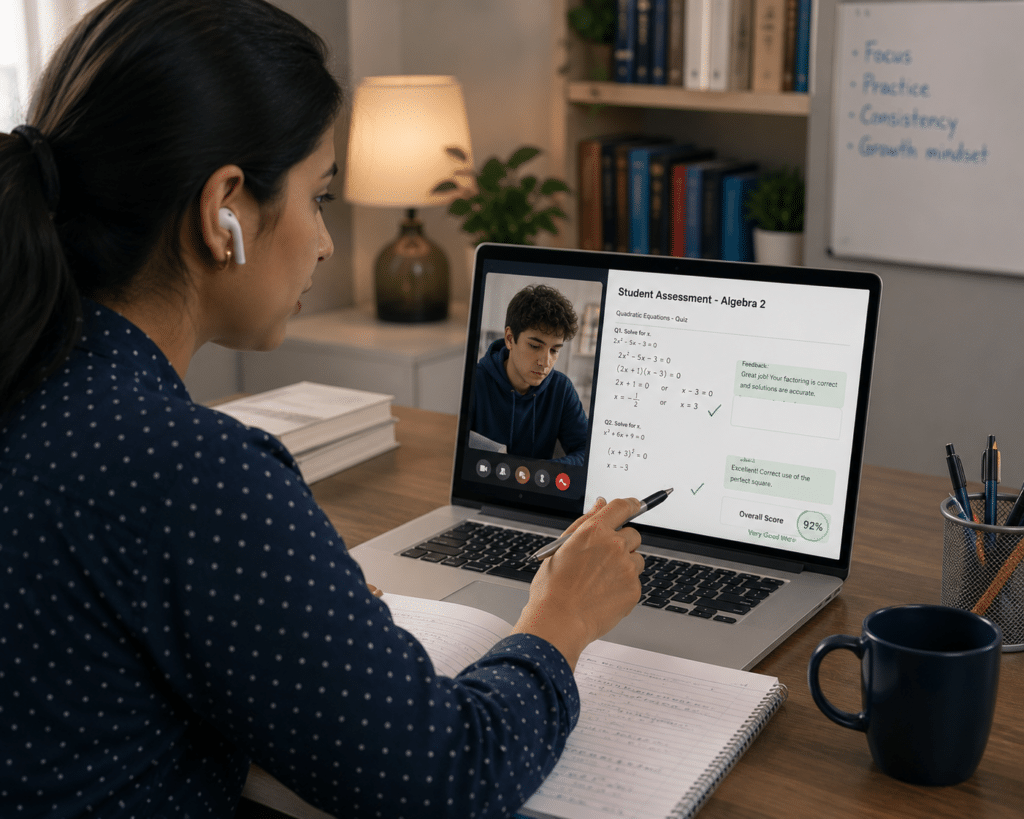
An experienced online math tutor reviews a student’s Algebra assessment during a live virtual session, providing personalized feedback that helps strengthen understanding and improve academic performance.
Key Takeaways
- A good Algebra 2 tutor targets the specific gaps causing a student’s struggle rather than reteaching the entire course from scratch.
- Consistent one-on-one online tutoring helps students strengthen conceptual understanding, build confidence, and make steady academic progress. Results vary based on participation, consistency, and individual learning needs.
- Most Algebra 2 confusion stems from unaddressed Algebra 1 gaps in functions, factoring, and equations, which a tutor should diagnose first.
- Personalized learning plans and regular progress updates help families understand how students are developing over time.
What Algebra 2 covers and why it’s challenging
Algebra 2 is where math stops feeling like a set of tricks and starts demanding real reasoning. The course stacks a lot of new Algebra 2 topics on top of each other. Quadratic functions, polynomials, logarithms, rational expressions, and systems of equations all show up, plus complex numbers and exponential models. Each one assumes the student already owns the skills below it.
Why does this matter? It comes down to how the subject is built. Algebra 2 exposes weak foundations fast. A student who never fully understood factoring in Algebra 1 will stall the moment polynomials show up. Factoring is the tool that makes polynomial work possible. The gap was always there. Algebra 2 just makes it visible. This is often where families first consider working with an online Algebra 1 tutor to close those earlier gaps before they compound.
That’s also the honest answer to the difference between Algebra 1 and Algebra 2. Algebra 1 introduces the ideas. Algebra 2 combines them and asks students to move between graphs, tables, and equations, often in a single problem. It’s the bridge to pre-calculus and college algebra. That’s why the algebra 2 concepts a student misses here tend to follow them into advanced math later.
Many parents assume Algebra 2 is uniquely hard. In reality, most students struggle not because the material is impossible, but because earlier concepts never truly clicked. Good Algebra 2 help starts by naming that gap instead of pretending it doesn’t exist.
How the right Algebra 2 tutor makes a difference
A strong Algebra 2 tutor doesn’t reteach the whole course. They find the two or three broken links in the chain and repair those first. That single decision changes how fast a student recovers.
The root cause of slow progress in group settings is pace. A classroom moves on a schedule, not on a student’s understanding. When a student is struggling, one confusing lesson quietly becomes three, and the class keeps going. Personalized algebra 2 online tutoring flips that. The tutor slows down where the student needs it and speeds up where they’re solid. No time gets wasted on things they already know.
Consistency is the other half. When a student works with the same tutor every week, that tutor remembers what tripped them up last Tuesday and builds on it. That continuity is where real progress comes from. It’s why one-on-one support with the same dedicated tutor beats rotating through a marketplace of strangers. If you’re weighing the investment, it’s worth understanding whether a math tutor is worth it before committing to a plan.
The effect is measurable. The What Works Clearinghouse at the U.S. Department of Education has documented that consistent tutoring produces some of the strongest gains of any intervention, especially when one-on-one online support is delivered regularly. Results vary based on how consistently a student attends and practices. Still, the pattern is clear: structured help with step-by-step explanations builds both skill and confidence. The goal is understanding, not just tonight’s answer.
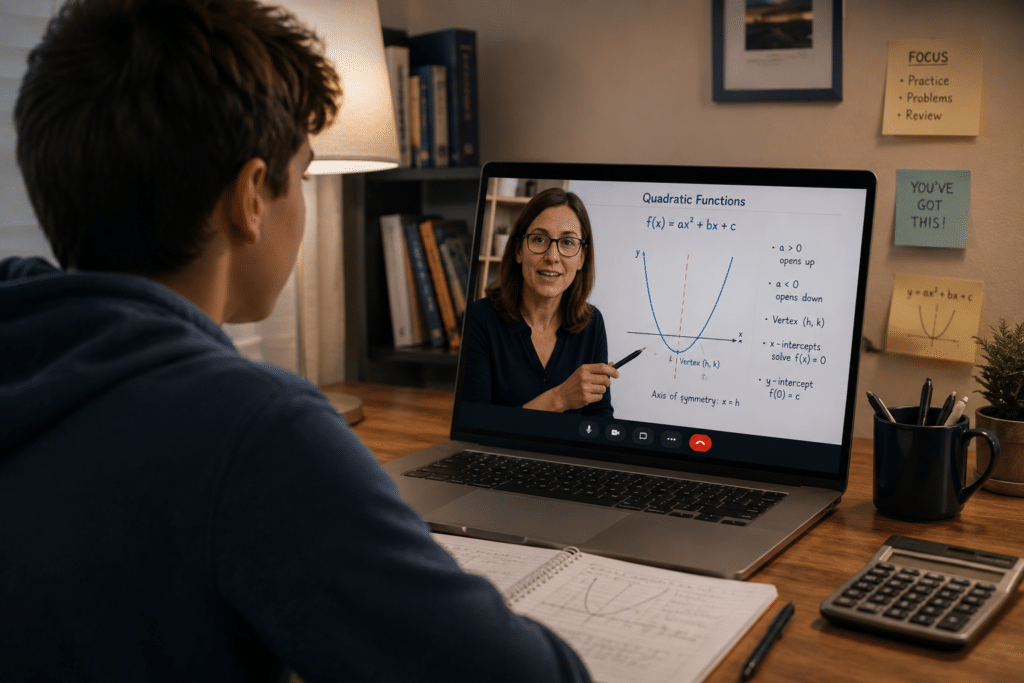
A teenage student follows along as an experienced online math tutor explains a quadratic graph in a live virtual lesson, creating an engaging and supportive learning experience from home.
Personalized, customized learning plans
Generic tutoring treats every student the same. A custom learning plan doesn’t. Two students can both be failing Algebra 2 for completely different reasons. One never mastered functions. The other understands the concepts but panics under time pressure. The same lesson won’t fix both. In fact, research on math anxiety from the American Psychological Association shows that pressure and fear can undermine performance just as much as missing skills.
A good plan starts by identifying learning gaps through personalized instruction and ongoing observation. Every student learns differently, so tutoring should adapt as understanding grows. At My Math Experts, tutors identify learning gaps through personalized instruction. After 2–4 sessions, families receive a Personalized Success Plan with specific goals, prescribed resources, and a long-term roadmap developed collaboratively by the tutor, student, and family. It includes specific goals based on the student’s needs, prescribed resources, including a textbook when appropriate for the semester, and a long-term plan built together by the tutor, student, and family.
The plan isn’t just a document. It keeps sessions pointed at real progress instead of drifting from one homework assignment to the next. A student weak in rational expressions gets targeted practice there. A student solid on algebra 2 concepts but shaky on logarithms spends time exactly where it counts.
It also respects how a student learns. Some need visual explanations. Others need to talk through the logic out loud. A good tutor adjusts to that learning style instead of forcing one method. A second custom learning plan detail matters too. When the material is matched to the student’s learning style, homework help stops being a nightly battle and starts to build confidence. The plan gives structure to something that otherwise feels random, and that structure turns scattered effort into steady improvement.
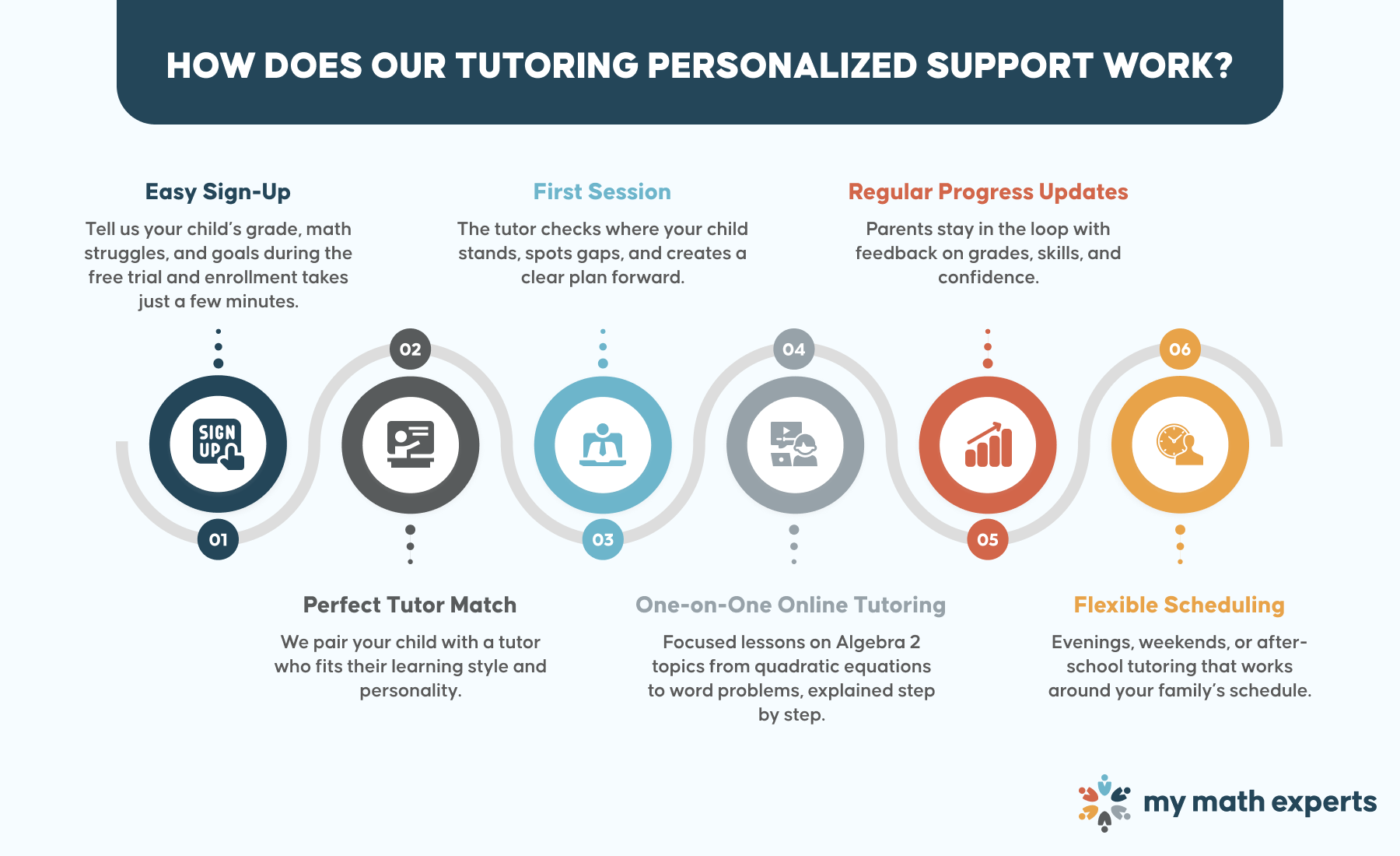
Our personalized tutoring begins with understanding each student’s strengths, challenges, and learning style. Every lesson is tailored to individual goals, helping students build confidence, master concepts, and achieve lasting academic success.
What to look for in a qualified tutor (experience and vetting)
Not all algebra 2 tutors are the same, and the difference shows up fast. Here’s how to vet one before you commit:
- Confirm a genuine math background. Look for someone with a real subject background in mathematics, not a general “I’m good at math” helper. A skilled tutor knows how to teach a concept, not just solve the problem in front of them.
- Ask about specific experience. A tutor should be comfortable with the full range of Algebra 2 topics, from quadratic functions through logarithms, and able to explain how each connects to the next.
- Require an initial assessment. A qualified tutor wants to find the learning gaps before teaching anything. If they skip straight to homework, that’s a warning sign.
- Check for progress tracking. You’ll receive session notes and clear updates so you can see whether the student is actually improving, not just guess.
- Insist on the same tutor each week. Consistency with one tutor is what builds trust and long-term momentum.
Many assume any smart college student can tutor Algebra 2. In reality, there’s a real difference between a peer who happens to remember the material and a professional educator who understands why students get stuck. You can meet our tutoring team to see what that professional standard looks like in practice. Casual help gets a student through tonight’s worksheet but rarely closes the gap underneath it. When you’re figuring out how to find a good math tutor, prioritize teaching skill and structure over convenience. That structure is what makes the difference.
Benefits and outcomes (better grades, problem-solving skills)
The payoff from consistent online tutoring shows up in more than one place. Improved understanding, stronger problem-solving skills, and greater confidence are the foundations of long-term academic growth. As students strengthen these skills, academic performance often improves as well.
Grades improve because the student stops making the same mistakes. As foundational concepts become stronger, many students experience improved classroom performance. Results vary based on participation, consistency, and individual learning needs. But the bigger win is problem-solving skills. Algebra 2 is really training in logical reasoning: breaking a messy problem into steps, choosing a method, and checking the result. Those skills carry into pre-calculus, college algebra, and every advanced math course after.
Confidence is the quiet outcome that changes everything. A student who used to freeze at the sight of polynomials starts raising their hand. That shift matters because a student who believes they can do math will attempt problems instead of giving up, and attempting is how you learn. The one-on-one support in personalized tutoring is designed to build confidence alongside skill.
Here’s the honest part. Results vary based on the student’s participation and how consistently they practice between sessions. A tutor can’t do the reps for them. What steady help does is make those reps productive, so effort turns into real progress instead of frustration. Step-by-step explanations, weekly consistency, and a plan that targets the right gaps are what move a student from surviving Algebra 2 to actually understanding it.

A proud high school student smiles while holding a top-scoring math test, with a supportive parent or tutor looking on in the background. The warm home setting highlights the confidence and encouragement that come from academic success.
Questions to ask before hiring an Algebra 2 tutor
Before you commit to any algebra 2 tutor, a short conversation tells you most of what you need to know. Ask these:
- What’s your math background? You want to hear about a real mathematics background, not vague reassurance.
- How do you figure out where my child is struggling? A good tutor explains how they identify learning gaps and personalize instruction over time.
- Will my child work with the same tutor every session? Consistency with one tutor is what builds trust and lets a real plan take shape.
- How will I know it’s working? Ask about session notes and progress updates so improvement is visible, not assumed.
- Do you teach the concept or just help finish the assignment? The answer should lean toward understanding, because homework help alone won’t close a learning gap.
- Are sessions online or in-person? My Math Experts provides only 1:1 online tutoring, which gives families across the U.S. flexible scheduling from home.
- How do you keep a plan on track over time? A tutor who works with your child consistently and adjusts the plan as gaps close is a sign of a serious provider.
If you’re searching for algebra 2 tutors near you, don’t stop at location. Online algebra 2 tutoring often gives you access to a stronger, more experienced online algebra 2 tutor than the nearest available option. Before you compare providers, it helps to review the math tutoring plans and pricing so you know what fits your family. The best tutors near you might not be nearby at all, and that’s fine. The quality of instruction matters far more than the zip code.
Signs your student needs an online Algebra 2 tutor
Sometimes it’s obvious. Often it isn’t. Here are the signals that it’s time to bring in personalized Algebra 2 tutoring:
- Grades are slipping on tests even though homework gets done. This usually means the student is copying methods without understanding them.
- Homework turns into a nightly fight. Frustration and avoidance are signs the material stopped making sense a while ago.
- Your child says they’re “just bad at math.” That’s rarely true. It’s usually a confidence issue rooted in a specific gap, and steady one-on-one support helps them build confidence again.
- They can’t explain how they got an answer. Getting the right result by guessing won’t hold up as Algebra 2 concepts get harder.
- Earlier topics like functions or factoring still feel shaky. Those Algebra 1 gaps are what quietly sink Algebra 2 later.
- They’re heading into advanced math soon. If pre-calculus or college algebra is next, closing gaps now prevents a bigger struggle later.
The good news is that none of these are permanent. Most math frustration comes from a foundation that was never fully set, and a focused tutor can rebuild it. The simplest way to find out where things stand is to start with a math assessment that pinpoints the exact gaps. Waiting rarely helps. In a cumulative subject, one shaky week tends to become a shaky unit. Catching it early keeps a small gap from becoming the reason a student avoids advanced math altogether.

A frustrated high school student pauses over unfinished algebra problems during a late-night study session, reflecting the challenges many students face with math. The quiet, dimly lit setting conveys the importance of timely academic support and personalized guidance.
If your student is struggling with Algebra 2 and you want to see whether the right Algebra 2 tutor could help, My Math Experts pairs students with a math tutor for consistent 1:1 online sessions built around a personalized plan. If your student is struggling with Algebra 2, contact My Math Experts to learn how personalized one-on-one online tutoring can strengthen foundational concepts, build confidence, and support long-term academic growth. Results vary based on participation, consistency, and individual learning needs.
Families interested in expert geometry tutoring can schedule a consultation with My Math Experts to discuss their child's goals, challenges, and learning needs. My Math Experts currently offers a 45-minute consultation for $15, 70% off the introductory rate, for those who wish to discuss the best tutoring method for their child, with flexible tutoring plans available to meet a variety of academic needs and goals.
Ready to Master Math with Confidence?
Don’t let challenges hold you back—our experts are here to guide you every step of the way. Book your personalized consultation today at My Math Experts and start turning confusion into clarity!
FAQs
Q1. What if my child already fell behind earlier in Algebra 1? Can an online tutor help?
Yes, because most Algebra 2 struggles trace back to unfilled gaps in Algebra 1 topics like functions, factoring, and equations. A good tutor identifies foundational learning gaps through ongoing instruction and builds a personalized plan to strengthen those concepts before moving forward.
Q2. What should I look for when choosing an Algebra 2 tutor?
Look for tutors who provide personalized instruction, consistent one-on-one support, structured progress updates, and a concept-first approach that strengthens long-term understanding.
Q3. How do I find a good online Algebra 2 tutor?
Start by pinpointing your need, homework help or concept mastery, then consider platforms like My Math Experts offering scheduling flexibility for online sessions. Choose a tutoring provider that offers personalized learning plans, consistent tutoring, and regular progress updates so you can clearly see how the student is developing over time.
Q4. Can a student realistically self-study Algebra 2 without a tutor?
Self-study is possible for motivated learners using textbooks, classroom resources, and regular practice, especially for review or enrichment. However, students who hit repeated roadblocks or have shaky Algebra 1 foundations usually progress faster with 1:1 online support to catch mistakes early.
Q5. Is Algebra 2 really the hardest math class in high school?
Algebra 2 feels hard for many students because it layers functions, logarithms, and complex numbers on top of earlier algebra skills, so weak foundations get exposed quickly. It’s less about the class being uniquely difficult and more about how well earlier concepts actually clicked.

Mr. Kemper is the founder and director of My Math Experts. He has taught and tutored thousands of math students in grades 1 - college over the last 20 years, in the classroom and in private education. Algebra is a special passion and Kemper believes that a solid Algebra foundation opens many doors. He has also trained and supported hundreds of teachers and continues to create and innovate in the math education world.