A second grader stares at 27 + 15 and writes 312. All the digits are there, but the answer is off by hundreds. That single mistake, repeated across a worksheet, usually means the student never fully grasped what regrouping is in math and why it matters. This guide breaks the concept down. You’ll learn what regrouping is, why place value makes it work, how carrying and borrowing differ, and how to teach regrouping without the frustration.
Key Takeaways
- Regrouping in math is moving values between place-value columns to make multi-digit addition and subtraction work correctly.
- Regrouping goes by two names: ‘carrying’ when you add and ‘borrowing’ when you subtract.
- In addition, you regroup whenever a column’s digits sum to 10 or more, write the ones digit, and carry the ten forward.
- In subtraction, you regroup when a top digit is too small, taking value from the next higher place to complete the operation.
- A solid understanding of place value is what makes regrouping click, which is why teachers introduce it with base-ten blocks before written steps.

A student struggling with 27 + 15 highlights why understanding regrouping and place value is essential for building strong math skills.
What is regrouping in math? (core definition)
So what is regrouping in math? It is the technique of exchanging value between place-value columns so that addition and subtraction with multi-digit numbers give the right answer. Each column- ones, tens, and hundreds- holds a maximum of nine before it “rolls over.” When a total spills past that limit, regrouping moves the extra value to the next column; nothing gets lost or crammed where it doesn’t fit.
Here’s the part most explanations skip. Our number system allows only one digit per place-value column. When 6 + 6 gives you 12, you can’t write “12” in the ones column, because a single column holds one digit. So you rearrange the digits, keeping the 2 in the ones and passing the 10 forward as a single ten. That’s all regrouping is: a bookkeeping move that respects how numbers are built.
The U.S. Department of Education’s National Center for Education Statistics tracks how early number skills predict later math performance, and place-value operations sit near the foundation. This makes it clear why building a strong math foundation matters: get regrouping right, and addition and subtraction with two-digit numbers, then three digits, then decimals all follow the same logic.
Understanding place value as the foundation of regrouping
Regrouping makes no sense without place value, so every good explanation starts here. In the number 34, the 3 isn’t just “three.” It’s three tens, or 30. The 4 is four ones. Each place-value column is worth ten times the column to its right this ‘ten times’ rule is the engine behind regrouping. That “ten times” rule is the engine behind regrouping.
When you regroup, you make a trade at a fixed exchange rate: ten ones for one ten, ten tens for one hundred. Twelve ones and one ten plus two ones are the same quantity, just written differently. The Common Core standards for Number and Operations in Base Ten build their entire progression around exactly this idea of place-value understanding.
Many parents assume regrouping is a set of steps to memorize. In reality, it’s a direct consequence of how groups of tens stack into larger units. A student who sees 34 as “3 tens and 4 ones” has already won half the battle.

Make place value easier to understand with a visual breakdown of hundreds, tens, and ones using colorful base-ten blocks.
Carrying vs. borrowing: the two forms of regrouping
Carrying and borrowing are the same idea pointed in opposite directions. Both are regrouping. The only difference is which way the value moves.
Carrying over happens in addition. When the digits in a column produce a sum of two digits, you keep the ones digit in place and carry the extra ten (or hundred) up to the next column. You add that carried value to the digits already there. People also call this “carrying over,” and it’s the version students usually meet first.
Regrouping in subtraction, or borrowing, works the other way. When the top digit is smaller than the one below it, you don’t have enough to subtract. So you borrow from the next column to the left. You take one unit from that higher place, break it into ten of the current place, and now the subtraction works.
Older textbooks used “carrying and borrowing” almost exclusively. Modern elementary math leans on the single word “regrouping” because it names the shared logic, rather than treating addition and subtraction as unrelated tricks. The National Council of Teachers of Mathematics standards for number and operations reinforce this unified view. If a child understands that both are just trades between place-value columns, they stop seeing two separate rules and start seeing one.
How to visualize regrouping (base-ten blocks, models)
Abstract steps on paper are where regrouping falls apart for many students. Learning how to visualize regrouping first, with physical objects, fixes that.
Base-ten blocks are the standard tool. Single cubes represent ones, and a “rod” of ten stuck-together cubes represents a ten. When a child adds two numbers and ends up with ten or more single cubes, they physically swap ten ones for one rod. That swap is regrouping. There’s no leap of faith. They can see the trade happen in their hands.
Bundles of ten craft sticks work the same way and cost almost nothing. Ten loose sticks get rubber-banded into one bundle, showing exactly how groups of ten form. For subtraction, the child unbundles a group of ten back into ten loose sticks when they need to borrow. Pairing these hands-on models with downloadable math worksheets gives kids a smooth bridge from concrete objects to written practice.
These models help students understand how regrouping works before the pencil-and-paper shorthand takes over. Once a student has traded ten ones for a ten a dozen times with blocks, the written “carry the 1” stops being a mystery. That’s why teachers move from concrete objects to pictures to numbers, in that order.
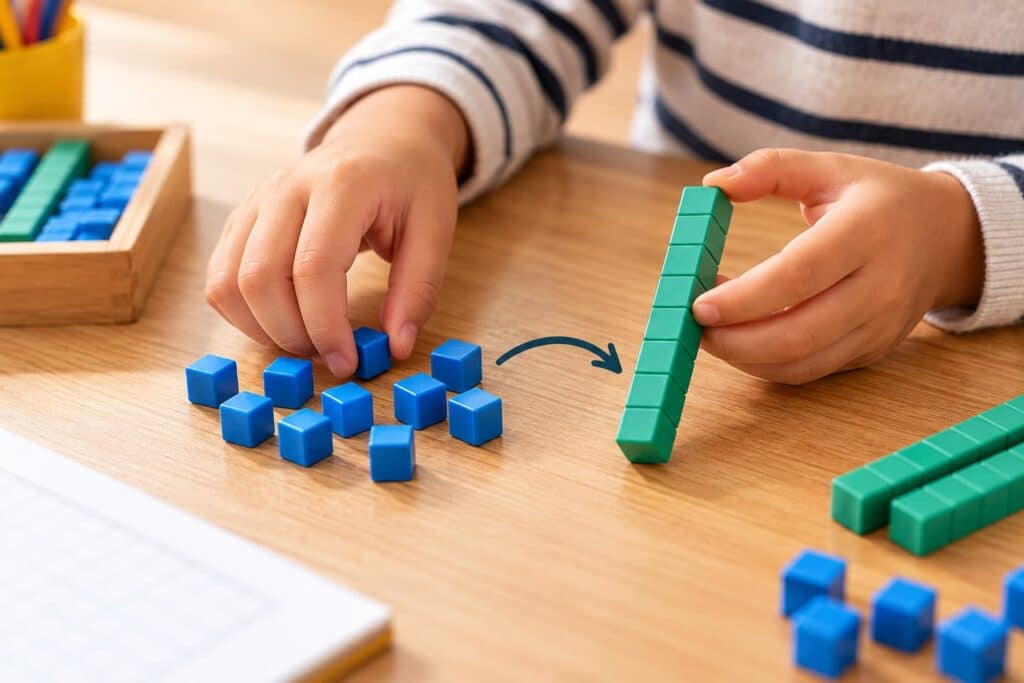
Help children understand regrouping through hands-on learning. Ten unit cubes can be exchanged for one ten-rod, making place value and addition easier to visualize.
Regrouping in addition: step-by-step
Regrouping in addition follows the same routine every time, no matter how large the numbers get. Here’s a step-by-step guide using 46 + 36 as an example.
- Line up the two-digit numbers so the ones sit above ones and the tens above tens.
- Add the ones column first: 6 + 6 = 12. The sum is 10 or more, so regroup.
- Write the 2 in the ones column and carry the 1 (one ten) to the top of the tens column.
- Add the tens column, including the carried digit: 4 + 3 + 1 = 8.
- Write 8 in the tens column. The final answer is 82.
Here’s why this matters. You carry because a single place-value column can’t hold a two-digit result. The 12 splits into “2 ones and 1 ten,” and each piece goes where it belongs. For larger numbers, repeat the same regrouping technique, moving left: ones to tens, tens to hundreds. The rule never changes.
Regrouping in subtraction: step-by-step
Regrouping in subtraction works in reverse. Instead of passing value up, you pull it down from a higher place. These solved examples use 52 – 27. The minuend is 52, and the subtrahend is 27; the top number is the minuend.
- Line up the numbers by place value, ones over ones and tens over tens.
- Look at the ones column: you need 2 – 7, but 2 is too small—time to regroup.
- Borrow one ten from the tens column. The 5 tens becomes 4 tens, and the borrowed ten adds ten to the ones column, turning 2 into 12.
- Subtract the ones now: 12 – 7 = 5. Write 5 in the ones column.
- Subtract the tens: 4 – 2 = 2. Write 2 in the tens column. The answer is 25.
Step 3 is a trade: one ten broken into ten ones, which is why the ones column jumps from 2 to 12. The number’s value never changes, only how it’s grouped. Practicing addition and subtraction side by side with this regrouping technique helps students see borrowing as the mirror image of carrying.

See how regrouping makes subtraction easier. Borrowing one ten creates ten ones, helping students solve subtraction problems accurately when the top digit is smaller than the bottom digit.
Common mistakes and why students struggle with regrouping
Common regrouping mistakes almost always trace back to one root cause: a weak grasp of place value, not carelessness. When a student writes 312 for 27 + 15, they added the columns but forgot that ten ones become one ten. So they parked the full sum in the wrong spot.
A few patterns show up again and again:
- Forgetting to add the carried digit into the tens column after writing the ones.
- Subtracting the smaller digit from the larger regardless of which is on top (writing 2 – 7 as 5 instead of borrowing).
- Borrowing but forgetting to reduce the higher column by one.
- Losing track of place value and treating each column as its own separate problem.
Picture a third grader who breezes through 52 – 27 on Monday but writes 35 on Friday because she subtracted 2 from 7 in the ones column instead of borrowing. Nothing about her effort changed. She never locked in that the top number sets the rule, and that single gap quietly follows her into three-digit subtraction and decimals.
These aren’t random slip-ups. Each common regrouping mistake is a specific gap in understanding groups of tens and how they move. That’s why drilling more problems rarely fixes it on its own. The learning gaps sit underneath the procedure, which is exactly where middle school math tutoring that closes learning gaps proves valuable if these errors carry forward. Going back to base-ten blocks and asking “what does this digit really mean?” resolves far more of these errors than repetition ever will.
How to help your child practice and build confidence with regrouping
Building confidence in math starts with removing the pressure and rebuilding the foundation. Regrouping practice works best in short, focused sessions, not long marathon worksheets that turn frustration into avoidance.
Try these approaches at home:
- Start with base-ten blocks or bundled sticks, not paper, until the trade feels obvious.
- Ask your child to explain each step out loud. If they can say why they carried or borrowed, they understand it.
- Mix regrouping and non-regrouping problems so they learn to spot when a trade is actually needed.
- Keep sessions short and celebrate correct reasoning, not just correct answers.
Knowing how to teach regrouping means aiming for understanding, not just the answer. Working through examples this way builds the problem-solving skills a child carries into bigger operations. That’s the heart of building math confidence. When learning gaps persist despite regrouping practice at home, one-on-one instruction can pinpoint exactly where the confusion starts. Booking a math diagnostic assessment helps identify those gaps precisely. My Math Experts pairs students with the same tutor each week and builds a Personalized Success Plan after the first few sessions, so foundational skills like regrouping get rebuilt in the right order instead of papered over.
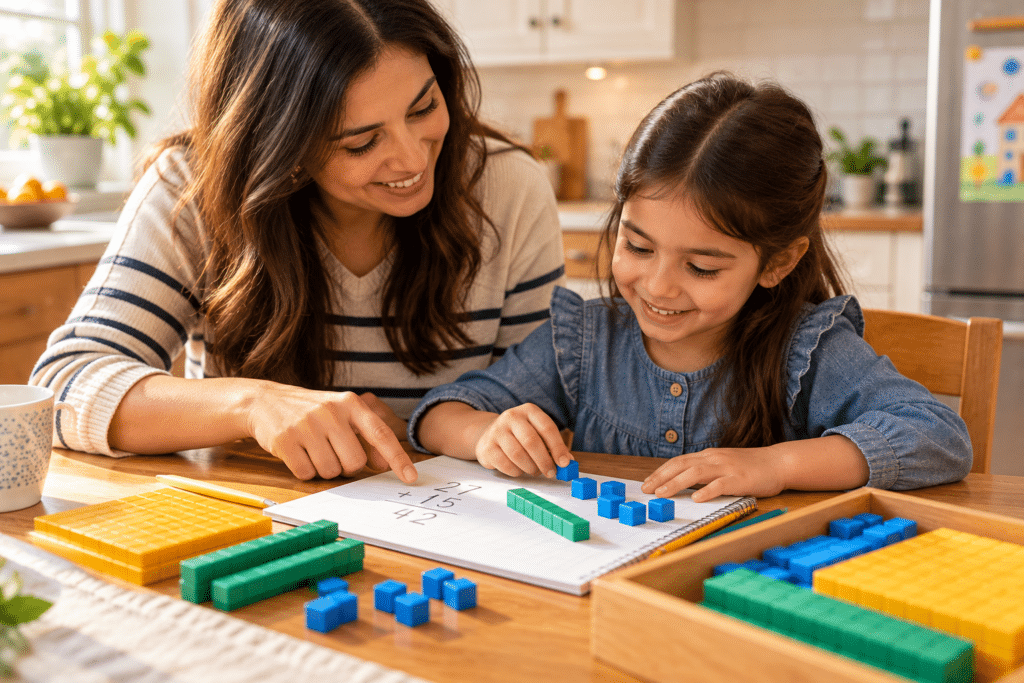
Make math learning a positive experience! Parents can help children understand regrouping through patient guidance, hands-on practice, and colorful base-ten blocks.
Now that you know what regrouping is in math and why place value makes it work, the next step is making sure it sticks. If your student keeps stumbling on regrouping or any foundational elementary math skill that later topics build on, structured one-on-one support with the same tutor each week can help build real understanding of the steps. My Math Experts pairs your child with the same tutor each week and focuses on the concepts behind the procedure, not just the answers. You can talk to an expert about your child’s math gaps to explore your options and see whether the program is a good fit. Results vary based on student participation, consistency, and academic needs.
Families interested in expert geometry tutoring can schedule a consultation with My Math Experts to discuss their child's goals, challenges, and learning needs. My Math Experts currently offers a 45-minute consultation for $15, 70% off the introductory rate, for those who wish to discuss the best tutoring method for their child, with flexible tutoring plans available to meet a variety of academic needs and goals.
Ready to Master Math with Confidence?
Don’t let challenges hold you back—our experts are here to guide you every step of the way. Book your personalized consultation today at My Math Experts and start turning confusion into clarity!
FAQs
Q1. What does regrouping mean in math?
Regrouping is the process of moving value between place-value columns: ones, tens, hundreds, and so on, so that multi-digit addition and subtraction work correctly. It’s called ‘carrying’ in addition and ‘borrowing’ in subtraction.
Q2. Can you show a simple example of regrouping?
For 46 + 36, add the ones first: 6 + 6 = 12, so you write 2 and carry 1 ten. Then add the tens plus that carried ten: 4 + 3 + 1 = 8, giving a final answer of 82.
Q3. What are the basic steps for regrouping in addition?
Add the digits in the ones column first, and if the sum is 10 or more, write the ones digit and carry the extra ten to the next column. Then add that carried value along with the other digits in the tens column, and repeat for larger place values.
Q4. How is regrouping different from borrowing?
Regrouping is the broader idea of rearranging value across place-value columns, while borrowing is specifically the subtraction version where you take value from a higher place. Carrying is the addition version, so borrowing and carrying are both types of regrouping.
Q5. When do you actually need to regroup in a problem?
In addition, you regroup whenever a column adds up to 10 or more, like 5 + 7 = 12 in the ones place. In subtraction, you regroup when the top digit is too small to subtract from, so you borrow from the column to the left.ggg
Q6. How is regrouping usually taught in 2nd grade?
Teachers often start with place value using base-ten blocks or bundles of sticks to show how 10 ones become 1 ten. They move from these concrete tools to pictures and finally to written numbers, so the step feels logical rather than memorized.
Q7. Is regrouping really necessary, or is it just extra steps?
Regrouping is necessary because our number system is based on place value, and you can’t fit a two-digit result into a single column. Without it, any addition or subtraction that crosses a place value would give the wrong answer.
Q8. What if my child keeps making regrouping mistakes?
Most regrouping errors come from a shaky grasp of place value, not from carelessness, so going back to what each digit represents usually fixes them. One-on-one support can pinpoint exactly where the confusion starts and rebuild that foundation step by step.

Mr. Kemper is the founder and director of My Math Experts. He has taught and tutored thousands of math students in grades 1 - college over the last 20 years, in the classroom and in private education. Algebra is a special passion and Kemper believes that a solid Algebra foundation opens many doors. He has also trained and supported hundreds of teachers and continues to create and innovate in the math education world.