The night before a math test, thousands of students flip frantically through a textbook. They reread worked examples they’ve already seen and hope the steps stick. They don’t. Rereading feels like studying. But when the test lands on the desk the next morning, the numbers change, and the method vanishes. Knowing how to study for a math test means practicing the actual skill you’ll be graded on, not just recognizing it on a page. This guide walks through what works, what wastes your time, and how to build a plan that leaves you calm instead of cramming.
Key Takeaways
- The most reliable way to study for a math test is active practice: solving problems from memory rather than rereading notes or examples.
- Spacing study across several short sessions helps you retain more math than one long cram session the night before.
- Interleaving different problem types in one session trains you to choose the right method on unfamiliar exam questions.
- A quick topic audit that flags your shaky areas lets you spend limited study time where it matters most.
- Most math test struggles trace back to missed foundational concepts, which structured, step-by-step practice can rebuild.

A focused student works through math problems in a notebook, using formulas and practice exercises to strengthen mathematical understanding.
Why studying for math is different from other subjects
History and biology reward you for remembering facts. Math doesn’t. You can memorize every formula in the chapter and still freeze when a problem asks you to apply it in a new way. Math is a performance skill, closer to playing an instrument than reciting dates. Reading a solution activates recognition. Solving a fresh problem forces recall plus application. Only that second process builds the ability you’re tested on.
This is also why math builds on itself. If fractions never clicked, algebra feels shaky, and later courses feel harder. Learning gaps follow you forward. That’s why understanding the material matters more than memorizing the procedure. Guidance from the U.S. Department of Education’s Institute of Education Sciences points to spaced, active practice as one of the most effective study habits for retaining and applying skills over time.
So when studying for a math test, you’re not memorizing answers. You’re rehearsing a process until you can run it without the instructions in front of you. That shift changes everything about how you prepare.
Why last-minute cramming doesn’t work for math
Cramming can get you through a vocabulary quiz. It falls apart on math exams. The reason is how memory forms. Information reviewed once, late at night, sits in short-term storage and fades within hours. Math requires you to hold multiple steps in working memory at once. A tired, overloaded brain simply can’t do that under test pressure.
Last-minute cramming also feeds math test anxiety. When you’ve only seen problems solved, not solved them yourself, the first hard question triggers panic. Panic wipes out the little you did absorb. The American Psychological Association’s guidance on test anxiety notes that preparation and practice under realistic conditions are among the strongest ways to reduce it. The National Center for Education Statistics publishes data on student test anxiety, showing how widespread the problem is.
Many students assume a marathon study session equals real preparation. In reality, six hours the night before is less effective than four twenty-minute sessions spread across a week. Consistency wins. When you practice daily, each concept gets reinforced before it fades. The material moves into long-term memory where you can actually reach it. That’s the difference between recognizing a problem and solving it.
Common reasons students lose points on math tests
Plenty of students understand math and still lose points on math tests. The mistakes are rarely about intelligence. They’re about habits.
The biggest one is skipping the instructions. Students who don’t follow directions solve for x when the question asked for y, or give a decimal when it wants a fraction. Reading carefully costs ten seconds and saves real points.
Other frequent point-losers:
- Arithmetic slips, like a dropped negative sign, that undo a perfectly correct method.
- Not showing work, so partial credit disappears when the final answer is wrong.
- Running out of time because early problems ate the clock.
- Memorizing the procedure without understanding why it works, so a reworded question stumps you.
Consider a student who aces every homework set but scores in the 70s on math exams. The pattern is almost always careless errors and misread directions, not missing knowledge. Sound test-taking strategies mean practicing accuracy, not just method. When you review for your test, check your work the way a grader would. The easy points stop slipping away.
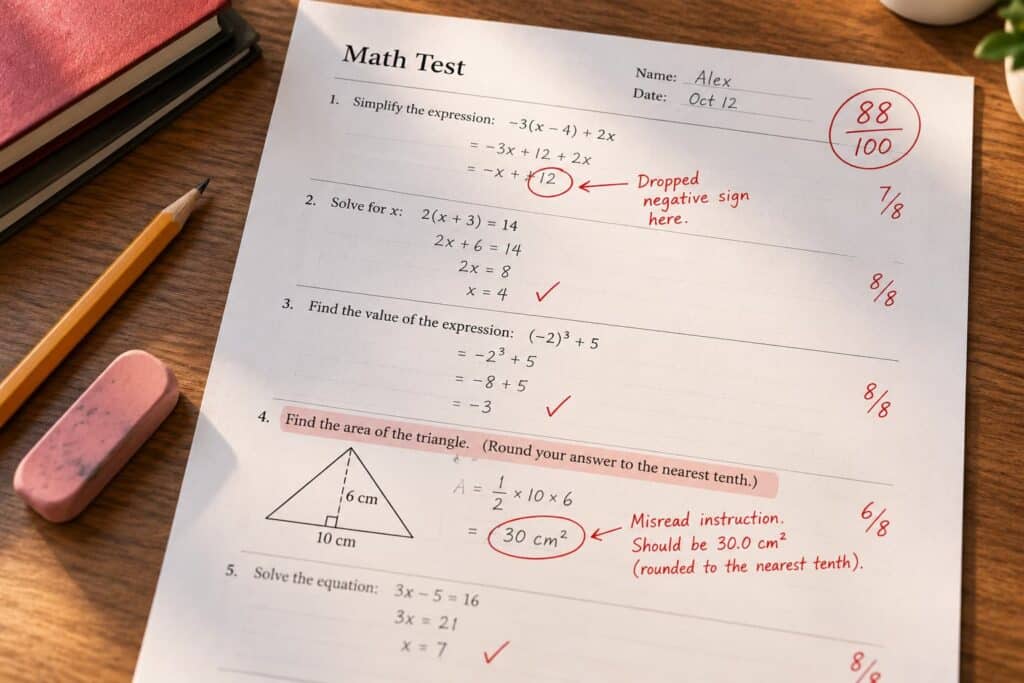
Small mistakes, such as dropping a negative sign or overlooking instructions, can affect math test scores. Reviewing corrections helps students improve accuracy and build confidence.
Practicing daily and starting early
The single habit that separates confident test-takers from stressed ones is simple. They start early. Not because early studiers are more disciplined by nature, but because spreading work out is how the brain locks in skills. When you practice daily, even for twenty minutes, each session strengthens what the last one built. This is the heart of studying for a math test.
Starting early also gives you time to find problems you can’t solve and still fix them. If you discover a weak spot the night before, you’re stuck. If you find it a week out, you can rework it, ask a teacher, or get help.
Here’s the practical version:
- Begin studying at least five to seven days before the math test, not the night before.
- Set a fixed 20- to 30-minute practice window each day and protect it.
- Rotate through every topic on the test across the week so nothing gets neglected.
- Track which problem types feel automatic and which still make you pause.
This kind of preparation feels slow at first. Then, a few days in, problems that used to take five minutes take one. That’s consistency doing its work. If daily practice is hard to organize on your own, structured homework support plans can give the routine a framework and keep it consistent. It’s how you build confidence before you ever sit down for the exam.
Working practice problems the right way (not just rereading)
Most students think they’re studying when they reread worked examples and nod along. That’s the trap. Recognition is not the same as ability. The fix is to close the book and solve.
The right way to use practice problems is simple. Cover the solution completely, work the problem on your own paper, and only check the answer after you’ve committed to one. If you got it wrong, don’t just glance at the correct steps. Redo the problem from scratch until you can do it cleanly without prompts. This is why you should redo your homework without the answers visible, since those are problems you’ve already been assigned and graded on.
The reason this matters is retrieval. Pulling a method out of your own memory is the exact skill the test demands. Every time you do it, the pathway gets stronger. Rereading skips that entirely.
Where do you find enough practice problems? Reread your textbook for the chapter review sets, use the odd-numbered problems with answers in the back, and pull from old quizzes. If you need more material beyond your textbook, math worksheets cover a range of topics. Studying for a math test this way turns passive review into real preparation. It also exposes learning gaps while you still have time to close them.
Spending time on hard problems and identifying weak areas
You naturally gravitate toward practicing what you’re already good at. It feels productive. It isn’t. Redoing problems you can already solve builds confidence but not competence. The points you’re losing live in the hard problems you keep avoiding.
Start by identifying weak areas honestly. Work through a mixed set and mark every problem where you hesitated, guessed, or got stuck. Those marks show you where to focus. Spend the bulk of your remaining time there, not on the comfortable material. If you’re not sure where your gaps really are, start with a student assessment that pinpoints your weak spots.
Hard problems deserve extra minutes for a reason. They usually combine two or three concepts, and the difficulty often comes from a missing foundational piece, not the problem itself. If a system of equations trips you up, the real gap might be in solving single equations. Trace it backward.
A useful rule for studying for a math test: if you can’t solve a hard problem after two honest attempts, that’s the exact topic to reread in your textbook or ask someone to explain. Understanding the material at its root, rather than working around the confusion, is what turns a weak area into a reliable one. It also quietly kills math test anxiety.

Challenging math problems take patience, practice, and persistence. Working through mistakes helps students strengthen their problem-solving skills and build confidence.
Creating a summary sheet and formula reference
Writing a summary sheet is one of the most underrated moves in test preparation, and the value isn’t the sheet itself. It’s the act of making it. When you condense a whole chapter onto one page, you’re forced to decide what actually matters. That filtering is deep studying in disguise.
Build your summary sheet by hand, not by copying the textbook. For each topic, write the core concept in your own words, the key steps, and one example. Keep it tight, since a page crammed edge to edge helps no one.
Alongside it, make a formula sheet. List every formula you’ll need, but don’t stop at the formula. Note when to use it and what each variable means. Knowing the quadratic formula is useless if you can’t tell when a problem calls for it.
The night before the math test, your summary sheet and formula sheet become your only review tools. If you built them well, one focused pass reminds you of everything without dragging you back into the full textbook. Some teachers even allow a formula sheet during the exam, which makes building a clear one twice as worthwhile.
Using flashcards for formulas and definitions
Some parts of math really do need memorization: formulas, definitions, unit conversions, common values. Flash cards handle these better than any other method because they force active recall. They also let you review in short, repeatable bursts.
Put one item per card. On the front, write the prompt, such as “area of a circle” or “derivative of sin(x).” On the back, write the answer. The trick is to test yourself in both directions. Seeing the name and recalling the formula is one skill. Seeing the formula and recalling what it’s for is another, and the test may ask for either.
Flash cards also fit into gaps other study methods can’t. Five minutes before class, waiting for a ride, between other subjects: those small windows add up. They help you build study habits that let you practice daily without a long block.
Keep a “missed” pile. Any card you get wrong goes back into rotation more often, so your time concentrates on what you don’t know yet. This works alongside practice problems, not replacing them. Flash cards lock in the pieces you need to recall instantly, while practice problems teach you how to use those pieces under real conditions.
Building a step-by-step math test study plan
All the tactics above only work if they fit together. A math test study plan turns scattered effort into steady progress, and it removes the guesswork that leads to last-minute cramming. Here’s a plan for preparing for tests and exams that you can adapt to almost any subject:
- Five to seven days out, list every topic that could appear and mark your weak areas.
- Build your summary sheet and formula sheet early, so you review them all week.
- Each day, work fresh practice problems for two or three topics, mixing them rather than blocking one at a time.
- Redo your homework and old quiz problems without looking at the solutions.
- Spend extra time on hard problems and anything you marked as shaky.
- Use flash cards daily for formulas and definitions in short bursts.
- The day before, do one full mixed practice set under timed conditions, then a calm pass through your summary sheet.
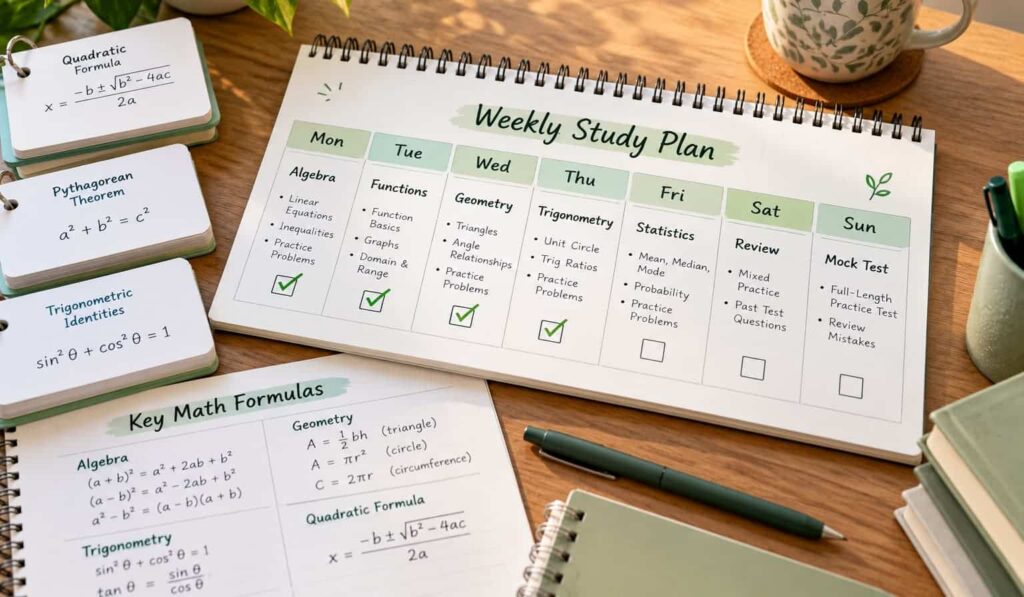
A well-planned study schedule helps students stay organized, practice math consistently, and build confidence one topic at a time.
When one-on-one tutoring or extra support can help
Self-study works well when the foundation is solid. But if you keep hitting the same wall, redoing a topic and still not getting it, that’s usually a sign of a deeper learning gap, not a lack of effort. Missed concepts from earlier grades don’t fix themselves. No amount of rereading closes a gap you can’t see clearly on your own.
This is where one-on-one support changes things. A tutor can watch you solve a problem, spot exactly where your reasoning breaks, and rebuild the missing piece with step-by-step instruction. That kind of targeted feedback is hard to get in a busy classroom that moves at its own pace. For older students especially, one-on-one high school math tutoring can address the specific gaps that make advanced courses feel overwhelming. My Math Experts pairs students 1:1 with the same tutor each week, so the tutor learns how you think and can build a plan around your specific weak areas rather than generic review. Tutoring supports your schoolwork rather than replacing your classroom instruction.
The goal of good math tutoring isn’t just a better grade on one test. It’s understanding the material well enough that the next unit doesn’t feel like starting over. Consistent help builds both problem-solving skills and the quiet confidence that makes math exams far less stressful.
Families interested in expert geometry tutoring can schedule a consultation with My Math Experts to discuss their child's goals, challenges, and learning needs. My Math Experts currently offers a 45-minute consultation for $15, 70% off the introductory rate, for those who wish to discuss the best tutoring method for their child, with flexible tutoring plans available to meet a variety of academic needs and goals.
Ready to Master Math with Confidence?
Don’t let challenges hold you back – our experts are here to guide you every step of the way. Book your personalized consultation today at My Math Experts and start turning confusion into clarity!
FAQs
Q1. What's the single most effective way to study for a math test?
Solve practice problems from scratch without looking at your notes, since actively retrieving the steps builds far stronger memory than rereading worked examples. Learning science calls this the ‘testing effect,’ and it consistently produces better long-term retention than restudying the same material.
Q2. Why do practice problems work better than just rereading my notes?
Practice problems build recall; rereading only builds recognition. That retrieval effort is what strengthens memory and shows you exactly where you’re stuck before test day.
Q3. Is making a study schedule really worth the effort for one math test?
Yes, because spacing study across several short sessions leads to more retention than one long cram session, according to research on spaced practice. A schedule also lets you interleave different problem types, which trains you to pick the right method on unfamiliar exam questions.
Q4. Should I mix different topics in one study session or focus on one at a time?
Mixing topics, called interleaved practice, helps you learn to recognize which strategy a problem needs, which more closely matches real test conditions. Studying one topic in isolation can feel easier but often leaves you unsure of which method to use when questions are jumbled.
Q5. Can I realistically get a perfect score on a math test?
You can achieve a higher score with active recall, spaced review, and targeted practice on weak spots. Rework every missed practice problem until you can solve it cleanly, closing the small gaps that usually cost those final points.

Mr. Kemper is the founder and director of My Math Experts. He has taught and tutored thousands of math students in grades 1 - college over the last 20 years, in the classroom and in private education. Algebra is a special passion and Kemper believes that a solid Algebra foundation opens many doors. He has also trained and supported hundreds of teachers and continues to create and innovate in the math education world.