A student stares at √72 on a test, punches it into a calculator, and writes 8.485. Marked wrong. The teacher wanted 6√2, the exact simplified form, and the decimal earned zero credit. That gap trips up thousands of algebra students every year. It is completely avoidable once you understand how to simplify square roots the right way. This guide breaks down the product rule, prime factorization, variables under the radical, fractions, and the mistakes that cost easy points. None of it requires a special talent for numbers. It requires a clear method and enough practice to make that method second nature.
Key Takeaways
- Simplifying square roots means finding the largest perfect-square factor of the radicand and moving its root outside using the product rule √(a×b) = √a × √b.
- A square root is fully simplified only when the number left under the radical has no perfect square factors other than 1.
- Prime factorization offers a reliable backup: pair up identical prime factors and move one of each pair outside, as with 180 = 2²×3²×5 becoming 6√5.
- For square roots with variables, halve any even exponent to bring the variable outside, and split odd exponents into an even part plus one leftover factor.
- Non-perfect squares like √5 and √7 are irrational and can’t be reduced further, so leaving them in radical form is the correct final answer.

A clear approach to square roots can make math feel easier. Learn how to simplify √72 into 6√2 by identifying perfect square factors and breaking down each step.
What it means to simplify a square root
Simplifying a square root means rewriting it in its cleanest form without changing its value. The square root of 4 is exactly 2 because 2 × 2 = 4. But most numbers are not perfect squares. Take √72. Its true value is an endless decimal, but you can still tidy it up by pulling out the part that has a neat root. If you want to see the formal definition of a square root stated precisely, it helps ground the intuition behind these steps.
The number sitting under the radical sign is called the radicand. Simplifying means breaking that radicand into a perfect square times something else. Then you move the root of the perfect square outside. In other words, you separate the “clean” part from the “leftover” part.
A square root is in simplest form when the radicand has no perfect square factors other than 1. This matters because a decimal approximation loses the exact value, while the simplified radical keeps it intact and shows the number’s structure.
The product rule for square roots (√ab = √a × √b)
Everything about simplifying square roots rests on one rule: the product rule. It says √(a×b) = √a × √b. In plain terms, the square root of a product equals the product of the square roots. That single fact lets you split a messy radicand into two friendlier pieces.
Here is why it matters. If one piece is a perfect square, its root becomes a whole number and comes out of the radical sign. The other piece stays inside. So √72 splits into √36 × √2, and since √36 = 6, you get 6√2. Recognizing perfect squares on sight is what makes this split fast, so it’s worth memorizing the first dozen or so.
Many students assume this rule works for addition too, that √(a+b) = √a + √b. In reality, it does not, and that mistake wrecks answers constantly. The reason is that squaring a sum produces cross terms (a+b)² = a² + 2ab + b², so the root of a sum can’t break apart the way a product can. The product rule applies only to multiplication and its cousin, division. For a formal statement of these radical properties, Purdue University’s Online Writing and Math resources on radicals lay out the exponent-and-root relationships.
Step-by-step method using perfect square factors
The most direct way to simplify square roots is to hunt for perfect square factors. Here are the step-by-step instructions, using √48 as the running example.
- Write down the radicand and list its factors, looking specifically for perfect squares (4, 9, 16, 25, 36, and so on).
- Pick the largest perfect square that divides evenly into the radicand. For 48, that’s 16, since 48 = 16 × 3.
- Rewrite the square root as a product using that factor: √48 = √(16 × 3).
- Apply the product rule to split it: √48 = √16 × √3.
- Take the square root of the perfect square, turning it into a whole number: √16 = 4.
- Write the whole number outside the radical and leave the leftover factor inside: 4√3.
- Check that the number still under the radical has no perfect square factors left. If it does, repeat the process.
Choosing the largest perfect square factor first saves you from repeating steps, because a smaller factor leaves a bigger radicand that may still hide another perfect square. Picture a student who grabs the first factor they spot instead of the largest one: they simplify √48 to 2√12, think they’re finished, and lose marks because 12 still contains a 4. Working from the largest factor sidesteps that trap.
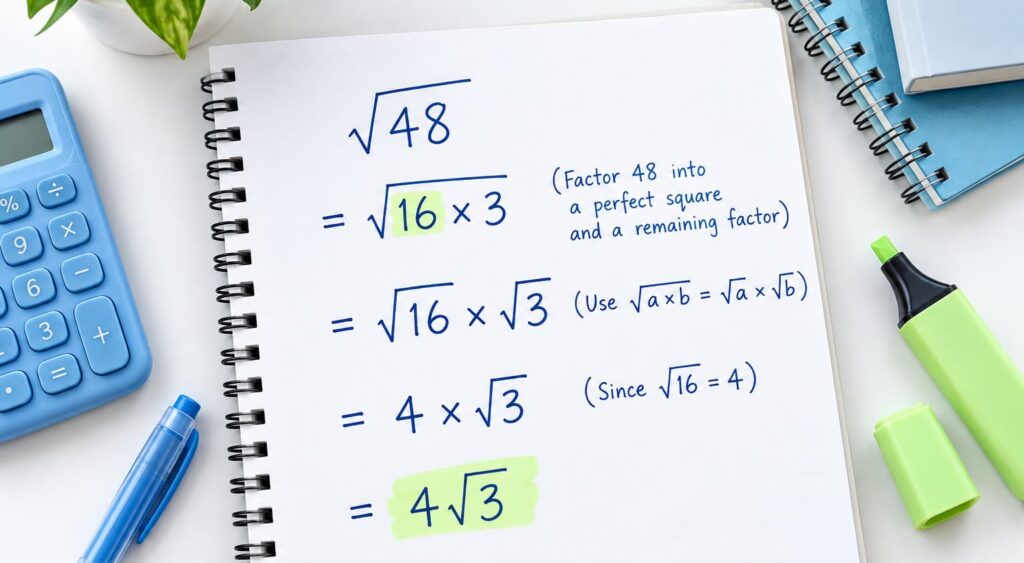
Simplifying square roots becomes easier when you identify perfect square factors. See how √48 transforms into 4√3 with a clear, step-by-step approach to understanding radicals.
Worked examples (√12, √45, √8, √18)
Let’s run four quick ones so the pattern sticks.
To simplify √12, find its largest perfect square factor. Since 12 = 4 × 3, you get √12 = √4 × √3 = 2√3. The 3 has no factors left, so 2√3 is in simplest form.
To simplify √45, notice 45 = 9 × 5. That gives √45 = √9 × √5 = 3√5. Done.
To simplify √8, use 8 = 4 × 2, so √8 = √4 × √2 = 2√2.
To simplify √18, spot that 18 = 9 × 2, giving √18 = √9 × √2 = 3√2.
See the rhythm? Pull out the perfect square, take its root, park the leftover under the radical sign. Notice that √8 and √18 both simplify to a multiple of √2. That becomes useful when you start adding square roots later. These practice examples cover the factor sizes you’ll meet most often in algebra.
Simplifying square roots with variables
Square roots that contain variables follow the same logic, with one twist: exponents. Because √(x²) = x, any variable raised to an even power comes out cleanly when you halve the exponent. So √(x⁶) = x³, and √(y⁴) = y². The halving works because taking a square root is the inverse of squaring, and squaring doubles an exponent, so the root cuts it in half.
When the exponent is odd, split it into an even part plus one leftover factor. Take √(x⁵). Rewrite it as √(x⁴ · x), pull out x² from the even part, and leave a single x inside: x²√x.
With one variable, it’s straightforward. With multiple variables, handle each separately, then combine. For √(a⁴b³), the a⁴ gives a², and b³ splits into b²·b, giving b√b. Put it together: a²b√b.
Most errors here come from forgetting to split odd exponents, so students write √(x⁵) = x². Always account for the leftover factor. Handling square roots with variables cleanly is a big part of succeeding in Algebra 2, and our Algebra 2 help and tutoring walks students through these patterns.
Adding and subtracting square roots (why the rule doesn’t apply)
Here is where the product rule stops helping. Adding square roots is nothing like multiplying them. You cannot merge √2 + √3 into √5. The product rule covers multiplication, not addition or subtraction, and pretending otherwise is one of the most common mistakes on the topic.
So how does adding square roots actually work? You treat them like terms in algebra. Only “like radicals,” radicals with the same radicand, can be combined. Think of √2 as a unit, like x. Then 3√2 + 5√2 = 8√2, exactly as 3x + 5x = 8x.
Subtracting square roots works the same way: 7√5 − 2√5 = 5√5. But 4√3 − 2√7 stays as it is, because the radicands differ.
The trick: simplify first. √8 + √18 looks similar, but √8 = 2√2 and √18 = 3√2, so their sum is 5√2. Simplifying reveals hidden like radicals.

Not all square roots can be combined! When radicals have the same radicand, like \(3\sqrt{2} + 5\sqrt{2} = 8\sqrt{2}\), you can add their coefficients. But unlike radicals, such as \(\sqrt{2} + \sqrt{3}\), cannot be combined into a single radical term. Understanding this rule makes simplifying radicals easier.
Simplifying square roots in fractions
Square roots in fractions add one more habit: you generally don’t leave a radical in the denominator. The product rule has a division partner, the quotient rule, which says √(a/b) = √a / √b. That lets you simplify the top and bottom separately.
Take √(9/16). Split it into √9 / √16 = 3/4, a clean fraction with no radical at all.
But what about √(3)/√(2)? A radical is stuck in the denominator. To fix it, multiply the top and bottom by √2. That gives (√3 × √2)/(√2 × √2) = √6/2. This move is called rationalizing the denominator, and it’s the standard way to present square roots in fractions in simplest form.
Here is why we bother: multiplying √2 by itself clears the radical because √2 × √2 = 2, turning an awkward irrational denominator into a whole number that’s easier to read, compare, and use in further calculations. When variables show up, the same rules apply. Simplify each part, then rationalize if a radical still sits underneath.
Practice problems with solutions
Try these on your own before checking the answers. Working through practice examples makes the steps automatic.
- Simplify √50. Solution: 50 = 25 × 2, so √50 = 5√2.
- Simplify √200. Solution: 200 = 100 × 2, so √200 = 10√2.
- Simplify √(x⁷). Solution: split into √(x⁶ · x) = x³√x.
- Simplify 2√12 + √27. Solution: √12 = 2√3 and √27 = 3√3, so 2(2√3) + 3√3 = 4√3 + 3√3 = 7√3.
- Simplify √(25/49). Solution: √25 / √49 = 5/7.
- Simplify √(48a⁴). Solution: √48 = 4√3 and √(a⁴) = a², so 4a²√3.
If problem 4 gave you trouble, revisit adding square roots: to simplify √12, you had to reduce it first before the like radicals appeared. This step-by-step instruction is exactly what tutoring sessions reinforce until it feels natural. If you’re unsure where your student’s gaps are, contact us for a student assessment to pinpoint which of these skills need the most attention.
Common mistakes students make when simplifying square roots
A handful of errors show up over and over. Knowing them ahead of time is half the battle.
First, splitting sums: writing √(9 + 16) = 3 + 4 = 7. Wrong. You add inside first: √25 = 5. The product rule never applies to addition.
Second, stopping too early. A student simplifies √72 to 2√18 and calls it done, but 18 = 9 × 2 still hides a perfect square. Always check the remaining radicand for more perfect-square factors.
Third, dropping the leftover when it has an odd exponent, turning √(x⁵) into x² instead of x²√x.
Fourth, mishandling radicals with negative numbers by treating them like normal numbers. √(−9) is not −3. Negative numbers under a square root move into imaginary numbers, a separate topic entirely.
Fifth, trusting the calculator’s decimal when the class wants exact radical form. A decimal like 8.485 isn’t the answer 6√2 the problem expects. Catching these habits early is one of the things our high school math tutoring services focus on before they harden into recurring errors.

Avoid common square root mistakes by understanding the rules behind radicals. From simplifying √(9 + 16) to recognizing why √(a + b) cannot be separated into √a + √b, learning the correct approach can build stronger algebra skills and improve mathematical accuracy.
Learning how to simplify square roots is a skill that clicks with consistent, guided practice. It’s much easier when someone can catch a small habit before it becomes a stubborn error. My Math Experts offers 1:1 online tutoring with the same tutor every week, so students build real number sense instead of guessing.
Families interested in expert geometry tutoring can schedule a consultation with My Math Experts to discuss their child's goals, challenges, and learning needs. My Math Experts currently offers a 45-minute consultation for $15, 70% off the introductory rate, for those who wish to discuss the best tutoring method for their child, with flexible tutoring plans available to meet a variety of academic needs and goals.
Ready to Master Math with Confidence?
Don’t let challenges hold you back – our experts are here to guide you every step of the way. Book your personalized consultation today at My Math Experts and start turning confusion into clarity!
FAQs
Q1. What are the steps to simplify a square root by hand?
Identify the radicand (the number under the √), find its largest perfect square factor, then use the product rule √(a×b) = √a × √b to pull that factor out. For example, √72 = √(36×2) = 6√2 because 36 is the largest perfect square dividing 72.
Q2. How do you simplify √72?
Since 72 = 36 × 2 and 36 is a perfect square, √72 = √36 × √2 = 6√2. The 6 comes out of the radical, and 2 stays inside because it has no perfect square factors left.
Q3. How do you simplify 3√20?
First simplify √20: since 20 = 4 × 5, √20 = 2√5. Then multiply by the 3 already outside: 3 × 2√5 = 6√5.
Q4. How does prime factorization help when the perfect square isn't obvious?
Break the radicand into primes and pair up identical factors; since √(p²) = p, let each pair move outside the radical. For example, 180 = 2² × 3² × 5, so the pairs of 2s and 3s come out as 2 × 3, giving 6√5.
Q5. Why can't some square roots be simplified?
A square root is in simplest form when its radicand has no perfect-square factors other than 1, which is why numbers like √5, √7, and √13 can’t be reduced. These are irrational numbers with no simpler integer or fraction form.
Q6. How do you simplify square roots that have variables and exponents?
Pull out any variable raised to an even exponent, since √(x⁶) = x³ (half the exponent comes outside). For odd exponents, split off one factor to make the rest even: for example, √(x⁵) = √(x⁴ · x) = x²√x.
Q7. Is it really worth learning to simplify by hand when a calculator can do it?
Calculators return decimals like 8.485 for √72, but math classes and school exams expect exact simplified radical form like 6√2. Understanding the process also builds the factoring and number-sense skills you’ll rely on in Algebra 2 and beyond.
Q8. What if I pick a smaller perfect square factor instead of the largest one?
You’ll still reach the correct answer, but it may take extra steps. For √72, using 4 instead of 36 gives √(4×18) = 2√18, which still isn’t simplified because 18 = 9×2, so you’d repeat the process to finish at 6√2.

Mr. Kemper is the founder and director of My Math Experts. He has taught and tutored thousands of math students in grades 1 - college over the last 20 years, in the classroom and in private education. Algebra is a special passion and Kemper believes that a solid Algebra foundation opens many doors. He has also trained and supported hundreds of teachers and continues to create and innovate in the math education world.