A student who aced algebra and breezed through precalculus can hit a wall the moment derivatives show up. It happens more than parents expect, and it rarely means the student got worse at math. Knowing when to hire a calculus tutor usually comes down to reading the warning signs early. Catch them before a few shaky concepts turn into a semester-long slide. This article walks through ten clear signals that extra help is worth it, plus what effective calculus tutoring actually looks like.
Key Takeaways
- Knowing when to hire a calculus tutor comes down to spotting patterns like declining grades, spending too much time on homework, and avoiding the subject.
- Because calculus builds on itself, early support helps prevent small misunderstandings from becoming larger learning gaps.
- One-on-one online calculus tutoring goes beyond grades, helping students reduce anxiety and build lasting confidence in problem-solving.

A focused study session can make even challenging calculus concepts feel manageable. With the right guidance, students can build understanding, confidence, and stronger problem-solving skills.
Introduction: why calculus trips students up and why timing matters
Calculus is different from the math that came before it. Algebra and geometry reward pattern recognition and steady practice. Calculus asks students to think about change, motion, and how functions behave as they approach a value. That is a real shift in reasoning. It is why a student with solid grades can suddenly feel lost.
Math builds on itself, so when one concept doesn’t click, the next one feels even harder. A wobbly grasp of limits and derivatives makes integrals confusing. Confusion in early units quietly turns into learning gaps that surface on every later test. The good news is these gaps are fixable, but timing matters. The longer a misunderstanding sits, the more material stacks on top of it. If you’re not sure where the gaps are, it can help to start with a free math assessment before the next unit piles on.
Catching trouble in a calculus class early protects more than one grade. It protects the courses, confidence, and options that follow.
Sign 1: Grades are slipping, or GPA is dropping in calculus
The first and most obvious signal is the gradebook. A student who held a B+ through the first unit and is now scraping by with a C-minus is telling you something. One bad quiz isn’t a crisis. A downward trend across several assignments and test scores is.
What actually happens is that calculus grades drop in steps, not gradually. A student understands the first chapter, gets shaky on the second, and by the third the cumulative subject pulls everything down at once. By the time a parent notices the GPA slide, the student has been confused for weeks. Broad assessments like The Nation’s Report Card show that math performance often dips precisely when concepts stack on top of one another.
Pay attention to the gap between effort and results. A student who studies and still earns lower test scores has a comprehension problem, not a motivation problem. A dropping calculus grade matters beyond the semester. This is one of the clearest moments to consider help. A calculus tutor can find where the slide started and rebuild from there. That usually does more for the GPA than another night of solo studying.
Sign 2: Persistent struggle with foundational concepts (limits, derivatives, integrals)
Some students keep their grade afloat while quietly not understanding the core ideas. They memorize steps, mimic the teacher’s examples, and survive routine problems. But the moment a question is phrased differently, they freeze. That’s a foundational problem, and it’s one of the strongest reasons to look into calculus tutoring.
Limits and derivatives are the backbone of the entire course. If a student can compute a derivative but can’t explain what it represents, they’re standing on sand. Integrals build directly on that understanding, so a gap in the early units guarantees trouble later. The root cause is usually that the concept was never broken down in a way that truly clicked, so the student defaulted to memorization.
Many parents assume their child just needs more practice problems. In reality, repeating the same misunderstood method only reinforces the error. The National Council of Teachers of Mathematics has long emphasized conceptual understanding over rote repetition for exactly this reason. What helps is step-by-step instruction that targets the concept itself, with one-on-one support that catches the exact point where reasoning breaks down. One of the key qualities to look for in a tutor is the patience to make sure the student understands why an answer works. That is what builds long-term understanding instead of fragile recall.

Big concepts become easier when you have the right guidance. Working through limits and derivatives together helps students build understanding, confidence, and stronger problem-solving skills.
Sign 3: Increasing math anxiety, frustration, or loss of confidence
When a student starts saying “I’m just bad at math,” the problem has moved past the content. Math anxiety is real, and it gets in the way of learning, just as nerves can derail a free throw. A capable student who freezes on tests, dreads opening the textbook, or gives up in frustration is dealing with a confidence problem layered on top of a comprehension one.
Most math frustration comes from a stretch of not understanding something, then feeling like everyone else gets it. That feeling compounds. The reason this matters is that anxiety narrows working memory.
One-on-one support changes the dynamic. In a private session, there’s no class to fall behind in or to hide confusion. A patient calculus tutor can slow down, normalize the struggle, and rebuild confidence one concept at a time. Confidence isn’t a soft add-on here. It’s often the thing that unlocks the actual learning, because it keeps a student trying long enough to get there.
Sign 4: Spending excessive time on homework with little progress
There’s a difference between a tough homework set and a student spending three hours on six problems and still getting most of them wrong. When homework time balloons and the results don’t improve, the issue isn’t laziness. The student is grinding against a gap they can’t close on their own.
This pattern is exhausting for everyone. It eats into sleep, crowds out other subjects, and turns evenings into a standoff between a frustrated student and an equally frustrated parent. Homework stress is one of the most common reasons families seek help, and it’s a legitimate concern.
The fix isn’t more hours. It’s better-aimed ones. Targeted homework support helps a student work through assignments while actually learning the underlying method, so the next set takes less time, not more. My Math Experts builds homework help into structured homework support plans rather than treating each assignment as a one-off. Students get unstuck on tonight’s problems and strengthen the skills that caused the slowdown. When homework stops being a nightly battle, study habits improve, and the whole household breathes easier.
Sign 5: Upcoming finals or major classroom assessments
A high-stakes exam on the calendar changes whether to get help. Comprehensive classroom exams and cumulative finals test everything at once. These assessments often expose learning gaps that have quietly developed throughout the semester. That exposes any gap a student has been quietly carrying all semester. Cramming the week before rarely fixes a concept that was never understood.
The challenge with cumulative calculus assessments is their breadth. The exam covers limits and derivatives, integrals, and application problems that combine several ideas in one question. A student can be comfortable with individual topics and still struggle to connect them under time pressure. That’s exactly the kind of thing targeted preparation addresses.
A calculus tutor working ahead of a big exam does two things at once. They shore up weak spots and build test-taking stamina through full-length, exam-style problems that sharpen problem-solving skills. Starting a few weeks out, not a few days out, gives enough runway to fix real issues instead of papering over them. For students preparing for important classroom assessments or the transition into college-level math, this structured learning builds stronger understanding and more consistent performance than last-minute cramming.

Preparation turns exam-day pressure into confidence. With organized review materials, practice exams, and a focused study plan, every study session brings students one step closer to success.
Sign 6: Falling behind the pace of a fast-moving calculus class
Calculus classes move fast, and they don’t wait. A teacher with thirty students and a fixed syllabus has to keep moving, even when a handful of students are still processing the last topic. A student who needs an extra day on derivatives doesn’t get one. The class rolls into integrals while they’re still catching up.
This is a structural problem, not a personal failing. A large classroom moves at the pace of the curriculum, not at the pace of the individual student. When a student misses the moment when something is supposed to click, every subsequent lesson assumes a foundation they don’t yet have. The gap widens week over week.
Personalized learning solves what the classroom can’t. A tutor adjusts the pace to the student instead of the calendar, spending extra time exactly where it’s needed and moving quickly through what’s already solid. This kind of personalized learning also means a student can stop and ask the question they’d never raise in front of a full class. For students who learn well but just need more time with certain concepts, consistent calculus tutoring helps close the gap between the class’s pace and their own.
Sign 7: Avoiding asking questions or hiding confusion from teachers
Plenty of students would rather stay confused than raise their hand. They don’t want to look like the only one who doesn’t get it, so they nod along, copy notes they don’t understand, and hope it sorts itself out. It doesn’t. Hidden confusion is one of the sneakiest signs that a student needs extra help, because grades may not drop until much later.
Watch for the tells: a student who can’t explain what they did on a problem, who says class “makes sense” but can’t do the homework, or who goes quiet whenever math comes up. The reason this matters is that calculus punishes hidden gaps harder than most subjects, since each unit assumes mastery of the one before it.
A private setting removes the social risk entirely. With a calculus tutor, there’s no audience and no embarrassment, so questions actually get asked. Many students who never speak up in a calculus class will talk freely in a one-on-one session once they realize the tutor’s whole job is to answer those questions without judgment. That openness is often where real progress starts.
Sign 8: Preparing for advanced or college-level coursework
Some students aren’t struggling at all. They’re getting ahead. A motivated student moving from precalculus toward AP Calculus or heading into college-level calculus benefits from support that emphasizes depth over rescue. The goal here isn’t fixing a problem. It’s building a foundation strong enough to hold up under harder material.
College-level calculus expects a different level of independence. Lectures move quickly, office hours are limited, and the jump from high school pacing catches many strong students off guard. Consider a strong precalculus student who lands in a college calculus lecture of 200 students: the professor covers in one session what high school spread over a week, and within a month, the student who never needed help is suddenly behind. Students preparing for that transition do well to strengthen their conceptual understanding while the stakes are still lower. Then they arrive ready instead of scrambling.
This is where concept-first calculus tutoring earns its keep. Working with state-certified teachers and experienced math educators who know the subject deeply, an advanced student can move beyond surface-level mechanics to the reasoning behind the math. That is the kind of academic growth that holds up in tougher courses. For ambitious students, tutoring isn’t remedial. It’s a way to turn a good foundation into a great one and to walk into demanding coursework with genuine problem-solving skills already in place.
Sign 9: Self-study or online learning isn’t working alone
A disciplined learner with a strong foundation in algebra and precalculus can work through videos and a textbook and do just fine. But if a student has been putting in honest effort with self-study tools and still isn’t improving, that’s a clear signal it’s time to bring in a person. If you’re weighing the decision, it’s worth thinking through whether hiring a math tutor is worth it for your situation.
The limit of learning alone is that you can’t catch a mistake you don’t know you’re making. A student can watch a worked example, feel like they understand it, and then apply a flawed version of the method without ever realizing where it went wrong. Videos can’t ask follow-up questions or notice the exact moment confusion sets in.
This is the core advantage of one-on-one support over a screen full of generic lessons. An online calculus tutor watches the student work in real time, spots the misconception immediately, and corrects it before it becomes a habit. While many families first consider local tutoring options, online calculus tutoring provides access to state-certified teachers and experienced math educators regardless of location. The live interaction is what self-study lacks, and for many students it’s the missing piece.
Sign 10: You want consistent, structured support rather than last-minute cramming
The students who improve the most usually aren’t the ones who hire a tutor in a panic the night before a test. They’re the ones who set up consistent, weekly support and let it compound. Deciding when to hire a calculus tutor is partly about timing and partly about choosing a steady process over an emergency patch.
Cramming might rescue a single test, but it doesn’t build anything that lasts. Structured learning does. A student who meets regularly with the same tutor builds momentum, develops better study habits, and steadily closes learning gaps rather than reopening them each grading period. Consistency is what turns scattered help into academic growth. Reviewing the available math tutoring rates and plans can help you find a steady weekly arrangement that fits your budget.
There’s a practical reason the same tutor every week matters: continuity. A tutor who knows a student’s history can plan ahead, track progress across topics, and adjust the approach as the student grows. They don’t start over each session. This kind of structured, personalized learning is the difference between treating symptoms and fixing the underlying issues. For long-term understanding, steady support beats last-minute cramming every time.
How the MME System provides structured calculus support
My Math Experts is built around the idea that consistency and structure drive real progress. Every student works one-on-one with the same certified teacher each week, which builds trust and enables long-term planning. These are experienced math educators with specialized expertise, not peer tutors or generalists. One of the qualities to look for in a tutor is exactly that depth of subject knowledge, and it’s a big part of the benefits of working with a math tutor rather than going it alone.
Tutors identify learning gaps through ongoing observation and personalized instruction, allowing every session to focus on the concepts that will have the greatest impact. After 2–4 sessions, families receive a Personalized Success Plan: an academic roadmap with specific goals, prescribed resources, including a textbook when appropriate, and a long-term plan developed collaboratively by the tutor, student, and family. From there, sessions stay aligned to the student’s coursework and longer-term goals.
The focus is always understanding, not just finishing tonight’s assignment. Tutors provide homework support, yes, but they also teach concepts, track progress, and work through the material as actual educators, using step-by-step instruction. Students receive online instruction from experienced, state-certified teachers and math experts, allowing families across the country to access high-quality support from home. Scheduling stays consistent each week, with emergency sessions available when a deadline sneaks up. Ranked the #1 academic tutoring company in Arizona, My Math Experts works with students across the U.S. through virtual sessions, helping remove the math friction from families’ lives.
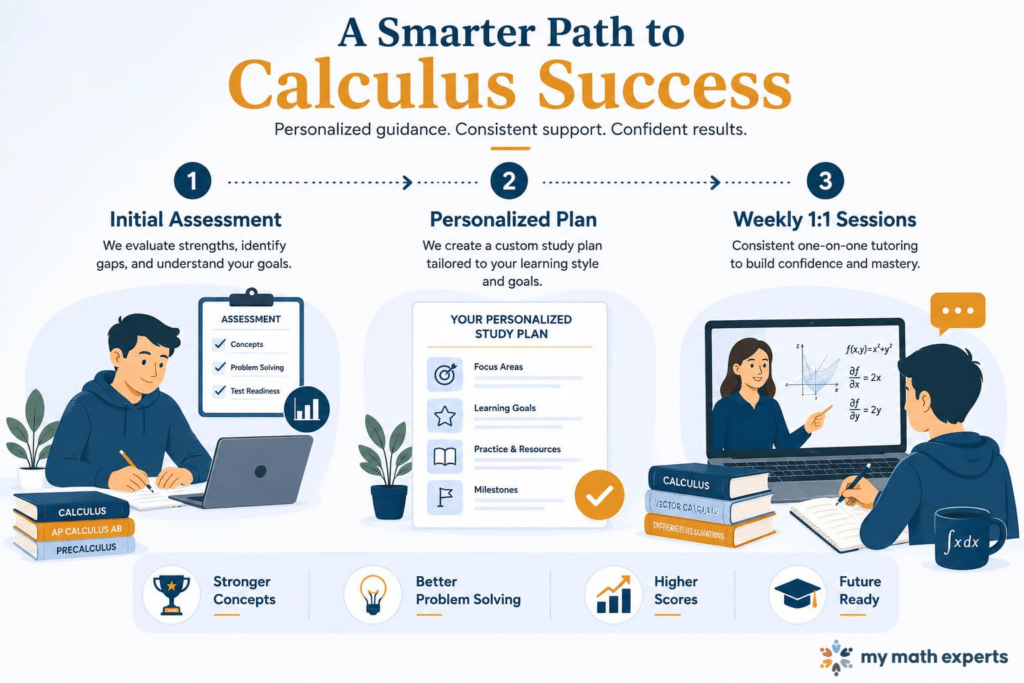
Calculus success starts with the right support. From an initial assessment to a personalized plan and consistent 1:1 sessions, every step is designed to help students build stronger concepts, improve problem-solving skills, and grow with confidence.
If your student is showing a few of these signs and could use more confidence, structure, and personalized support in calculus, it’s worth weighing your tutoring services options before the next test sneaks up.
Talk with the team at My Math Experts to learn how personalized 1:1 online calculus tutoring can help your student strengthen foundational concepts, build confidence, and create a plan for long-term academic success. Results vary based on participation, consistency, and individual learning needs.
Families interested in expert geometry tutoring can schedule a consultation with My Math Experts to discuss their child's goals, challenges, and learning needs. My Math Experts currently offers a 45-minute consultation for $15, 70% off the introductory rate, for those who wish to discuss the best tutoring method for their child, with flexible tutoring plans available to meet a variety of academic needs and goals.
Ready to Master Math with Confidence?
Don’t let challenges hold you back – our experts are here to guide you every step of the way. Book your personalized consultation today at My Math Experts and start turning confusion into clarity!
FAQs
Q1. What are the clearest signs that a student needs a calculus tutor?
The most reliable signs include declining test scores, difficulty grasping core ideas such as limits, derivatives, and integrals, spending excessive time on assignments, and statements like “I’m just bad at math.” These patterns usually point to learning gaps rather than a lack of ability.
Q2. How do I know if I can study calculus on my own instead of hiring a tutor?
Self-study can work if you have strong discipline, a solid foundation in algebra and precalculus, and the ability to catch your own mistakes. If you keep putting in effort without seeing improvement, a tutor can identify the misconceptions that self-study often leaves unaddressed.
Q3. Is hiring a calculus tutor worthwhile for advanced high school or college-level calculus?
For advanced high school and college-level calculus, one-on-one tutoring can help students strengthen conceptual understanding, improve problem-solving skills, and build confidence with increasingly complex material.
Q4. What if my student is already trying hard but still struggling?
Consistent effort without improvement is one of the strongest signals that a tutor is needed, as it usually indicates that the study approach or foundational understanding needs adjustment. A tutor can pinpoint where the gaps are and rebuild the concepts so the work finally clicks.
Q5. Can a calculus tutor help with more than just grades?
Yes, beyond test scores, tutoring helps reduce math anxiety, rebuild confidence, and strengthen the problem-solving habits students carry into future courses. The goal is long-term understanding, not just getting through the next assignment.
Q6. How quickly should I act once I notice my student is struggling?
Sooner is better, since calculus is cumulative and small gaps tend to compound into bigger ones. Addressing the issue early helps prevent a temporary struggle from turning into a persistent loss of confidence.

Mr. Kemper is the founder and director of My Math Experts. He has taught and tutored thousands of math students in grades 1 - college over the last 20 years, in the classroom and in private education. Algebra is a special passion and Kemper believes that a solid Algebra foundation opens many doors. He has also trained and supported hundreds of teachers and continues to create and innovate in the math education world.