Key Takeaways
- A mathematical constant is something that has a set value and doesn’t change from that value.
- Constants are commonly used in functions and real-world applications, where they are fixed values.
- When students are aware of the constants and how to use inverse operations, they can solve equations and find the value of different variables (“x” or “y”, for example).
- Therefore, the primary goal of math tutoring in a 1:1 session is to increase students’ understanding of constants, a key part of Algebra, thereby leading to their later academic success.
When students discover the fundamental ideas that underpin mathematics, their initial exposure to these ideas and the degree to which they grasp them will play a significant role in determining how they handle and securely develop their confidence in Algebra and Mathematics in general. It is also essential that students feel their way in Algebra by grasping the concept of constant, as well as the other concepts that make up algebraic expressions, functions, and solving word problems. If a student doesn’t have a solid understanding of the meaning of the term “constant”, then their ability to develop their skills in working with variables and equations may be diminished or even non-existent.
Through virtual sessions with state-certified teachers from My Math Experts, ranked the #1 academic tutoring company in Arizona, students will receive high-quality tutoring focused on deepening their understanding of the material they are studying. With this knowledge, students will be able to understand why constants behave as they do in equations and how they connect to broader mathematical concepts.
Understanding the Definition of a Constant in Math
Before achieving success in solving equations, students need to know which parts of an equation remain unchanged and which can vary, and understanding the concept of a constant is the first step towards this knowledge. What is a Constant? To say that something is a constant means that the value does not change over time or with the method of working, whereas a variable can be assigned different values.
A constant can be a specific number or a collection of numbers. A whole number would be represented as “5” or a negative as ” -3.” A constant number can also be defined as a real number, which includes irrational numbers, so it could stand alone or become part of an algebraic expression. One good example of an algebraic constant is the number 7 in the expression 4x + 7. Regardless of the value for “x”, the value for “7” will never change.
Tutors at My Math Experts focus on helping students clearly understand the difference between constants and variables, as this is a common source of mistakes in math. Leading U.S. math education standards emphasize building strong conceptual understanding, where students learn how fixed values like constants function within equations and problem-solving.
Examples of Constants in Mathematics
When students repeatedly encounter constants across different contexts, they begin to identify them quickly and accurately.
Common Uses of Constants
Some of the more identifiable examples of a constant are:
- Numerical constants: 2, 10, -6}
- The Golden vector (φ), one of the most well-known constants in mathematics
- The square root of 2 (irrational) is a numerical constant with a defined value.
- Pythagoras’ Constant (π) appears in Geometry as a constant.
The examples of constants above illustrate that there is no single, narrow definition of a constant. They can be simple, whole numbers; natural, irrational numbers, or even a value of any rational number. The key to constants is that, regardless of whether they are numbers, their value remains unchanged.
Types of Constants and Their Applications
Different constants serve different functions; understanding them better helps students learn to use them correctly across various math problems.
Mathematical Constants vs Physical Constants
A mathematical constant is a number that is defined only in terms of mathematics itself, such as pi (π or 3.14) or the golden ratio (1.618). Such mathematical constants are used in mathematical equations, formulas for curves or graphs, and geometric figures.
A physical constant, on the other hand, is used in the physical sciences and applied sciences, for example, the speed of light and the gravitational constant.
Although physical constants are necessary in many cases to understand the relationship between specific physical properties and mathematical principles, My Math Experts focuses on helping students apply mathematical constants clearly within algebra and problem-solving.
Constants in Algebraic Expressions
Among all areas of Mathematics, Algebra contains many constants that students must interpret correctly. Unfortunately, misunderstanding these constants may lead students into difficulties while working with algebraic expressions. Constants are those parts of algebraic expressions that do not have a variable attached to them.
For instance, the expression “3x + 9” refers to the element that changes (3x) and the number 9 that always remains constant. In the same way, “y = mx + c” is an expression where “c” is the variable.
The constant term of the polynomial refers to the location where a line crosses the y-axis; this point is called the “y-intercept”. Once the students understand constant terms, they will be able to study graph behaviour while exploring Algebraic equations further.
The Role of Constants in Functions
A constant function has the same output value for all input values of the function. In function notation, for example, f(x) = 4 means that the constant function produces only the value of 4.
Many students incorrectly identify constant functions as having a value of zero or as having variables that are not changing. My Math Experts offers one-on-one tutoring sessions to help students grasp the true meaning of these concepts. The tutors enhance students’ understanding by working on real-world applications and engaging in interactive discussions. They give their full attention to each student so that each student understands how constants function in equations.
How Constants Differ from Variables
Students need to understand the difference between a constant and a variable.
- A constant always has a fixed value.
- A variable represents values that can change or are unknown.
The constant in the equation of y = 2x + 5 is the number 5; the value of x is the independent variable, and the value of y is the dependent variable.
This distinction is essential for solving algebraic equations correctly, interpreting word problems, and arriving at the correct answer quickly.
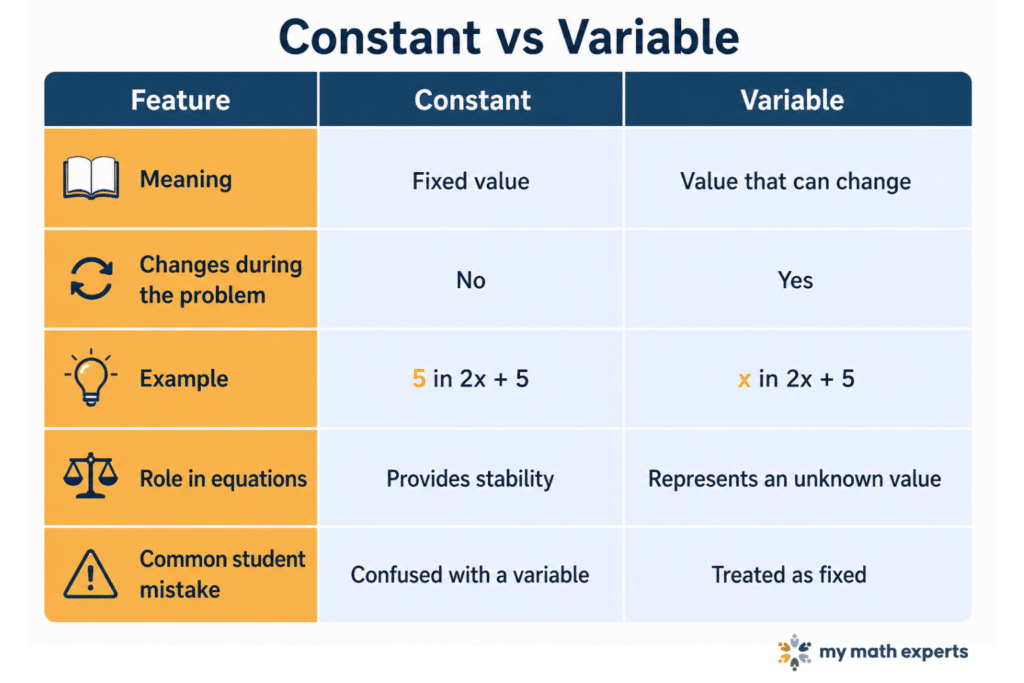
Understanding the key differences between constants and variables in algebra
Why Learning About Constants Matters
From basic arithmetic through advanced algebra, there are many different areas of mathematics where you’ll see constants featured heavily. When students do not understand what constants are, they tend to have trouble with:
- Simplification of mathematically related items
- Interpreting more complex equations accurately
- Word problem-solving confidence.
At My Math Experts, we identify learning gaps early and guide students toward clarity through structured support. This means that students will develop a solid foundation in math rather than relying on memorization for a specific period.
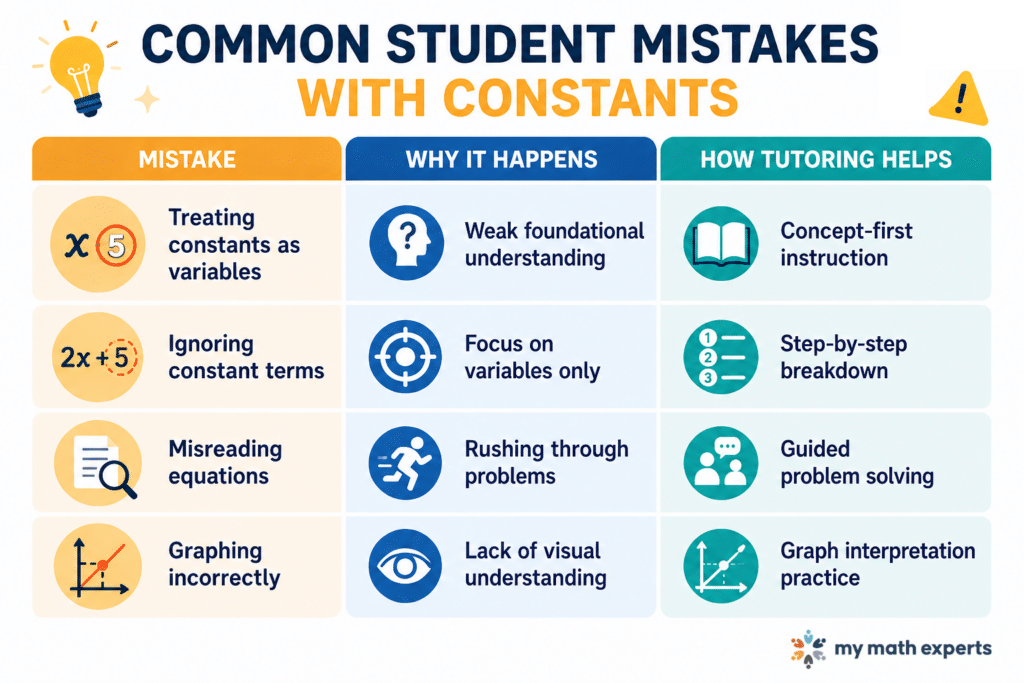
Common student mistakes with constants and how to fix them
How My Math Experts Supports Long-Term Math Success
My Math Experts helps remove the math struggle from families’ lives by providing 1:1 online math tutoring with consistent, personalized instruction from state-certified teachers.
The focus is not just on solving immediate problems, but on helping students understand concepts clearly so they can apply them independently in future topics.
Why Families Choose My Math Experts
- Always 1:1 sessions with the same teacher.
- The teachers are state-certified and math experts
- Steady progress is ensured through regular, structured weekly sessions.
- Online and flexible schedules, including emergency sessions, are available.
- Personalized Success Plans are shared after the initial sessions to guide long-term progress.
They get to understand the significance of the term constant not only from the standpoint of the subject matter but also from the perspective of its application to a wide range of concepts and ideas. Our tutors tailor a simple, individualized plan for each student, whether to sharpen basic skills, prepare for future Math Classes, or simply gain confidence with algebraic expressions.
Families interested in expert geometry tutoring can schedule a consultation with My Math Experts to discuss their child's goals, challenges, and learning needs. My Math Experts currently offers a 45-minute consultation for $15, 70% off the introductory rate, for those who wish to discuss the best tutoring method for their child, with flexible tutoring plans available to meet a variety of academic needs and goals.
Ready to Master Math with Confidence?
Don’t let challenges hold you back—our experts are here to guide you every step of the way. Book your personalized consultation today at My Math Experts and start turning confusion into clarity!
FAQs
Q1. What is a constant in math in simple terms?
A constant is simply a number that has a definite and fixed value. That means it doesn’t change throughout the equation or expression.
Q2. Can constants be negative or irrational?
Yes. A constant is not limited to positive numbers only. It can be a negative number, a whole number, or an irrational number, such as √2.
Q3. Why do students confuse constants and variables?
Students sometimes mix up variables with constants because variables change, but constants stay the same. This usually happens when the concept is not clearly understood.
Q4. How does tutoring help students understand constants better?
Experienced tutors break down the concept of constants by using them in real-life situations, help students get the definition clear through lots of practice, and show them how constants relate to real math problems.

Mr. Kemper is the founder and director of My Math Experts. He has taught and tutored thousands of math students in grades 1 - college over the last 20 years, in the classroom and in private education. Algebra is a special passion and Kemper believes that a solid Algebra foundation opens many doors. He has also trained and supported hundreds of teachers and continues to create and innovate in the math education world.