Key Takeaways
- An online statistics tutor is a great resource for students who need explanations of data, probability, and statistical analysis, delivered through a well-organized, customized math tutoring program.
- My Math Experts offers certified, regular, and personalized 1:1 online math tutoring, including support for statistics concepts in high school and university-level coursework.
- Students gain momentum from weekly sessions, have access to proprietary assessments, and receive a targeted plan that deepens their understanding of the basics of statistics.
- A gratis 30-minute test lesson enables families to meet a tutor, ask questions, and start creating a long-term learning plan.
Statistics has gradually become one of the most powerful skill sets in modern education without making much noise. In any case, when interpreting data analysis, preparing for hypothesis testing, or understanding confidence intervals and statistics, the student must be clear and have a strong mathematical foundation. However, numerous high school and college students find that a tiny gap in their algebra or Pre-Calculus knowledge is enough to make statistics so intimidating that they cannot overcome it.
This is the place where a professional online statistics tutor, especially a certified math educator, can totally make a difference in the learning journey. At My Math Experts, statistics tutoring is not just a brief stop at homework. It is a structured, personalized, and research-driven approach to students that helps them understand complex statistical concepts and use them confidently in coursework, AP exams, and real-world applications.
My Math Experts, the top academic tutoring company in Arizona, is ranked #1 and is available to learners across the country via flexible virtual sessions. Each student works with one expert tutor whom they can meet every week, thus maintaining continuity, trust, and steady academic progress.
Why Choose Online Statistics Tutoring?
A suitable learning environment that adjusts to a student’s particular tempo, skill, and objectives is a prerequisite for students to be able to excel in statistics. No doubt, online tutoring is more user-friendly in terms of time and place, and its service entails an expert, which most of the time, a classroom cannot provide. To a great extent, for students in high schools and colleges, this kind of one-on-one support is just the margin that separates them from merely coping with math tasks to excelling in math classes.
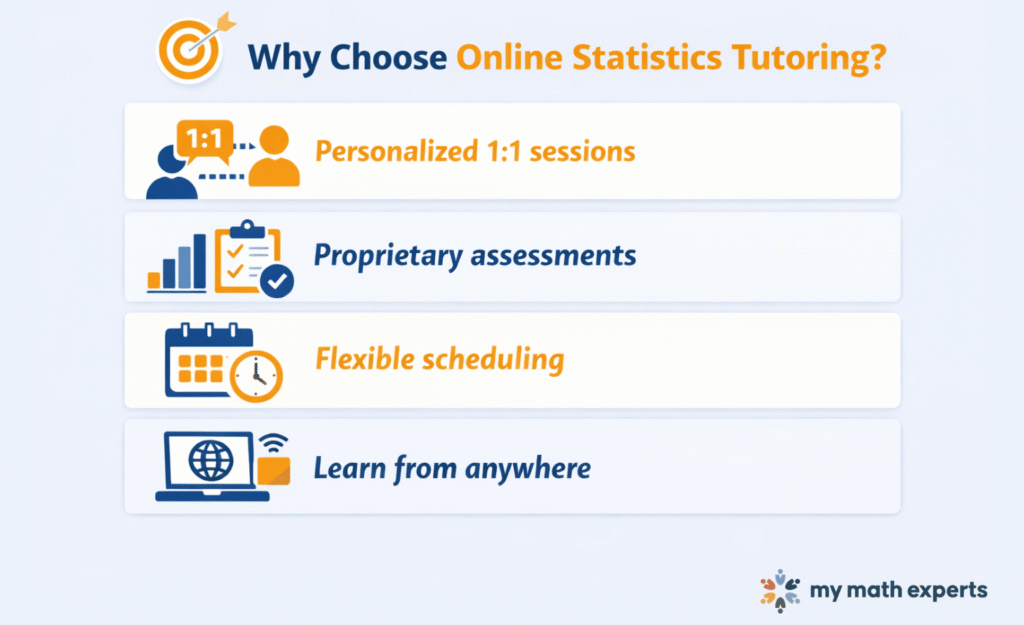
Online statistics tutoring made easy — personalized, flexible, and accessible anywhere.
Personalized Support for All Learning Needs
A lot of students coming to statistics classes have varied math backgrounds. And a tutor who can promptly and accurately identify these gaps is the one who really makes the difference.
My Math Experts tutors can begin with a proprietary grade-level assessment or dive into the student’s coursework. In the initial sessions, the tutor will discover any gaps in algebraic reasoning, probability basics, Pre-Calculus readiness, and the student’s current understanding of statistics concepts. Such a preliminary look allows them to uncover:
- The areas of prior knowledge that should be practiced again
- The concepts that need to be explained again at the conceptual level
- The ways in which the student expresses mathematical ideas
- The most effective teaching method and speed for the student’s success
After the very first sessions, each student is assigned a Personalized Success Plan (PSP) that details the specific goals set, the resources allocated, the skill-level targets, and a strategic roadmap of academic progress over time. The plan is a collaborative effort between the tutor, student, and family.
Flexible Support for Busy Students
Online statistics tutoring is a great support resource:
- For high school students who juggle AP classes, math courses, and extracurricular activities
- College students handling university-level coursework, labs, and deadlines
- Professionals in areas like data science, Computer Science, Environmental Science, or Business Statistics who are looking for understanding and confidence
- Students holding major assessments in view, such as test prep, AP Statistics exam, or general exam preparation
My Math Experts provides regular weekly sessions along with emergency sessions that can be booked up to the start time, a rare facility for your last-minute assignments or difficult topics. Get step-by-step help from a math expert. Book your 1:1 consultation and start improving today.
What Sets the Best Online Statistics Tutors Apart?
What separates average support from exceptional tutoring is the educator’s qualifications, consistency, and communication skills. It is a known fact that not all online tutors have the same level of competency, and students benefit most from those experts who have a thorough understanding of math and can explain it clearly.
Expert Tutors with Proven Teaching Experience
Quality of tutoring is heavily influenced by the tutor’s qualifications, experience, and the ability to explain mathematics in a clear and understandable way. At My Math Experts:
- Each tutor is a certified math teacher or a college-level math educator and not a peer tutor or a generalist.
- Tutors have Bachelor’s degrees, Master’s degrees, or higher in Mathematics, Applied Mathematics, Actuarial Science, Mathematical Statistics, or a related field.
- Every tutor is backed by years of experience in teaching and tutoring.
- Tutors focus on targeted areas, ranging from Introductory Statistics to Statistical Inference, Probability distributions, and Sampling distributions.
This background enables the tutors to provide clear, confident explanations of standard deviation, significance level, regression analysis, and real-world statistical analysis.
Engaging and Effective Teaching Methods
Excellent statistics tutoring isn’t a lecture; it’s more about recognizing the student’s way of thinking and leading them to a deep understanding of the concepts. The tutors of my Math Experts employ:
- Dynamic, real-time problem solving
- An interactive whiteboard that enables students and tutors to go through steps together
- Strong communication skills to create ease, mastery, and higher grades
- Instructional methods that correspond to the student’s learning, strengths, and level of skills
Concepts such as the Central Limit Theorem, normal distributions, inferential statistics, and random variables become less scary when the right approach and pace are used in the explanation.
Statistics Topics Covered by Online Tutors
If a student is a beginner or is working on advanced topics, My Math Experts is able to provide support for a full range of statistics lessons, which include:
- Probability distributions & Sampling distributions
- Normal distributions & Statistical significance
- Confidence intervals & Hypothesis testing
- Regression analysis & Data collection
- Introductory Statistics to Advanced Mathematical Statistics
- Real-world applications and problem-solving
- College Statistics and Business Statistics coursework
Tutors are on hand to help students with their homework, AP exams, and major tests by not only going through worksheets but also strengthening students’ conceptual understanding.
Who Can Benefit from Online Statistics Tutoring?

Online tutoring is a great resource for any learner, not just those who are struggling. It’s simply for anyone who wants to receive guidance, gain understanding, and see their development.
Ideal for Students At Every Level
- High school students preparing the AP Statistics exam or using statistics in math classes
- College students handling university-level coursework in statistics, Linear Algebra, Differential Equations, or Applied Mathematics
- Professionals wanting to acquire the skill set of a data analyst or data scientist
- Students living in cities such as New York, Los Angeles, San Francisco, or San Antonio who desire flexible and consistent online tutoring
- Learners who need assistance with Statistics Homework, test preparation, or long-term mastery
Through regular weekly sessions with a private tutor who understands their strengths and weaknesses, students develop not only a solid foundation but also gain measurable confidence.
My Math Experts: Your Partner in Statistics Success
My Math Experts takes the academic stress that often goes with math-heavy courses out of the students’ (and families’!) lives. Students get:
- Always 1:1 sessions with the same tutor
- Certified tutors with deep statistics and math expertise
- A structured weekly routine for lasting progress, if desired
- A Personalized Success Plan that guides learning
- Initial assessments and planning created specifically to uncover hidden gaps
- Flexible online tutoring anywhere in the U.S.
The students start to see the power not only in statistics classes but also in all other math courses, as their comprehension deepens, becomes more transparent, and becomes more integrated.
Reach Your Goals with the Best Online Statistics Tutoring
My Math Experts has the perfect solution for you if enhancing your self-confidence, bettering your test results, and truly grasping the subject matter of statistics are among your goals. You will have access to skilled teachers, tailor-made materials, and regularity throughout the entire week, among other things.
Don’t let challenges hold you back—our experts are here to guide you every step of the way. Book your personalized consultation today at mymathexperts.com and start turning confusion into clarity!
Book a Consultation
FAQs
Q1. Can an online statistics tutor really help me improve my grades?
A1. Yes. With consistent weekly sessions, a structured plan, and certified math educators guiding you, students typically see stronger comprehension, higher test scores, and reduced stress.
Q2. What topics can a tutor help with?
A2. Tutors cover everything from probability and random variables to confidence intervals, the Central Limit Theorem, regression analysis, and exam preparation for high school and college students.
Q3. How are tutors selected at My Math Experts?
A3. Every tutor is a certified math teacher or college professor with years of teaching and tutoring experience. Students always work with the same expert each week.
Q4. How quickly can I get started with an online statistics tutor?
A4. You can get started almost immediately. My Math Experts offers flexible scheduling, including sessions that can be booked up to the start time. Families can also book a consultation to discuss goals and create a personalized learning plan.

Mr. Kemper is the founder and director of My Math Experts. He has taught and tutored thousands of math students in grades 1 - college over the last 20 years, in the classroom and in private education. Algebra is a special passion and Kemper believes that a solid Algebra foundation opens many doors. He has also trained and supported hundreds of teachers and continues to create and innovate in the math education world.