Key Takeaways
- A reciprocal is a number that, when multiplied by the original number, results in one. A reciprocal can also be defined as the multiplicative inverse of a non-zero number.
- Reciprocals are the basis for operations with fractions, division, and algebraic equations.
- Turning mixed numbers or decimals into their reciprocals will require you to perform some additional operations.
- One-on-one math tutoring can help students build clarity and confidence in understanding reciprocals.
Reciprocal is a term from math that finds its use in various areas like fractions, division, algebra, inverse functions, and so forth. While the definition seems simple enough, a lot of students have a hard time figuring out the right reciprocals for different kinds of numbers, for instance, when mixed fractions, decimals, or negative numbers are involved.
My Math Experts, ranked the #1 academic tutoring company in Arizona, provides personalized 1:1 online Math tutoring to students across the United States. The focus is on helping students build real understanding and reduce math-related frustration through consistent, expert-led instruction.
Here, the concept of reciprocals has been explained step by step, with explicit instruction and targeted support, helping students gain a real grasp of this essential idea.
Understanding What Reciprocal Means in Mathematics
Before explaining the rules and examples of the word reciprocal it is essential to outline its meaning in common mathematical language.
Reciprocal in math is literally the opposite of any number and is often also called the multiplicative inverse. It is the number that the original one can be multiplied by to get 1. The word itself comes from a Latin root that means “returning” or “responding,” and that is precisely what it is: two numbers that are reciprocals of each other, and their multiplication results in 1.
A reciprocal is a number that, when multiplied by the original, yields 1. It is derived from a Latin word meaning “returning” or “responding”, which is very fitting: two reciprocals multiply to return 1.
There is a reciprocal for any number except zero. The only exception is zero because division by zero is undefined.
Why Reciprocals Matter
Reciprocals are an integral part of:
- The division operation
- Simplifying fractions
- Solving equations
- Inverse function understanding
Understanding reciprocals early helps students improve accuracy and confidence as they progress to more advanced math topics.
Reciprocals are the kidneys that keep the blood of the math body flowing, from the Middle School and High School molecules to its organs. Consequently, it is crucial to understand the concept right from the very first moment.
According to the National Assessment of Educational Progress, a significant percentage of middle school students struggle with fraction-based concepts, which directly impacts their ability to understand reciprocals and division.
Definition and Importance of Reciprocals
A reciprocal is a number defined as one that, when multiplied by the original number, gives the result of 1.
For example:
- The reciprocal of 6 is 1/6
- The reciprocal of 2/7 is 7/2
They multiply a number by its reciprocal, and the result is 1.
Dividing by a number is really the same as multiplying by its reciprocal. This notion is going to be very important in the later stages of algebra and beyond.
Steps to Find the Reciprocal of Different Numbers
Finding reciprocals is governed by straightforward rules; however, these rules change a bit depending on the kind of number you are dealing with. Knowing these distinctions helps students avoid common errors.
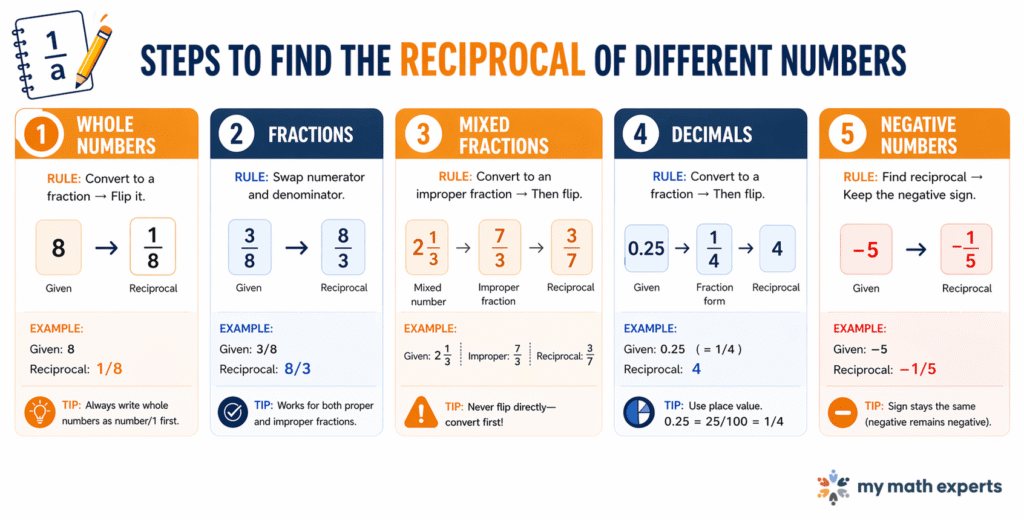
Step-by-step guide to finding reciprocals of whole numbers, fractions, mixed numbers, decimals, and negative numbers
Reciprocal of a Whole Number
A unit fraction is obtained when a natural number or whole number is inverted.
Example:
- Given number: 8
- Reciprocal: 1/8
This also applies to prime numbers like 7 or 11.
Reciprocal of a Fraction
To get the reciprocal of a fraction, all you have to do is interchange the numerator and denominator.
Example:
- First fraction: 3/8
- Second fraction (reciprocal): 8/3
This works for both proper and improper fraction forms.
Reciprocal of a Mixed Fraction
A mixed number has to be turned into an improper fraction first.
Reciprocal of a Mixed Fraction – Example:
- Mixed fraction: 2 1/3
- Improper fraction form: 7/3
- Reciprocal: 3/7
This stage is essential in math from the 6th grade and further.
Reciprocal of a Decimal
One way to find the reciprocal of a decimal number is first to change the decimal into a fraction.
Example:
- 0.25 → 1/4
- Reciprocal of a decimal: 4
This approach helps deepen understanding of place value.
Reciprocal of a Negative Number
The reciprocal of a negative number remains negative.
Example:
- Given number: -5
- Reciprocal: -1/5
The minus sign is always attached to the resultant number.
Examples of Reciprocals for Practice
Let’s walk through some clear examples of reciprocals:
- Reciprocal of 3/4 → 4/3
- Reciprocal of -5 → -1/5
- Reciprocal of mixed number 1 4/7 → 7/11
- Reciprocal of 0.2 → 5
Examples of this nature allow students to understand the reciprocal rule principle deeply and, at the same time, gain fluency.
Properties of Reciprocals and Special Cases
Understanding these properties helps students apply reciprocals correctly across different problem types.
Key Properties
- All real numbers apart from zero have their reciprocal
- The reciprocal of any natural number is always a unit fraction
- Zero does not possess a reciprocal
- Reciprocating the reciprocal will give the original number
- The inverse of a number under multiplication is the number that, when multiplied by the given number, results in 1
Reciprocals differ from additive inverses, which are related to addition, not multiplication.
Applications of Reciprocals in Everyday Math
Reciprocals are not merely abstract math terms—they are employed all the time.
Real-Life Scenarios
- Solving ratios and rates
- Calculating speed and time
- Understanding financial formulas
- Working with scale and proportions
Among various applications of reciprocal concepts, one crucial application is in simplifying division problems.
Classroom Integration
Teachers incorporate reciprocals through:
- Lesson plans
- Word problems
- Practice questions
Strong teaching focuses more on explaining than on memorizing.
Practice Problems and Study Resources
Practice Questions
- What is the reciprocal of 5/6?
- Find the reciprocal of a negative number -8
- Convert the mixed number 3 2/5 into its reciprocal
- Determine the reciprocal of 0.125
Each correct answer accumulates learners’ knowledge and mathematical fluency.
Suggested Educational Aids
Well-organized online websites are perfect for self-practice; however, most students derive the most significant benefit from teacher-led instruction.
My Math Experts provides structured 1:1 online math tutoring with certified teachers who focus on concept clarity, identify learning gaps, and help students plan next steps for steady improvement.
Advanced Topics: Reciprocal Rule and Inverse Functions
Students encounter reciprocals in very complex contexts as they continue their learning journey.
- The reciprocal function is very similar to the inverse function
- In calculus, the reciprocal rule is used to determine characteristics of derivatives
- Reciprocals are also related to square roots, cube roots, and algebraic identities
Often, these topics become difficult for students who don’t have a solid foundation in the basics.
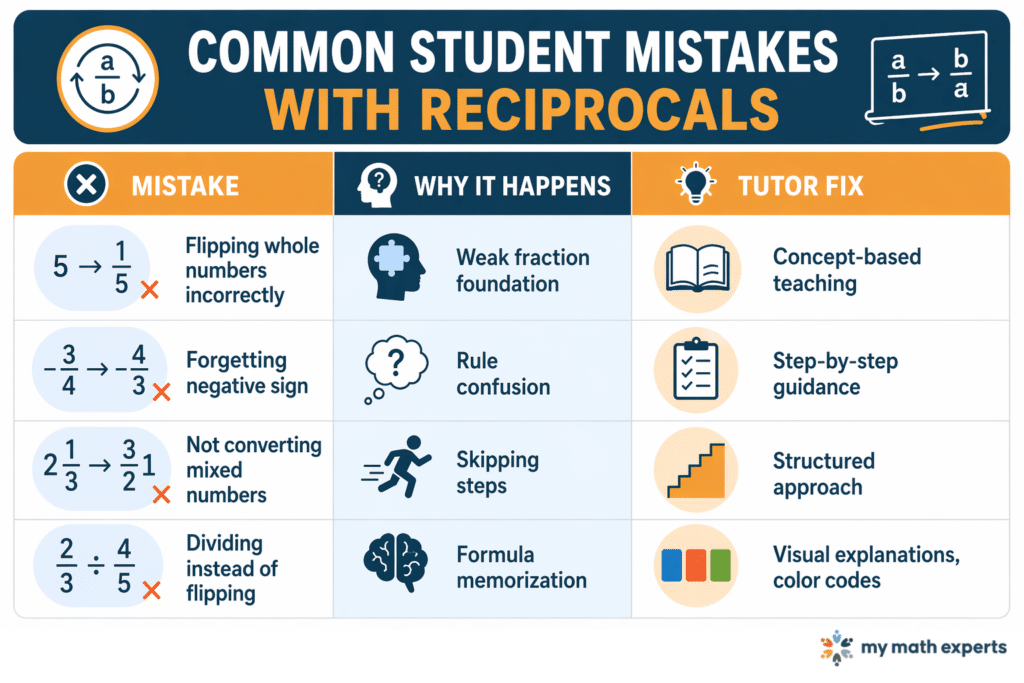
Common student mistakes with reciprocals and simple tutor strategies to fix them effectively.
How My Math Experts Help Students Master Reciprocals
At My Math Expert, our sessions are fully interactive and individually designed to support your child’s long-term educational progress.
Reasons Why Families Trust My Math Experts
Always 1:1 with the same teacher
Students work with one dedicated teacher every week, allowing for consistency, stronger communication, and measurable academic progress
State-certified teachers and math experts
Sessions are led by experienced educators who specialize in math, ensuring concepts like reciprocals are taught with clarity and precision
Targeted gap identification and support
Teachers identify exactly where the student is struggling, whether in fractions, division, or number relationships, and address those gaps directly
Concept-first teaching approach
Students learn the reasoning behind reciprocals, helping them apply the concept across equations and problem-solving with confidence
Consistent weekly sessions
Regular sessions reinforce understanding, improve retention, and support steady progress over time
Flexible online scheduling
Students can attend sessions from anywhere, with scheduling options that fit into busy routines
Personalized Success Plan after 2–4 sessions
Families receive a structured plan with clear goals, recommended material, and next steps to support long-term improvement. Upon identifying gaps, tutors reinforce core math concepts and guide students from confusion to clarity.
We never do tutoring at My Math Experts by passive exposure. Our sessions are fully interactive and individually designed to support your child’s long-term educational progress.
Explore our flexible plans and pricing to find the right fit for your learning goals and schedule. Whether you need one-on-one support or ongoing math tutoring, our options are designed to help you master concepts like reciprocals with confidence.
Families interested in expert geometry tutoring can schedule a consultation with My Math Experts to discuss their child's goals, challenges, and learning needs. My Math Experts currently offers a 45-minute consultation for $15, 70% off the introductory rate, for those who wish to discuss the best tutoring method for their child, with flexible tutoring plans available to meet a variety of academic needs and goals.
Ready to Master Math with Confidence?
Don’t let challenges hold you back—our experts are here to guide you every step of the way. Book your personalized consultation today at My Math Experts and start turning confusion into clarity!
FAQs
Q1. What is reciprocal in math?
A number that is multiplied by the original number to give 1 is called a reciprocal.
Q2. Does zero have a reciprocal?
Zero has no reciprocal because division by zero is undefined.
Q3. What is the reciprocal of a mixed number?
So you have to rewrite the mixed number as an improper fraction and then invert it (flip it).
Q4. Why do students struggle with reciprocals?
Primarily, their confusion stems from a lack of a firm grasp of fractions and from improper teaching of the concept.

Mr. Kemper is the founder and director of My Math Experts. He has taught and tutored thousands of math students in grades 1 - college over the last 20 years, in the classroom and in private education. Algebra is a special passion and Kemper believes that a solid Algebra foundation opens many doors. He has also trained and supported hundreds of teachers and continues to create and innovate in the math education world.