Many students hit a wall in trigonometry when the formulas start piling up. Reciprocal identities, angle formulas, and trigonometric identities can feel overwhelming when you see them as separate rules. The good news is that most formulas belong to a few connected families. Understanding those relationships makes the entire subject easier to learn and remember.
Key Takeaways
- Trigonometry formulas fall into clear families: basic ratios, reciprocal functions, and Pythagorean identities that build on each other rather than existing as isolated rules.
- The six trig functions (sin, cos, tan, csc, sec, cot) all derive from just two ratios, since csc, sec, and cot are reciprocals of sin, cos, and tan.
- The unit circle explains why formulas like sin(−θ) = −sin θ hold true, turning sign rules into logic instead of memorized exceptions.
- Deriving an identity from the unit circle or a right triangle tends to stick better than memorizing the formula in isolation.

A well-organized study desk featuring essential trigonometry formulas, right-triangle concepts, and a unit circle diagram.
What is trigonometry and why it matters (definition, meaning of ‘trigon’ + ‘metry’)
The word itself tells you the job. “Trigon” means triangle and “metry” means measurement, so trigonometry is the study of measuring triangles: the relationships between their angles and side lengths. That idea gives rise to tools used in engineering, physics, navigation, and computer graphics. Measurement conventions vary by field and country, so the exact units and standards depend on the governing body; the NIST guide on units and measurement is a useful U.S. reference for how angles and units are standardized in technical work.
Trigonometric functions describe repeating or angular patterns, from sound waves to satellite orbits. The U.S. Bureau of Labor Statistics lists many engineering careers that depend on this math daily. Trigonometry matters because it connects geometry and calculus.
The six trigonometric ratios (sine, cosine, tangent, cosecant, secant, cotangent)
There are six trigonometric ratios, but they come from only two ideas: sine, cosine, tangent, and their reciprocals. The other three, cosecant, secant, and cotangent, are just flip sides of those first three. Here’s the full list:
- sin θ = opposite/hypotenuse
- cos θ = adjacent/hypotenuse
- tan θ = opposite/adjacent
- csc θ = hypotenuse/opposite (the reciprocal of sine)
- sec θ = hypotenuse/adjacent (the reciprocal of cosine)
- cot θ = adjacent/opposite (the reciprocal of tangent)
Students who want structured, 1:1 guidance with the same certified math expert through this material often benefit from working with online precalculus tutors who walk through each ratio family step by step.
SOHCAHTOA and right-angled triangle formulas
SOHCAHTOA is the memory hook almost every student meets first, and it exists for one reason: to lock in the three core trigonometric ratios inside a right-angled triangle. Break it apart, and it reads:
- SOH → Sine = Opposite / Hypotenuse
- CAH → Cosine = Adjacent / Hypotenuse
- TOA → Tangent = Opposite / Adjacent
In a right-angled triangle, the ratio between two sides stays fixed for a given angle, no matter how large the triangle grows, because similar triangles share side ratios. If you’re missing a side and know one angle, you pick the ratio that connects the side you have to the side you want.
The unit circle and trigonometric ratios on it
The unit circle is a circle with radius 1 centered at the origin, and it’s where trigonometric ratios stop being about triangles and start describing angles of any size. For any angle θ measured from the positive x-axis, the point on the circle has coordinates (cos θ, sin θ). Tangent is the ratio sin θ / cos θ. That’s the whole engine.
The unit circle explains why sine, cosine, and tangent values repeat, why some go negative, and why tangent is undefined at 90°: cos θ hits zero there, and you can’t divide by zero. Once students see the unit circle, standard angle values stop feeling arbitrary and start making sense as coordinates.
Trigonometry becomes much easier when students understand how formula families connect instead of treating them as isolated rules. My Math Experts, ranked the #1 academic tutoring company in Arizona and serving students nationwide through virtual sessions, helps remove the math friction from families’ lives through personalized 1:1 online math tutoring focused on conceptual understanding and long-term progress.
Reciprocal and quotient identities
Reciprocal identities are the shortest formulas you’ll learn, and they save real time. Each of cosecant, secant, and cotangent is one over a primary function:
- csc θ = 1 / sin θ
- sec θ = 1 / cos θ
- cot θ = 1 / tan θ
The quotient identities connect tangent and cotangent back to sine and cosine:
- tan θ = sin θ / cos θ
- cot θ = cos θ / sin θ
Many assume cosecant, secant, and cotangent are new functions to memorize separately. In reality, they’re rewrites of sine, cosine, and tangent. Knowing this lets you simplify messy expressions by converting everything back to sine and cosine, often the fastest cleanup move.

Understand the three pairs of reciprocal trigonometric functions with a simple visual guide covering sine, cosecant, cosine, secant, tangent, and cotangent.
Pythagorean identities
The Pythagorean identities come straight from the Pythagorean theorem applied to the unit circle. Since any point on the circle satisfies x² + y² = 1, and x = cos θ while y = sin θ, you get the master identity:
- sin²θ + cos²θ = 1
Divide both sides by cos²θ to get the second. Divide by sin²θ, and you get the third:
- 1 + tan²θ = sec²θ
- 1 + cot²θ = csc²θ
These are three of the most-used trigonometric identities in algebra and calculus, showing up constantly when you need to swap one function for another during simplification. Memorize the first, derive the other two.
Even/odd (negative angle) and co-function formulas
Even and odd angle formulas describe what happens when you flip an angle negative. On the unit circle, a negative angle reflects across the x-axis, which flips the sign of the y-coordinate (sine) but leaves the x-coordinate (cosine) alone:
- sin(−θ) = −sin θ (odd)
- cos(−θ) = cos θ (even)
- tan(−θ) = −tan θ (odd)
Co-function formulas link each function to its “co” partner using complementary angles that add to 90°:
- sin(90° − θ) = cos θ
- tan(90° − θ) = cot θ
- sec(90° − θ) = csc θ
That’s why they’re named in pairs. “Cosine” literally means the sine of the complementary angle.
Sum and difference formulas
Sum and difference formulas let you find the trig value of a combined angle, like 75° = 45° + 30°, without a calculator. These identities are worth learning as a group because the underlying patterns are easier to recognize when studied together than when memorized individually.
- sin(A ± B) = sin A cos B ± cos A sin B
- cos(A ± B) = cos A cos B ∓ sin A sin B
- tan(A ± B) = (tan A ± tan B) / (1 ∓ tan A tan B)
Watch the signs closely: cosine’s sum formula uses a minus in the middle, which trips up nearly everyone at first. Quick example: sin(75°) = sin(45° + 30°) = sin 45° cos 30° + cos 45° sin 30°. These formulas are also the foundation for the double angle formulas coming next.
Double angle formulas
Double angle formulas come directly from the sum formulas by setting A = B. Instead of A + A, you just double the angle:
- sin(2θ) = 2 sin θ cos θ
- cos(2θ) = cos²θ − sin²θ
- tan(2θ) = 2 tan θ / (1 − tan²θ)
Cosine’s double angle formula has three equivalent forms, because you can use the Pythagorean identity to rewrite it:
- cos(2θ) = 1 − 2 sin²θ
- cos(2θ) = 2 cos²θ − 1
If you can derive double-angle formulas from sum and difference formulas, you never have to memorize them cold.
Half-angle formulas
Half-angle formulas do the reverse of doubling: they find the trig value of half an angle. They come straight from the cosine double-angle formulas, solved for the single-function term:
- sin(θ/2) = ±√((1 − cos θ) / 2)
- cos(θ/2) = ±√((1 + cos θ) / 2)
- tan(θ/2) = (1 − cos θ) / sin θ
The ± sign is not optional decoration. Its value depends on which quadrant θ/2 lands in, which you check on the unit circle. Half-angle formulas are handy for finding exact values of angles like 22.5°, half of 45°.
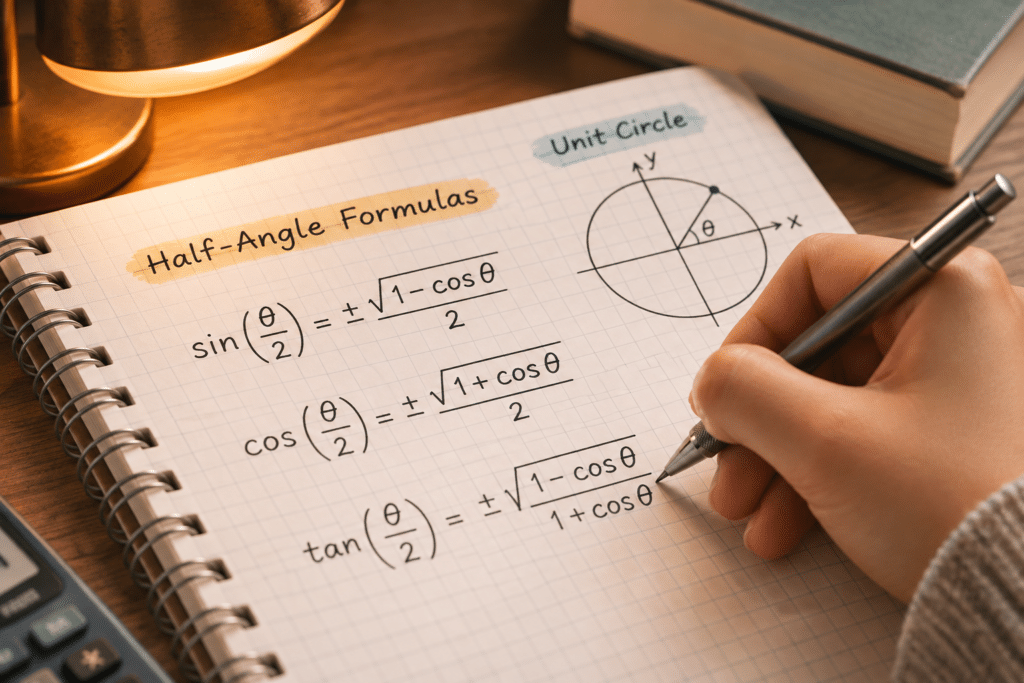
A focused study session exploring half-angle identities, square-root formulas, and unit circle concepts in trigonometry.
Triple angle (thrice angle) formulas
Triple angle formulas extend the pattern one step further, giving the trig value of 3θ in terms of θ. These are less common in early coursework but show up in advanced problems:
- sin(3θ) = 3 sin θ − 4 sin³θ
- cos(3θ) = 4 cos³θ − 3 cos θ
- tan(3θ) = (3 tan θ − tan³θ) / (1 − 3 tan²θ)
You don’t have to memorize these separately. Triple angle formulas come from combining the double angle formulas with the sum and difference formulas: 3θ is just 2θ + θ. That’s the theme running through all multiple angle formulas, and it’s why students who understand these trigonometric identities as a system rarely need a cheat sheet.
Product-to-sum and sum-to-product formulas
These two families convert between multiplication and addition, exactly what you need when an equation is stuck in the wrong form. Product-to-sum formulas turn a product of trig functions into a sum:
- sin A cos B = ½[sin(A + B) + sin(A − B)]
- cos A cos B = ½[cos(A + B) + cos(A − B)]
Sum-to-product formulas do the opposite, turning a sum into a product:
- sin A + sin B = 2 sin((A + B)/2) cos((A − B)/2)
- cos A + cos B = 2 cos((A + B)/2) cos((A − B)/2)
These come straight from the sum and difference formulas by adding or subtracting them. Product-to-sum formulas and sum-to-product formulas are used most in calculus and when solving certain trig equations, so they’re worth a spot on any trig identities cheat sheet.
Law of Sines and Law of Cosines (non-right triangles)
SOHCAHTOA only works on a right-angled triangle. For any other triangle, you need two rules. The law of sines, also called the sine rule, relates each side to the sine of its opposite angle:
- a / sin A = b / sin B = c / sin C
Use the sine rule when you know an angle and its opposite side, plus one more piece. The law of cosines, or the cosine rule, is a generalized Pythagorean theorem:
- c² = a² + b² − 2ab cos C
Use the cosine rule when you know two sides and the angle between them, or all three sides. Between the law of sines and the law of cosines, you can solve any triangle for a missing side and missing angle.
Area of a triangle using trigonometry
You don’t always need the height to find the area of a triangle. If you know two sides and the angle between them, trigonometry gives you a direct formula:
- Area = ½ ab sin C
Here, a and b are two sides, and C is the included angle between them. This works because the height of the triangle equals one side times the sine of the included angle, folding the “½ base × height” rule into a single step. When you know all three sides instead, pair the law of cosines to find an angle first, then apply this area formula.
Inverse trigonometric functions and their formulas
Inverse trigonometric functions answer a different question. Instead of “what’s the ratio for this angle,” they ask “what angle gives this ratio.” They’re written as:
- sin⁻¹(x) or arcsin(x)
- cos⁻¹(x) or arccos(x)
- tan⁻¹(x) or arctan(x)
If sin θ = 0.5, then sin⁻¹(0.5) = 30°. That superscript −1 does not mean a reciprocal here, which is a genuine trap: sin⁻¹(x) is not 1/sin(x). Each inverse function has a restricted range so it returns just one answer, because the original trigonometric functions repeat forever and would otherwise give infinite solutions. You’ll reach for inverse trigonometric functions any time you’re solving for a missing angle after setting up a ratio.

Understand arcsin, arccos, and arctan through a visual guide connecting angle measurement with right-triangle side ratios.
Reflections, shifts, and periodicity of trig functions
The periodicity of trigonometric functions makes them useful for anything that repeats. Sine and cosine complete a full cycle every 360° (or 2π radians), so:
- sin(θ + 360°) = sin θ
- cos(θ + 360°) = cos θ
Tangent repeats faster, every 180°. Shifts move a graph left or right, and reflections flip it across an axis, exactly as the even- and odd-angle formulas describe. Cosine is really just sine shifted 90° to the left: cos θ = sin(θ + 90°).
Table of standard trig values (0°, 30°, 45°, 60°, 90°)
Certain standard angle values come up so often that recognizing them instantly saves time on every problem. Here they are for sine, cosine, and tangent:

A quick reference guide to the sine, cosine, and tangent values of standard angles from 0° to 90°.
Notice the pattern: sine climbs from 0 to 1 while cosine falls from 1 to 0. Tangent is undefined at 90° because cosine hits zero there. Keep these standard angle values close on any trig identities cheat sheet.
How to choose and apply the correct trig formula (worked examples)
Solving trigonometry problems is mostly about matching the situation to the right formula family. Ask yourself two questions first: is this a right-angled triangle, and what am I actually solving for?
- Right triangle, missing side or missing angle? Use SOHCAHTOA.
- Non-right triangle? Use the law of sines or the law of cosines.
- Simplifying an expression? Reach for the Pythagorean identities or reciprocal identities.
- Combined or halved angle? Use sum and difference formulas, double angle formulas, or half angle formulas.
Picture a ladder leaning against a wall at 70°, with its base sitting 2 feet out. To find the ladder length, you have the adjacent side and want the hypotenuse, so cos 70° = 2 / hypotenuse, giving about 5.85 feet. Working through examples like this shows how the right formula depends on the information you have.
Students often struggle not because they don’t know a formula, but because they aren’t sure which formula applies to a specific problem. Working with an online math tutor can help students develop the reasoning skills needed to recognize patterns, choose the right approach, and build confidence solving unfamiliar problems.
Common mistakes and how to avoid memorization traps
Most trig errors aren’t about intelligence. They’re about pattern confusion. Watch for these:
- Mixing up sine and cosine ratios. Sketch the triangle and label sides before writing anything.
- Reading sin⁻¹ as a reciprocal. It means inverse function, not 1/sin.
- Forgetting the ± sign in half-angle formulas. Always check the quadrant on the unit circle.
- Dropping the negative in cosine’s sum formula. cos(A + B) uses a minus in the middle.
The deeper trap is treating formulas as disconnected facts instead of a connected system. The fix is to derive formulas from the unit circle and the Pythagorean identities, so if recall fails, you can rebuild them on the spot.
Study tips for learning trig formulas and building a strong foundation
The students who actually retain trig formulas treat them as a connected system, not flashcards. A few approaches that work well for trigonometry for beginners:
- Start with the unit circle. Almost every identity, from even- and odd-angle formulas to the Pythagorean identities, traces back to it.
- Derive instead of memorize. Build the double-angle formulas from the sum and difference formulas, so you’re not relying on recall alone.
- Keep a personal trig identities cheat sheet. Writing your own list beats copying someone else’s.
- Practice mixed problems. Choosing the right formula is a separate skill from knowing it.
- Work spaced repetition. Short, frequent sessions outlast one long cram.
Trig is a foundation subject: gaps here quietly make Calculus feel harder later, especially once students move into precalculus concepts that build on trigonometry and expect these identities to already be second nature.

Building math confidence one problem at a time! Consistent practice, clear concepts, and the right study approach make learning trigonometry easier.
If your student is running into the exact traps above, where the trigonometry formulas half-stick but fall apart under a real problem, consistent 1:1 support with the same tutor can rebuild the foundation instead of just patching individual homework questions. Every student works consistently with the same math expert each week. Sessions are led by certified math teachers and college-level educators who focus on building deep understanding, not just solving the next homework problem. If that sounds like what your student needs, you can talk to an expert about your student’s math goals to explore your options.
Families interested in expert geometry tutoring can schedule a consultation with My Math Experts to discuss their child's goals, challenges, and learning needs. My Math Experts currently offers a 45-minute consultation for $15, 70% off the introductory rate, for those who wish to discuss the best tutoring method for their child, with flexible tutoring plans available to meet a variety of academic needs and goals.
Ready to Master Math with Confidence?
Don’t let challenges hold you back – our experts are here to guide you every step of the way. Book your personalized consultation today at My Math Experts and start turning confusion into clarity!
FAQs
Q1. What are the basic trigonometry formulas everyone should know?
The core set includes the three ratios (sin θ, cos θ, tan θ), their reciprocals (csc θ, sec θ, cot θ), and the Pythagorean identity sin²θ + cos²θ = 1. These formulas cover most Algebra 2 through Precalculus problems before students move into sum, difference, and double-angle identities.
Q2. What are the 6 trigonometric functions and how are they related?
Sine, cosine, and tangent are the primary functions, while cosecant, secant, and cotangent are their reciprocals (csc θ = 1/sin θ, sec θ = 1/cos θ, cot θ = 1/tan θ). On the unit circle, tangent also equals sin θ divided by cos θ, which is why it’s undefined wherever cos θ = 0.
Q3. What's the fastest way to solve a trigonometry problem?
Start by identifying what’s given (angle, sides, or ratio) and match it to the right formula family: ratio formulas for right triangles, or Pythagorean/angle-sum identities for equations. Sketching the triangle or unit circle position first prevents the most common sign and ratio mix-ups.
Q4. What are the three main trig equations students are asked to solve?
Most coursework centers on solving for an unknown angle or side using sin θ = opposite/hypotenuse, cos θ = adjacent/hypotenuse, or tan θ = opposite/adjacent. From there, students apply inverse functions (sin⁻¹, cos⁻¹, tan⁻¹) to isolate θ.
Q5. Is memorizing trigonometry formulas actually necessary, or can you just look them up during tests?
Many classroom assessments require students to recall core trigonometric relationships, so understanding the formulas rather than relying on a reference sheet can be valuable.
Q6. Do trigonometry formulas still matter if a student is using a calculator anyway?
Calculators compute values, but they don’t tell you which formula applies to a word problem, a proof, or a multi-step identity simplification. Students who skip formula understanding often stall out in Precalculus and Calculus, where trig identities are used as tools within larger problems, not the end goal.
Q7. What's the difference between a trig formula and a trig identity?
A formula (like sin θ = opposite/hypotenuse) defines a ratio for a specific triangle or angle, while an identity (like sin²θ + cos²θ = 1) holds true for all values of θ. Identities are typically used to simplify or rewrite expressions rather than solve for a single unknown.
Q8. Why do some trigonometry formulas change sign depending on the angle?
Sign changes come from the unit circle: sine, cosine, and tangent are positive or negative depending on which of the four quadrants the angle falls into. This is why sin(−θ) = −sin θ and cos(−θ) = cos θ:cosine is an even function, and sine is odd.

Mr. Kemper is the founder and director of My Math Experts. He has taught and tutored thousands of math students in grades 1 - college over the last 20 years, in the classroom and in private education. Algebra is a special passion and Kemper believes that a solid Algebra foundation opens many doors. He has also trained and supported hundreds of teachers and continues to create and innovate in the math education world.