A student who aced Algebra 2 last year suddenly stares at a page full of sines, cosines, and Greek letters and freezes. This happens all the time, and it almost never means the student got worse at math. Figuring out how to learn trigonometry mostly comes down to sequencing: build the right-triangle basics first, then the unit circle, then identities, in that order. This guide covers trigonometry basics, why trig is challenging for so many, and study tips that make it stick.
Key Takeaways
- Learning trigonometry works best when you master right-triangle ratios and SOH-CAH-TOA before moving on to the unit circle or identities.
- Trigonometry difficulty is often really an algebra or geometry gap showing up, not a problem with trig concepts themselves.
- Students typically encounter trigonometry in 10th or 11th grade, folded into Geometry, Algebra 2, or a dedicated Trig course.
- Getting comfortable with radians (not just degrees) before calculus prevents confusion once trig functions appear in derivatives and integrals.
- Test-focused trig prep should center on right-triangle ratios, common unit circle values, and the identity sin²θ + cos²θ = 1 rather than broader review.

Make trigonometry easier with the right resources! Explore essential formulas, unit circles, right triangles, and sine wave graphs to build a stronger understanding of math.
Getting started with trigonometry: what it is and why it matters
Trigonometry studies the relationships between the angles and sides of triangles. That sounds narrow, but those relationships describe anything that repeats or rotates: sound waves, tides, orbits, and circular motion of every kind. Trig is the math of cycles, which is why it shows up everywhere.
To get started with trigonometry, make sure you have sine, cosine, and tangent down first. Each is just a ratio of two sides of a right triangle, and understanding sine, cosine, and tangent as one connected system is the foundation everything else builds on. Most students already know some geometry and algebra by the time trig arrives in high school math, so these basics build directly on prior work. Broader readiness concerns aren’t unfounded, either. National data on student math performance from the National Center for Education Statistics show how many students hit rough patches in math well before trig enters the picture, which is why catching gaps early matters so much. If you’re unsure where those gaps might be, a math diagnostic assessment can pinpoint them before trig even begins.
Consider a student who breezed through right triangles in geometry but never got comfortable with fractions. When trig identities arrive, and every step involves rewriting sine over cosine, that old fraction weakness quietly derails problem after problem, and the student walks away convinced they “can’t do trig.” The real fix is often in strengthening an earlier algebra or geometry concept rather than spending more time on the current trig chapter.
Trig isn’t a dead-end subject. It feeds straight into pre-calculus, physics, engineering, and any field that models waves or motion, and a solid grip on trigonometric functions makes that transition smoother. Students planning to continue into pre-calculus often benefit from working with online pre-calculus tutors who can bridge trig concepts directly into the coursework that follows.
Why trigonometry feels challenging (and why that’s not about ability)
Here’s the part most students never get told: when trigonometry feels impossible, the problem is usually somewhere behind it. Trig builds on algebra and geometry, so a shaky spot in either one shows up as trig confusion. That’s a big reason trigonometry is challenging for so many capable students. They’re not stuck on the trig; they’re stuck on a fraction, a factoring step, or a triangle rule that never fully clicked.
Part of why trigonometry is challenging is that it combines two skills at once: reasoning geometrically about angles and triangles while manipulating expressions algebraically. Many assume they’re “bad at trig.” In reality, they have small, fixable gaps in algebra and geometry that quietly compound.
Math anxiety makes it worse, since a student who expects to fail stops working carefully. The American Psychological Association notes that anxiety narrows working memory during problem-solving, exactly when it’s needed most. Naming the real gap, not the imaginary “ability” one, is the first step to fixing it, and it’s often the first step toward rebuilding real math confidence too.

Trigonometry brings together different math concepts. With the right approach and consistent practice, even complex formulas become easier to understand!
Step-by-step action plan to start learning trig the right way
This step-by-step sequence is the backbone of learning trigonometry without gaps, and skipping steps is exactly why students get lost.
- Lock down prerequisites first: solving equations, fractions, the Pythagorean theorem, and basic angle rules from geometry.
- Learn the three core trig ratios using SOH-CAH-TOA, tying each to the opposite, adjacent, and hypotenuse sides of a right triangle.
- Practice right-triangle problems until you can find a missing side or angle without pausing to look up which ratio to use.
- Learn both ways to measure angles, degrees first, then radians, so you’re comfortable with each before calculus.
- Build the unit circle and memorize key angle measures at 0°, 30°, 45°, 60°, and 90°.
- Study the graphs of sine, cosine, and tangent so you can picture how each function behaves.
- Introduce the core trig identities, starting with sin²θ + cos²θ = 1.
- Do mixed practice that forces you to switch between ratios, the unit circle, and identities.
Move to the next step only after the current one feels automatic. This order works for a reason: each step reuses the skill from the one before it, so a weak link early on breaks everything after it. Rushing creates the exact learning gaps that make later topics feel impossible.
Master the unit circle and core trig functions first
The unit circle is the single most useful tool in trigonometry, and students who skip it pay for it in every later course. It’s a circle of radius one centered at the origin. Every point on it gives you a cosine value (the x-coordinate) and a sine value (the y-coordinate) for a given angle. Because the radius is exactly one, the coordinates *are* the sine and cosine values directly, with no extra arithmetic, which is why the circle makes those functions readable instead of abstract. Once that connection clicks, trigonometric functions stop being random button presses on a calculator.
What actually happens when a student “gets” the unit circle is that sine, cosine, and tangent become one connected picture instead of three separate rules. You can read values straight off the circle, see why sine and cosine repeat, and understand negative values without memorizing a chart.
Focus first on common angle measures, 0°, 30°, 45°, 60°, and 90°, plus their radian equivalents, since these show up over and over. Practice drawing the circle from memory rather than staring at a printed one. The goal is long-term understanding, not a copy you can’t reproduce on a test.
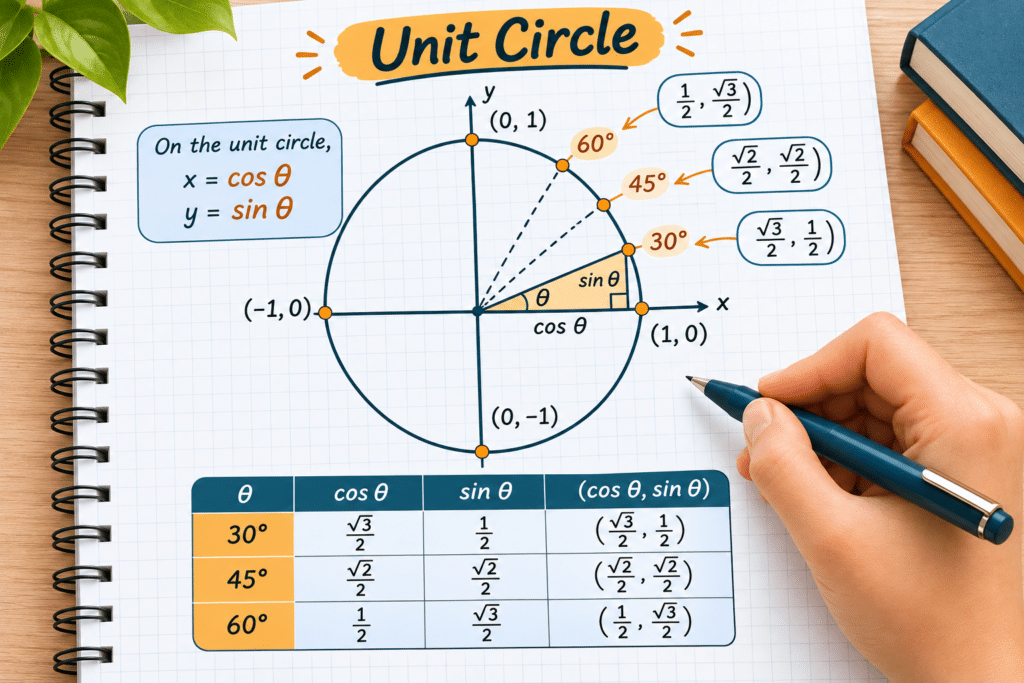
Explore how the unit circle connects angles with sine and cosine values. A visual guide to mastering essential trigonometry concepts.
Breaking down trig identities step by step
Trig identities intimidate students because there seem to be dozens of them. In reality, almost all trace back to a small handful. Start with the Pythagorean identity, sin²θ + cos²θ = 1, which comes directly from the unit circle and the Pythagorean theorem. Once you see where it comes from, you don’t have to memorize it as a magic formula.
Work through identities like a puzzle: pick one side of the equation and transform it into the other using ratios you already know. Rewrite tangent as sine over cosine. Replace one term using the Pythagorean identity. Small, familiar moves chained together solve most problems. This works because every identity is really just a restatement of the same few relationships, so the goal is recognizing which basic move applies, not recalling a separate rule for each case.
A trig identities cheat sheet is a solid study tip for building fluency, and My Math Experts offers one you can keep beside your practice problems. Use it to check yourself, not to avoid the reasoning. The goal is understanding why an identity works so you can rebuild it when you forget one line under pressure.
Using visual aids, graphs, and real-world applications to make trig click
Trigonometry becomes much easier when students can connect formulas to visual models and graphs. Visual aids and graphs turn abstract functions into shapes you can reason about. Plot sine and cosine as waves, and you can see the period, amplitude, and where the curve crosses zero, making questions about those features obvious rather than memorized.
Real-world applications do the same for motivation. Trig describes circular motion, sound and light waves, the swing of a pendulum, and the angle of a ramp. Surveyors and builders use it constantly, calculating a roof pitch or the distance to a landmark you can’t walk to. Connecting a formula to something physical gives students a reason to care, and reasons help concepts stick because the brain holds onto information tied to meaning far better than information memorized in isolation.
Try sketching every problem before solving it. Draw the triangle, plot the wave, mark the angle on the unit circle. This habit builds problem-solving skills because it forces you to understand the setup before reaching for a formula, which is where careless errors usually start.

Trigonometry isn’t just about formulas and graphs! Discover how sine waves explain real-world patterns, from Ferris wheel rotations to the movement of ocean tides.
Building consistent study habits and practice routines
Trig rewards frequency over cramming. Twenty focused minutes a day beats a single three-hour session the night before a quiz, because ratios and unit circle values need repeated exposure to move into long-term memory. Consistent study habits separate confident students from lost ones.
Among the best study tips for trigonometry: keep a running sheet of identities and unit circle values you draw from memory, redo practice problems you got wrong instead of only doing new ones, and space practice across the week. If you’re unsure where to start, a math diagnostic can pinpoint exactly which gap to target first. When weighing self-study vs. tutoring, the biggest difference often isn’t the material; it’s whether someone keeps you honest about doing it consistently.
Also, mix problem types. If every problem in a session uses the same identity, you’ll recognize the pattern without really learning it. Deliberately switching between right-triangle problems, graphing, and identities builds the flexible problem-solving skills that harder questions actually require, and costs nothing but attention.
How 1:1 online tutoring accelerates trig mastery
By this point one thing should be clear: the trouble with trig is almost never the trig itself. It’s a specific missed step buried somewhere in algebra, geometry, or the sequence above. The fastest way to close that gap is to have someone find exactly where understanding broke and fix it with step-by-step instruction that targets that spot directly. A classroom of thirty can’t do that. This is where trigonometry tutoring earns its place: 1:1 support targets your specific learning gaps instead of a class average, which is the whole point of personalized learning. This kind of targeted approach is a core part of math tutoring for high school students, where trig often becomes the first real test of how solid earlier math foundations really are.
My Math Experts pairs students with a dedicated instructor for 1:1 trigonometry tutoring, always with the same tutor every week. That consistency matters, because the tutor already knows whether your struggle is really an algebra issue or a genuine trig concept, and can adjust instruction accordingly. These are expert-led, math-focused sessions, not casual peer help. After each session, you’ll receive session notes so you know exactly what was covered and what to practice next.
My Math Experts works with students across the U.S. through virtual sessions, building trig confidence: concept first, then practice, then real progress. Personalized, 1:1 online math tutoring with the same tutor brings that support to you, wherever you are.

Make challenging math concepts easier with personalized online tutoring. Learn, practice, and solve problems with expert guidance and interactive whiteboard sessions.
If your student is stuck on trigonometry and it’s starting to shake their math confidence, targeted 1:1 support with the same tutor each week can help you find the real gap and rebuild it. You can talk to a math expert at My Math Experts to explore your options and plan next steps together.
Families interested in expert geometry tutoring can schedule a consultation with My Math Experts to discuss their child's goals, challenges, and learning needs. My Math Experts currently offers a 45-minute consultation for $15, 70% off the introductory rate, for those who wish to discuss the best tutoring method for their child, with flexible tutoring plans available to meet a variety of academic needs and goals.
Ready to Master Math with Confidence?
Don’t let challenges hold you back – our experts are here to guide you every step of the way. Book your personalized consultation today at My Math Experts and start turning confusion into clarity!
FAQs
Q1. What's the easiest way to start learning trigonometry?
Start with right triangles and SOH-CAH-TOA before moving to the unit circle or identities, since most students find ratios easier to visualize than abstract formulas. Make sure basic geometry (angles, the Pythagorean theorem) and algebra skills are solid first, since gaps there tend to resurface as trig confusion.
Q2. Is trigonometry actually harder than other math subjects?
Trigonometry isn’t inherently harder than Algebra 2 or Geometry, but it can feel that way because it combines both subjects at once: algebraic manipulation with geometric reasoning about angles and triangles. Students with shaky algebra foundations often struggle more with trig than with the concepts themselves.
Q3. Can someone realistically teach themselves trigonometry?
Yes, many students can learn trigonometry independently with quality instructional resources and regular practice. Success usually depends on having strong algebra and geometry foundations and maintaining a consistent study routine.
Q4. What grade do students typically take trigonometry?
Trigonometry is most commonly taught in 10th or 11th grade, often as part of Geometry, Algebra 2, or a standalone Trig/Pre-calculus course depending on the school’s sequence. Some students encounter trig concepts earlier if they are on an accelerated math track.
Q5. Do I need to learn trigonometry before taking calculus?
Yes, trig functions like sine, cosine, and tangent show up constantly in calculus, especially in derivatives, integrals, and problems involving periodic motion. Working comfortably in radians (not just degrees) before starting calculus prevents a lot of confusion later on.
Q6. What if I'm cramming trig for a test in just a few days: where should I focus?
Prioritize right-triangle ratios, the unit circle values for common angles (0°, 30°, 45°, 60°, 90°), and the identity sin²θ + cos²θ = 1, since these show up repeatedly on tests. Skip deep dives into proofs and instead build quick-reference memory tools for formulas you’ll need to recall fast.
Q7. What if I keep mixing up sine, cosine, and tangent?
This is one of the most common trig struggles, and it usually means the ratios were memorized as letters instead of understood as relationships between specific triangle sides. Going back to labeled right-triangle diagrams and practicing which side is ‘opposite,’ ‘adjacent,’ and ‘hypotenuse’ for different angles usually clears it up faster than more memorization drills.

Mr. Kemper is the founder and director of My Math Experts. He has taught and tutored thousands of math students in grades 1 - college over the last 20 years, in the classroom and in private education. Algebra is a special passion and Kemper believes that a solid Algebra foundation opens many doors. He has also trained and supported hundreds of teachers and continues to create and innovate in the math education world.