A student aces Algebra 1, breezes through Geometry, then hits a wall three weeks into Algebra 2 the moment logarithms show up. It happens all the time, and it rarely means the student isn’t capable. The jump in abstraction catches most kids off guard. This guide walks through every Algebra 2 topic you’ll meet in a standard course, explains where each one tends to cause trouble, and shows how they connect so nothing feels like it came out of nowhere.
Key Takeaways
- Algebra 2 topics span a wide range, from polynomial and rational functions to logarithms, conic sections, and probability.
- Most students encounter Algebra 2 in 10th or 11th grade, though advanced tracks may introduce it in 9th grade.
- Logarithmic functions, conic sections, and rational expressions are consistently the topics students find most difficult.
- Skipping Algebra 2 can limit college admissions options and create gaps before Precalculus or Calculus.
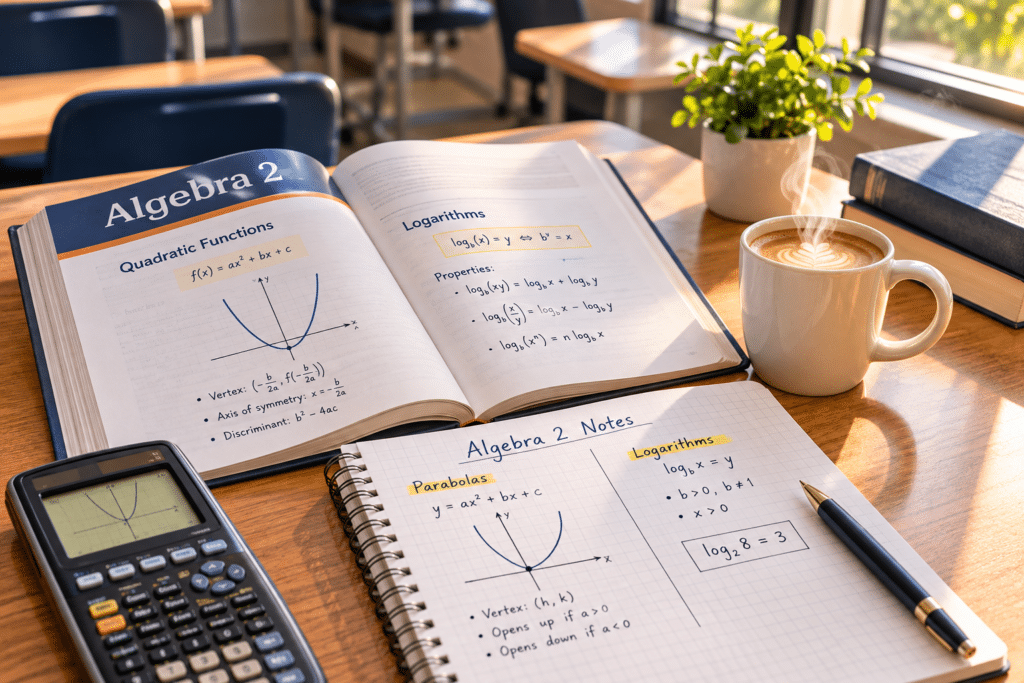
A productive start to mastering Algebra 2! From understanding quadratic functions and parabolas to solving logarithmic equations, the right study tools make complex math concepts easier to explore.
What Algebra 2 Is and Why It Matters
Algebra 2 is the course where math stops being mostly about numbers and starts being about relationships between quantities. You’ll work heavily with functions, model real situations with equations, and learn tools used across science, finance, and engineering. Most states require it, and colleges commonly expect it for admission. If you’re still getting oriented, it helps to start with what Algebra 2 actually covers before diving into the specific units below.
Here’s why that matters: Algebra 2 is the gateway to Precalculus and Calculus. Skip it or scrape by, and every later course inherits the gaps. The National Center for Education Statistics tracks how high school math course-taking connects to later outcomes, and completing higher-level math aligns with stronger college readiness.
Many parents assume Algebra 2 is just “more Algebra 1.” In reality, it’s a wider course that pulls in exponents, logarithms, trigonometry basics, and probability. That breadth is exactly why it feels overwhelming, and why a strong foundation going in makes such a difference. Parents often also wonder whether Algebra 2 is harder than other math courses their student has already taken, which is worth understanding before assuming the worst about a rough start.
How Algebra 2 Builds on Algebra 1 and Fits the Math Sequence
Algebra 2 sits in the middle of the typical high school math path: Algebra 1, then Geometry, then Algebra 2, then Precalculus, then Calculus. Almost everything in Algebra 2 assumes you already own the Algebra 1 toolkit: solving linear equations, factoring, graphing functions on a coordinate plane, and working with exponents.
When a student struggles, it’s usually a missing Algebra 1 skill resurfacing. If factoring never fully clicked, polynomials and quadratic equations in Algebra 2 become a daily fight. Later topics lean on earlier fluency, so a gap that seems small in one unit tends to resurface in the next.
So Algebra 2 isn’t a fresh start. It’s Algebra 1 extended into new territory. That’s good news. A student who shores up specific earlier skills and gets real Algebra 2 help when needed often sees the “hard” new topics get much more manageable, since the underlying moves were the real obstacle.
Equations and Inequalities (Linear, Absolute Value, Systems)
Algebra 2 opens by stretching what you already know about solving. You’ll revisit linear equations, then move into absolute value equations and inequalities, where a single equation can produce two answers because distance works in both directions. That split throws students who expect one clean solution.
Inequalities get more involved too. You’ll graph solution sets on number lines and in the coordinate plane, and keep track of when to flip the inequality sign. Then come systems of equations: two or more equations solved together, by substitution, elimination, or graphing. Later you’ll handle systems of three variables and systems involving inequalities.
The practical payoff is modeling. Systems of equations describe situations with multiple constraints, like budgets or mixtures, which is why they show up constantly in word problems. Students who nail the mechanics here build problem-solving skills that carry straight into the harder function work ahead.
Functions and Their Graphs
Functions are the backbone of the entire Algebra 2 course. A function is just a rule that assigns exactly one output to each input, but the way Algebra 2 uses functions is what makes the course feel new. You’ll study domain and range, function notation like f(x), and how to combine and transform functions.
Graphing functions is where it clicks or doesn’t. You’ll learn how shifting, stretching, and reflecting a graph connects to small changes in the equation. Once you see that a “+3” slides the whole graph, parabolas, cube roots, and exponential curves all start to feel related instead of random.
A lot of Algebra 2 frustration traces back to this unit. Students who treat each function type as a disconnected memorization task drown. Students who understand transformations learn each new graph as a variation on one they already know, which is far less work over the full year.

Visualizing math makes learning more engaging! Explore how parabolas, exponential functions, and linear equations behave on a coordinate grid. Interactive graphing tools help students understand mathematical relationships and build confidence in Algebra.
Quadratic Functions and Equations
Quadratic functions are the first big “aha” of Algebra 2 for many students, partly because their graphs, parabolas, are so visual. You’ll solve quadratic equations by factoring, completing the square, and using the quadratic formula, then learn when each method is the fastest route.
This unit also introduces complex numbers. When the quadratic formula hands you a negative under the square root, you can’t stop at “no solution” anymore. The imaginary unit, i, lets you express those roots, and complex numbers quietly become part of your toolkit from here on.
Many students assume factoring is always the goal. In reality, factoring only works cleanly on some quadratic equations, and knowing when to switch to the quadratic formula is the real skill. Mastering quadratic functions also sets up polynomial functions directly, since a quadratic is simply a second-degree polynomial.
Polynomials and Polynomial Functions
Polynomials extend quadratics to higher degrees: cubics, quartics, and beyond. You’ll add, subtract, multiply, and divide polynomials, including long division and synthetic division, which feels mechanical at first but becomes essential for finding roots.
Polynomial functions are where graphing meets algebra again. End behavior, turning points, and zeros all connect to the expression’s degree and factored form. The Fundamental Theorem of Algebra tells you how many roots to expect, including complex ones, which ties this unit back to the complex numbers from the quadratic chapter.
Polynomials matter beyond the classroom because they’re the building blocks for modeling curves in physics, economics, and computer graphics. A student who can factor confidently and interpret a polynomial’s graph has genuinely transferable problem-solving skills. If division and factoring feel shaky, that’s usually a signal to patch an Algebra 1 gap before pushing forward, because this unit punishes weak factoring fast.
Rational Expressions and Equations
Rational expressions are fractions with polynomials on top and bottom. They look intimidating, and they’re consistently one of the topics students find hardest, but the core moves are the same fraction rules from middle school applied to variables.
You’ll simplify rational expressions by factoring and canceling, then add, subtract, multiply, and divide them. Solving rational equations adds a twist: you have to watch for values that make a denominator zero, since those create “extraneous” solutions that look valid but aren’t. Missing that step is the single most common error in this unit.
What actually trips students up here isn’t the new content; it’s rusty factoring. Because every rational expression lives or dies on clean factoring, learning gaps from the polynomials unit show up immediately. Professional educator-led instruction that targets the exact factoring step a student keeps missing is often more effective than generic homework help or peer tutoring.
Radical Expressions, Exponents, and Roots
This unit connects roots and powers into one idea. You’ll work with radical expressions, simplify square roots and higher-index roots, and rationalize denominators. Then comes the key insight: a radical is just a fractional exponent, so a square root is the same as raising to the one-half power.
Once that lands, the rules of exponents do all the heavy lifting. The same rules apply whether the exponent is a whole number or a fraction. Solving radical equations introduces the same extraneous-solution trap you met with rational equations, because squaring both sides can create false answers.
This section matters so much because it’s the bridge to exponential functions. Students who treat exponents as a messy set of disconnected rules struggle later, while students who see the single underlying pattern move into logarithms with a strong foundation already in place.
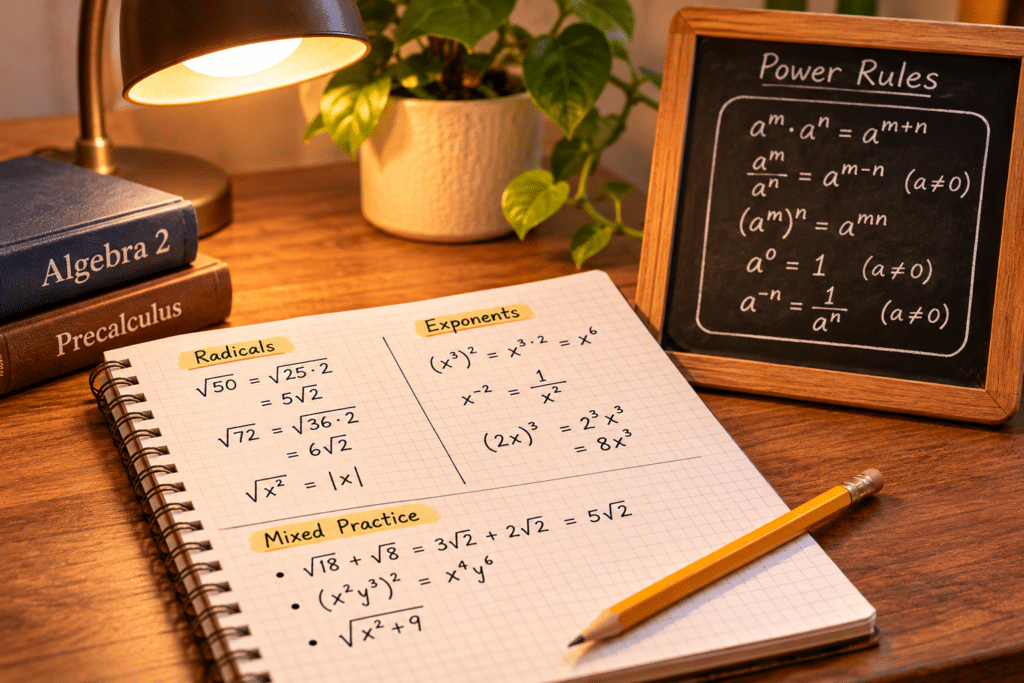
Mastering math starts with understanding the fundamentals! From simplifying square roots to applying exponent rules, practicing essential algebra concepts helps students build stronger problem-solving skills and mathematical confidence.
Exponential and Logarithmic Functions
Exponential functions model anything that grows or shrinks by a constant rate: populations, compound interest, radioactive decay. The curve starts slow and then explodes, which is why these functions are so useful and so often misread by students expecting a straight line.
Logarithmic functions are the inverse. A logarithm answers the question “what exponent produces this number?” That’s genuinely new reasoning, and it’s why logarithms rank among the toughest Algebra 2 topics year after year. You’ll learn the properties of logarithms, how to switch between exponential and logarithmic form, and how to solve equations using each.
Many students decide logarithms are impossible. In reality, logarithms only feel alien because they run the usual operation backward. Once you see them as the undo button for exponents, the properties start to make sense. This pairing of exponential functions and logarithmic functions is one of the highest-value payoffs in high school math, since both appear constantly in science and precalculus.
Sequences and Series
Sequences and series deal with ordered lists of numbers and their sums. You’ll focus on two main types: arithmetic, where you add a constant each step, and geometric, where you multiply by a constant ratio. Each has formulas for finding any term and for summing a set of terms.
The useful part is pattern recognition. Spotting whether a sequence grows by addition or multiplication tells you instantly which tools apply, and geometric series connect directly back to the exponential functions you just studied. Summation notation, the capital sigma, gets introduced here too, which previews notation you’ll see again in Calculus.
Students sometimes dismiss sequences and series as a side topic. In practice, they build genuine problem-solving skills, since many problems hide the pattern and expect you to uncover it. They also reward careful, organized work, making them a good way to strengthen study habits before the demands of Precalculus.
Probability and Statistics Basics in Algebra 2
Most Algebra 2 courses include a unit on probability and statistics, though the depth varies by state standards. You’ll learn to count outcomes using permutations and combinations, calculate basic probabilities, and interpret data with measures like mean, median, and standard deviation.
Some courses add the binomial theorem here, which connects back to polynomials by expanding expressions like (a + b) raised to a power. That link surprises students, but it shows how Algebra 2 topics weave together rather than sitting in separate boxes.
This unit tends to feel easier than logarithms, but it’s conceptually different, which throws some students. Probability rewards careful reading and clear thinking about what’s being asked, not just procedural steps. Because it connects to real-world decision-making, from sports to medical testing, it’s often the unit where math-averse students finally find something relevant, which can rebuild confidence for later work.
Common Struggles and How to Build a Strong Foundation
The pattern is almost always the same. A student who did fine in Algebra 1 starts slipping in Algebra 2, and everyone assumes the new material is the problem. Usually it’s not. The new topic simply exposes a weak earlier skill- factoring, fraction operations, or graphing- that was never fully solid.
Picture a student who gets a 68 on the rational expressions test. Reteaching rational expressions won’t help much if the real issue is shaky factoring from two units back. Fix the factoring, and the “hard” chapter suddenly becomes doable. That’s how learning gaps work in a course where everything stacks.
Building a strong foundation means diagnosing the actual gap instead of guessing. My Math Experts starts every student with a grade-level math diagnostic assessment, which pinpoints exactly which earlier skills need shoring up before they sink the current unit. Parents who want a clear starting point can take a math diagnostic assessment to see exactly where a student stands. Standards for what this math course must cover vary by state, so it’s worth checking your state’s math standards or your school’s syllabus to know exactly what your student will face.

A parent supports her child during an online math tutoring session, as he learns from an expert tutor through a live virtual lesson. With personalized guidance and encouragement at home, students can build confidence, strengthen math skills, and better understand challenging concepts.
Study Tips and Getting Help with Algebra 2
The students who thrive in Algebra 2 treat it as connected, not as a pile of separate chapters. A few habits make the biggest difference. Keep a running list of the concepts that feel shaky and revisit them weekly, since nearly every new unit reuses an old skill. Work problems by hand before reaching for a calculator, because understanding the steps beats getting a fast answer you can’t explain.
Build consistent study habits early rather than cramming before tests. Twenty focused minutes most days beats a frantic three-hour session the night before. And when a topic stays stuck after a genuine effort, get targeted help instead of spinning in place, since one unaddressed gap tends to snowball into the next unit. Many families find it easier to work with an Algebra 2 tutor online than to coordinate in-person schedules around an already packed school week.
Good Algebra 2 help should explain the why, not just hand over answers, through clear, expert-led instruction rather than quick fixes. The goal is understanding that lasts into Precalculus and Calculus, not just a passing grade.
If your student could use more structure and clearer explanations across these Algebra 2 topics, My Math Experts offers consistent 1:1 online tutoring with the same tutor every session, so lessons build on each other instead of starting over. The focus stays on closing specific learning gaps and rebuilding confidence, one concept at a time. You’ll receive session notes after each lesson so you can track progress.
Families interested in expert geometry tutoring can schedule a consultation with My Math Experts to discuss their child's goals, challenges, and learning needs. My Math Experts currently offers a 45-minute consultation for $15, 70% off the introductory rate, for those who wish to discuss the best tutoring method for their child, with flexible tutoring plans available to meet a variety of academic needs and goals.
Ready to Master Math with Confidence?
Don’t let challenges hold you back – our experts are here to guide you every step of the way. Book your personalized consultation today at My Math Experts and start turning confusion into clarity!
FAQs
Q1. Is Algebra 2 harder than Algebra 1 and Geometry?
Algebra 2 is generally considered more demanding because it combines skills from both prior courses and introduces abstract topics like logarithms and complex numbers. The difficulty usually comes from the volume of new concepts rather than any single topic being impossible to learn.
Q2. What are the hardest topics in Algebra 2?
Students most often struggle with logarithmic and exponential functions, conic sections, and rational expressions because these topics require connecting several earlier skills at once. Polynomial division and sequences and series also trip students up when foundational algebra skills aren’t fully solid.
Q3. What grade do students typically take Algebra 2?
Most students take Algebra 2 in 10th or 11th grade, following Algebra 1 and Geometry. Students on an accelerated math track may take it as early as 9th grade in preparation for Precalculus or AP coursework.
Q4. Can a student skip Algebra 2 in high school?
Some schools allow students to skip Algebra 2, but most colleges and universities require it for admission, and it’s a prerequisite for Precalculus, Trigonometry, and Calculus. Skipping Algebra 2 can create gaps that make later math courses significantly more challenging, especially Precalculus and Calculus.
Q5. Is it worth getting a tutor for Algebra 2 instead of just using free videos or apps?
Free videos can explain a concept once, but they can’t identify why a specific student is stuck on something like factoring or function transformations. One-on-one online tutoring adapts in real time, which matters most in Algebra 2 since so many topics build directly on each other.
Q6. What if my child was doing fine in Algebra 1 but is suddenly struggling in Algebra 2?
This is common because Algebra 2 introduces more abstract topics, like functions and logarithms, that require a different kind of reasoning than the arithmetic-heavy work in Algebra 1. A learning gap from earlier material often surfaces here rather than being a new problem altogether.
Q7. How many topics are typically covered in a full Algebra 2 course?
A standard Algebra 2 curriculum usually spans 10 to 14 major units, covering everything from polynomial and rational functions to probability, sequences, and matrices. The exact scope varies by state standards and whether the course is honors or standard level.

Mr. Kemper is the founder and director of My Math Experts. He has taught and tutored thousands of math students in grades 1 - college over the last 20 years, in the classroom and in private education. Algebra is a special passion and Kemper believes that a solid Algebra foundation opens many doors. He has also trained and supported hundreds of teachers and continues to create and innovate in the math education world.