A student who finishes algebra in June can lose nearly two months of math skill by September if those concepts sit untouched all summer. Teachers call it the “summer slide,” and it shows up every fall when classes re-teach material that was supposedly mastered. Picture a fifth-grade teacher in early September who planned to launch into multi-digit multiplication, only to discover that half the class has forgotten how to carry the one or line up place values. She spends the first two weeks re-teaching last year’s lessons instead of moving forward, and the whole class loses momentum because a handful of students let skills go dormant.
The right summer math programs prevent summer learning loss by keeping skills warm, but choosing one is where most families get stuck. The wrong fit wastes a summer; the right mathematics summer courses turn June through August into the period where a struggling student finally catches up or an advanced one moves ahead. Good online math courses do this with personalized learning that meets each child where they are.
Many families now choose 1:1 online math tutoring because it combines personalized instruction, flexible scheduling, and consistent support throughout the summer. Rather than relying on generic review packets, students receive targeted instruction that focuses on the concepts they need most while helping them build confidence before the new school year begins.
This guide cuts through the marketing language. It explains how these summer math programs actually work, who benefits, and how to tell a serious course from a glorified worksheet packet. Too many providers lean on promises of “fun, stress-free learning” without explaining what a student will be able to do by August. A parent who pays $800 for a math summer camp and gets back a stack of worksheets and a smiling photo has no way to know whether anything was learned. Worse, that parent often discovers the gap only in October, when the report card arrives, and the “fun” summer turns out to have been an expensive holding pattern. By the end of this article, you’ll have a checklist of questions that separate worthwhile mathematics summer courses from the ones that simply babysit.

A middle-school student stays academically engaged over summer by practicing math at a bright, sunlit kitchen table with the help of a notebook and tablet.
Key Takeaways
- Math skills decay faster over the summer than reading skills, which is why math summer courses focus on continuous practice to prevent summer learning loss and on procedural fluency, which erodes without use.
- The best summer math courses target a specific goal: remediation, grade-level maintenance, or acceleration. A course that claims to do all three usually does none well.
- The strongest programs prioritize conceptual understanding through personalized instruction from experienced, state-certified teachers rather than one-size-fits-all lessons.
- A good program measures academic growth with a thorough assessment, not just attendance.
Why Summer Math Loss Happens
Math is cumulative. Each topic rests on the one before it, so learning gaps in fractions become a wall in algebra two years later. A child in elementary school math who never grasped how to find a common denominator will struggle to add rational expressions later, and the teacher won’t reteach sixth-grade fractions. The same chain links negative numbers to slope and exponents to logarithms, so a single weak link can sabotage a topic that comes years later. A student who fuzzes over the rules for negative numbers in seventh grade will misgraph half the lines in a coordinate geometry unit. The reason summer math programs reverse the slide is mechanical: spaced retrieval over the break keeps neural pathways active, so the brain treats those skills as worth keeping. When practice stops, the fluency built through repetition fades quickly, leaving students slower and more error‑prone even if they still understand the steps. A student might still understand how to solve an equation, but if it now takes four minutes and two errors to do what took thirty seconds, they fall behind during timed tests.
The most effective tutoring doesn’t simply keep students busy over the summer – it helps them understand why mathematical concepts work. When students develop conceptual understanding instead of memorizing procedures, they are better prepared to apply those skills confidently when school resumes.
Reading holds up better over summer partly because kids encounter text everywhere: signs, screens, captions, and the messages they send friends all day. Almost no one does long division for fun in July. There is no real-world exposure to multiplying mixed numbers or graphing. A child reads dozens of texts and video captions before lunch, but the last time they reduced a fraction was the final week of school. That asymmetry is why math loss is steeper and why families who would never let their child stop reading often let elementary and middle school math go completely silent. Without practice, problem-solving skills erode, and math anxiety can take root.
Consider a seventh grader who scraped through pre-algebra with a low B. Over the summer, the family travels, the textbook stays in the closet, and by August, she’s forgotten how to isolate a variable. In September, she’s placed in a class that assumes she remembers, and within three weeks, she’s lost, not because she’s incapable but because the foundation went stale. She starts to believe she’s “just not a math person,” and her math anxiety grows as she stops raising her hand. By October, she’s avoiding homework and copying answers so the page looks finished. By winter break, she’s failing quizzes she could have aced in June, and the family is now paying for a tutor to undo damage that a few summer sessions would have prevented. What began as a few rusty skills has hardened into a learning gap. That scenario plays out in thousands of classrooms every fall, and the saddest part is how preventable it was.
How to Choose the Right Program
Start with the goal, not the catalog. Remediation, maintenance, and acceleration are three different jobs. A student who failed a unit needs targeted reteaching with step-by-step instruction that finds the missing step and rebuilds it; a student heading into AP Calculus needs advanced coursework that pushes them. A maintenance student needs enough regular contact to keep material fresh. Instruction only works when it meets the student at their level, so any program worth paying for begins with a thorough assessment. If a provider asks only for your child’s grade level and a credit card, they are guessing, and they will waste weeks teaching things your child already knows or skipping the very learning gaps that need filling. Imagine a strong eighth grader stuck reviewing place value for two weeks while the one concept he actually missed, solving two-step inequalities, never comes up. A good program builds a customized learning plan so lessons target the actual weakness.
Many parents assume a bigger, well-known program means better results. In reality, what drives outcomes is cohort size, the educator’s experience, and how closely instruction addresses each student’s gaps. A famous brand with 40 kids per teacher will lose your child faster than a small group of six with state-certified teachers offering one-on-one support. In a large room, a shy student who doesn’t understand step two nods along and falls silently behind, while in a group of six, the instructor notices and stops to help. Picture a student who misreads a negative sign in factoring: with one-on-one support, the teacher catches it within minutes, whereas in a crowded session, that error compounds until every answer is wrong and the student concludes the topic is impossible. Name recognition buys marketing polish, not the personalized learning that produces real results.
When evaluating summer math programs, ask whether the curriculum aligns with recognized standards. Organizations like the National Council of Teachers of Mathematics publish frameworks that serious programs follow, and a provider that can’t tell you which standards they map to is improvising. Ask directly: which standards does this course cover, and how does it sequence them? A confident answer signals a thought-out curriculum; a vague reassurance signals the opposite.
It’s equally important to ask how instruction is personalized. Effective tutoring should focus on helping students understand mathematical concepts, strengthen reasoning skills, and address learning gaps, rather than simply completing homework or reviewing worksheets.
This is where structured providers such as My Math Experts stand out, since placement starts with an initial grade-level assessment rather than guesswork, addressing the mismatch that derails so many enrollments. When the starting point is accurate, every hour is spent on material that supports academic growth.
Students at My Math Experts work with the same state-certified teacher each week, allowing instruction to build consistently over time. After the first 2-4 sessions, families receive a Personalized Success Plan that outlines learning priorities, goals, and recommended next steps to support long-term academic growth.
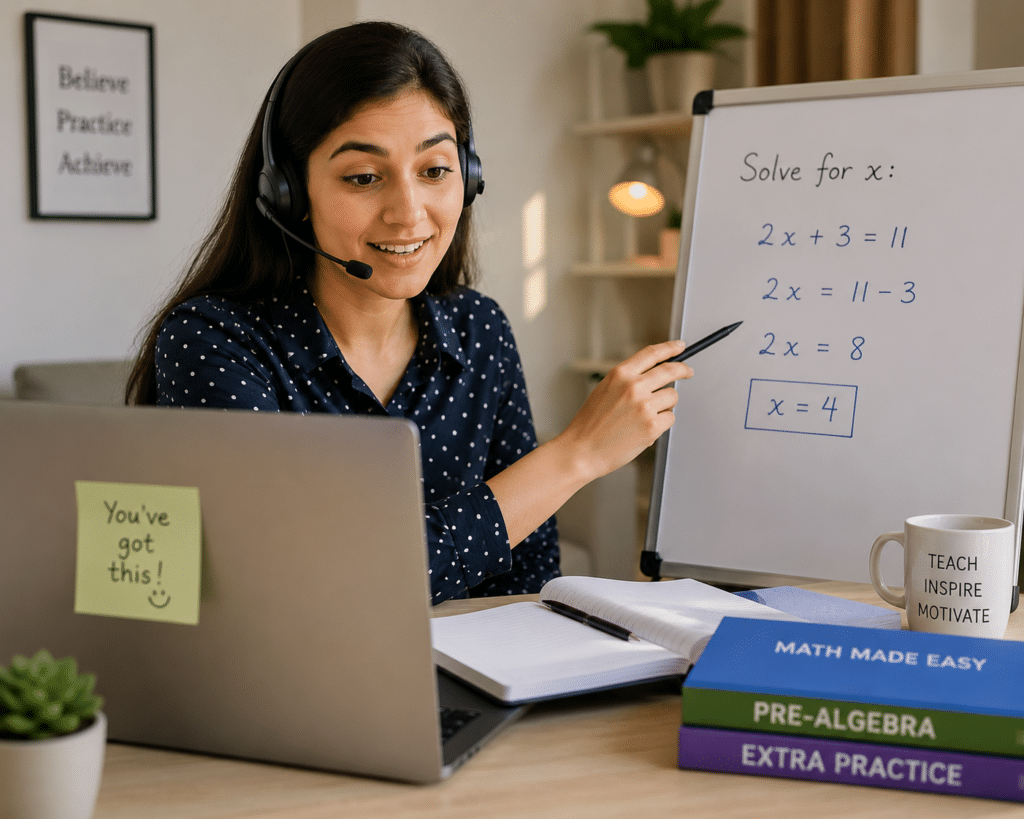
An online math tutor explains an algebra problem during a one-on-one virtual lesson, making complex concepts easier to understand.
What Real Progress Looks Like
A course that can’t show you a before-and-after isn’t measuring anything. Insist on a pre-assessment at intake and a post-assessment at the end. Without that, “progress” is just hours logged, and hours tell you nothing about whether a skill has improved. A student can attend twenty sessions and leave with the same gaps if no one tracks mastery. Weekly feedback to parents, not just the student, is another marker of a program that takes academic growth seriously. When you get a short note each week explaining what your child worked on and where they’re stuck, you can see the trajectory and step in, rather than waiting until September. A note that reads “she’s solid on factoring now but still hesitates on word problems” gives you something concrete to follow up on, while “great week!” tells you nothing and could describe a child who learned nothing.
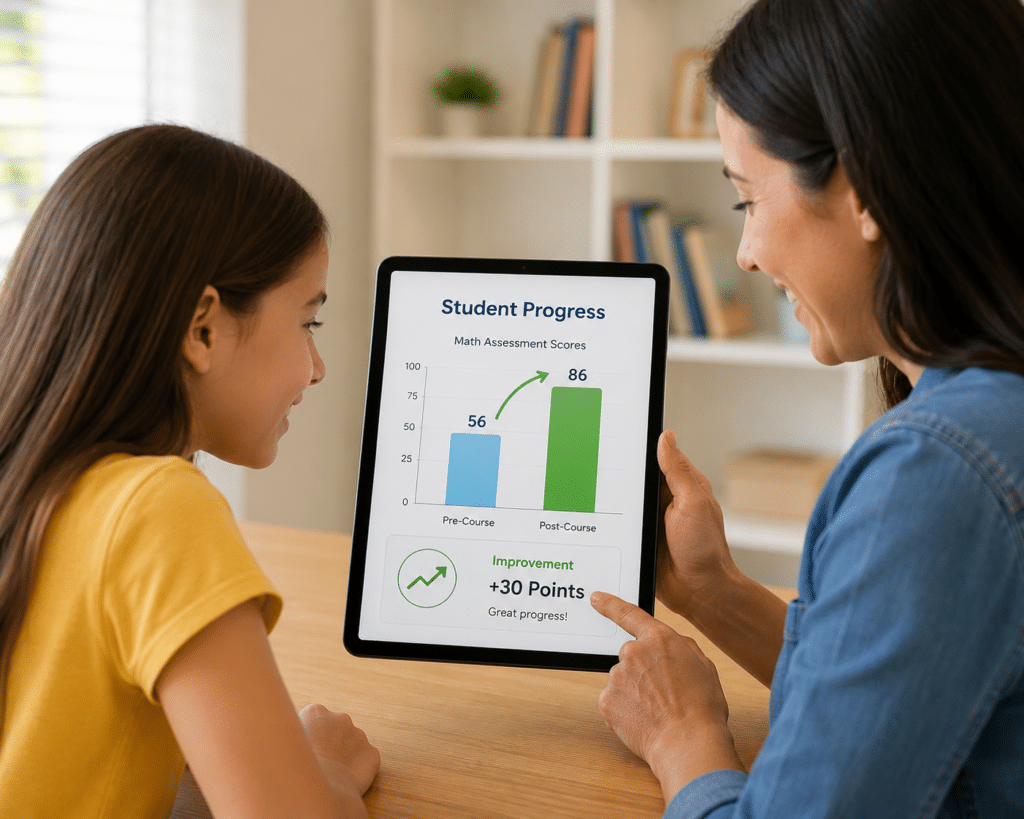
A parent and student celebrate measurable math progress by reviewing assessment results on a tablet after completing an online tutoring program.
Putting Your Summer to Work
Math skills are built or lost in the months no one is watching, and the right summer math courses turn that idle stretch into measurable gain that helps students stay ahead. The families who get the most out of K-12 mathematics summer courses match the program to a clear goal and demand evidence of progress, not just enrollment. They start with a diagnostic, choose a format that fits their child’s habits, and check the weekly feedback. A summer program that pays off is shaped by small disciplines – confidence‑building programs or steady review for struggling students – that cost far less than the frantic catch‑up in September.
If you’re weighing your options, the team at My Math Experts can help you sort out whether your child needs remediation, maintenance, or acceleration before you commit. Speak with the team to discuss a placement that fits your student, rather than a generic package.
Families interested in expert geometry tutoring can schedule a consultation with My Math Experts to discuss their child's goals, challenges, and learning needs. My Math Experts currently offers a 45-minute consultation for $15, 70% off the introductory rate, for those who wish to discuss the best tutoring method for their child, with flexible tutoring plans available to meet a variety of academic needs and goals.
Ready to Master Math with Confidence?
Don’t let challenges hold you back—our experts are here to guide you every step of the way. Book your personalized consultation today at My Math Experts and start turning confusion into clarity!
FAQs
Q1. How long should a mathematics summer course last?
Six to eight weeks with 2–3 sessions per week. Spaced practice builds retention better than cramming.
Q2. Are mathematics summer courses worth it for a student who's already doing well?
Absolutely. High achievers thrive on enrichment or advanced previews (such as trigonometry before precalculus), not on remedial review.
Q3. Can online courses really match in-person results?
Yes – live instruction and accountability make online programs just as effective, often more personalized than crowded classrooms. My Math Experts combines live 1:1 online instruction, regular progress updates, and consistent sessions with the same state-certified teacher to help students stay engaged and continue building confidence throughout the summer.
Q4. How do I know if my child needs remediation or acceleration?
A diagnostic assessment is key. Grades alone can hide gaps or strengths, so testing ensures the right track.
Q5. Is there ever a time when it's not worth enrolling in a summer course?
Yes – if a child is burned out. Light practice at home or math‑rich activities (like cooking or budgeting) can keep skills fresh without formal classes.

Mr. Kemper is the founder and director of My Math Experts. He has taught and tutored thousands of math students in grades 1 - college over the last 20 years, in the classroom and in private education. Algebra is a special passion and Kemper believes that a solid Algebra foundation opens many doors. He has also trained and supported hundreds of teachers and continues to create and innovate in the math education world.