
A student who aced Algebra 1 can hit Algebra 2 and suddenly feel lost by the third week. They stare at a logarithm problem that looks like a foreign language. It happens all the time, and it rarely means the student got worse at math. It usually means one earlier concept never fully clicked, and Algebra 2 exposed it. The good news is that the right Algebra 2 help targets that exact gap. It does not force a student to redo an entire year of material. This guide walks through what Algebra 2 covers, why it trips people up, and how to get support that leads to real progress.
Key Takeaways
- Effective Algebra 2 help starts with identifying the specific topics you’re stuck on- like logarithms or complex numbers- rather than reviewing the whole course again.
- Most Algebra 2 struggles trace back to shaky Algebra 1 foundations such as factoring, fractions, and solving equations.
- One-on-one online tutoring provides dedicated feedback, accountability, and explanations tailored to a student’s learning needs.
- Identifying learning gaps through personalized instruction, followed by a structured, step-by-step plan, can help students turn repeated Algebra 2 struggles into steady progress.

A focused high school student works through Algebra 2 problems in a calm, organized home study space.
What Algebra 2 help looks like and who needs it
Algebra 2 help isn’t one thing. For some students it means untangling a single unit, like exponential and logarithmic functions, while keeping up with current coursework. For others it means rebuilding the foundational math skills that Algebra 2 quietly assumes you already have. So a lot of students ask, is Algebra 2 hard? The honest answer is yes. It’s harder than Algebra 1 because it stacks more abstract ideas on top of everything before it. If those earlier skills feel shaky, catching up with Algebra 1 tutoring online first can make the whole course feel less overwhelming.
Most students take this high school math course in 10th or 11th grade. That answers a common question about what grade you learn Algebra 2. If you’re comparing Algebra 2 vs precalculus, the short version is simple. Algebra 2 teaches the tools, and precalculus makes you use several at once on harder problems. Students who want to get ahead often line up precalculus help once their Algebra 2 foundation is solid.
The students who benefit most from algebra 2 tutoring understand the lesson in class but freeze on homework. Others keep losing points on the same type of problem. The National Center for Education Statistics tracks course-taking patterns that show how central algebra sequences are to a student’s later math options, and their national data on high school mathematics coursework underscores just how many students move through these sequences each year. Getting personalized support early keeps a small gap from becoming a wall.
Core Algebra 2 topics you’ll get help with
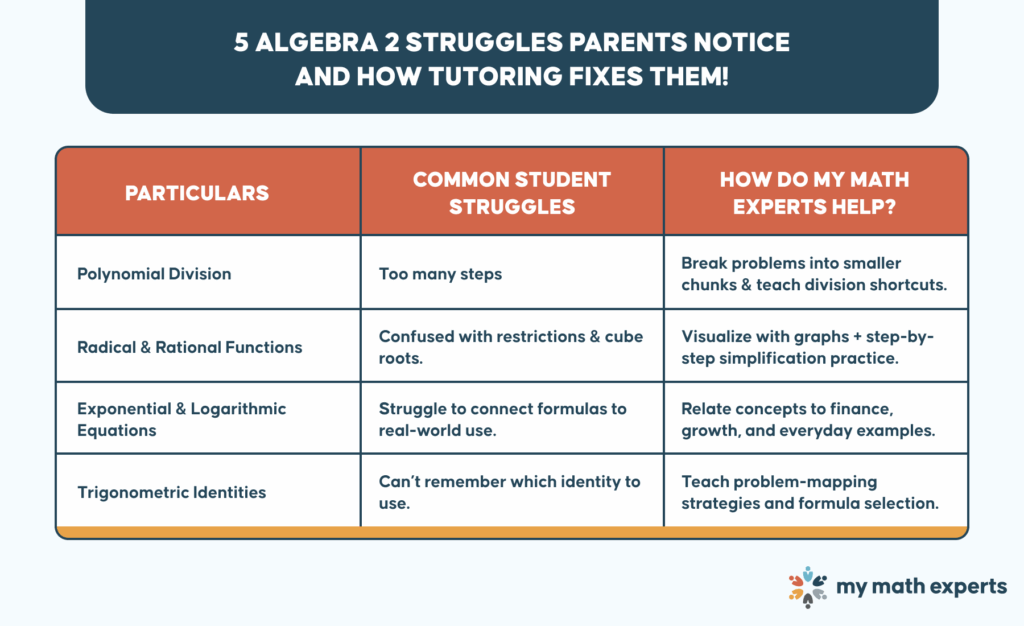
Algebra 2 topics fall into a handful of big buckets. Knowing which one is giving you trouble is half the battle. Here’s what most students work through:
- Linear equations and systems: the review layer that everything else builds on
- Quadratic equations: factoring, completing the square, and the quadratic formula
- Polynomials: dividing, factoring, and graphing higher-degree expressions
- Rational expressions: fractions with variables, plus finding restrictions
- Exponential and logarithmic functions: growth, decay, and how logs undo exponents
- Complex numbers: what happens when you take the square root of a negative
The reason this matters: these topics aren’t a random list. Quadratic equations lead into polynomials, and logarithms only make sense once exponents are solid. Many students weighing Algebra 2 vs. College Algebra assume both are just more of the same. In reality, each one introduces genuinely new kinds of thinking. That’s especially true with logarithms and complex numbers, where the rules feel counterintuitive at first. Mastering these buckets means balancing procedural fluency with conceptual understanding, so you can work quickly and know why the steps work.
Good Algebra 2 help zeroes in on the specific bucket you’re stuck on. It won’t drag you back through material you already know. Working with a personalized Algebra 2 tutor online is one of the fastest ways to target that single trouble spot.
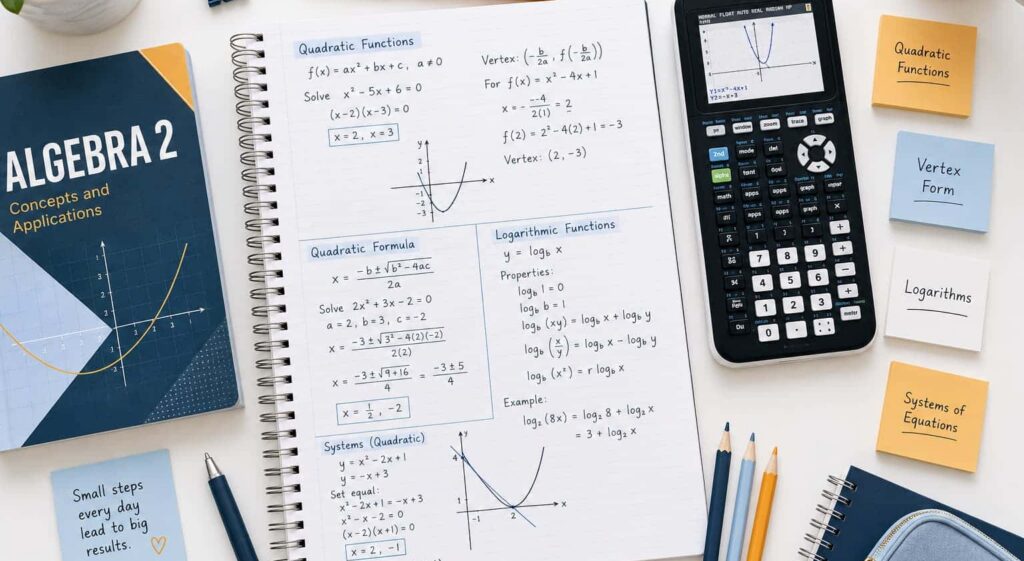
An organized Algebra 2 study setup featuring handwritten equations, graphs, a graphing calculator, colored pencils, and topic-labeled notes in a clean, modern palette.
Why students struggle with Algebra 2 (and why it isn’t ability)
Here’s the part parents rarely hear: most Algebra 2 struggle has nothing to do with how “smart” a student is. What actually happens is that Algebra 2 assumes fluency in skills from earlier courses. If factoring never fully clicked in Algebra 1, quadratic equations and polynomials will feel impossible. Both lean on factoring constantly.
Math builds on itself. So when one concept doesn’t land, the next one feels harder, and the one after that feels hopeless. Students mistake that snowball for “I’m just bad at math.”
The other big factor is pace. A classroom of 30 students moves at one speed, and it’s rarely the speed a struggling student needs. Picture a student who needed two days to absorb linear equations, but the class covered them in one. That student quietly falls behind on day two and never gets the time to catch up, so every later unit inherits the same shortfall.
Learning gaps also hide well. A student can pass a unit with a C, carry the missing pieces forward, and crash weeks later on rational expressions or logarithms. That’s why guessing at what’s wrong wastes time. Pinpointing the real gap rebuilds both skills and math confidence. It’s usually faster than students expect.
How to get started with Algebra 2 help: your action path
You don’t need a dramatic overhaul to turn things around. You need a clear sequence. Here’s a practical way to start:
- Understand the learning gaps. Start by reviewing the student’s current coursework, challenges, and foundational skills. Tutors can identify learning gaps through personalized instruction rather than relying on a one-time assessment.
- Prioritize the gaps. Address foundational skills such as factoring or fractions before moving into concepts that depend on them.
- Match support to the gap. Homework help for a single challenging unit looks different from rebuilding foundational skills across the course.
- Build a personalized learning plan. Structure the material around the student’s needs and adjust it as their understanding develops.
- Set a consistent schedule. Weekly sessions keep momentum going, which matters more than cramming.
My Math Experts tutors identify learning gaps through personalized instruction and ongoing observation. After 2–4 sessions, families receive a Personalized Success Plan with specific goals, prescribed resources, and a long-term plan developed collaboratively by the tutor, student, and family, so the work targets real gaps instead of a generic checklist. That structure separates scattered help from steady improvement. It’s the difference between spinning your wheels and real progress.
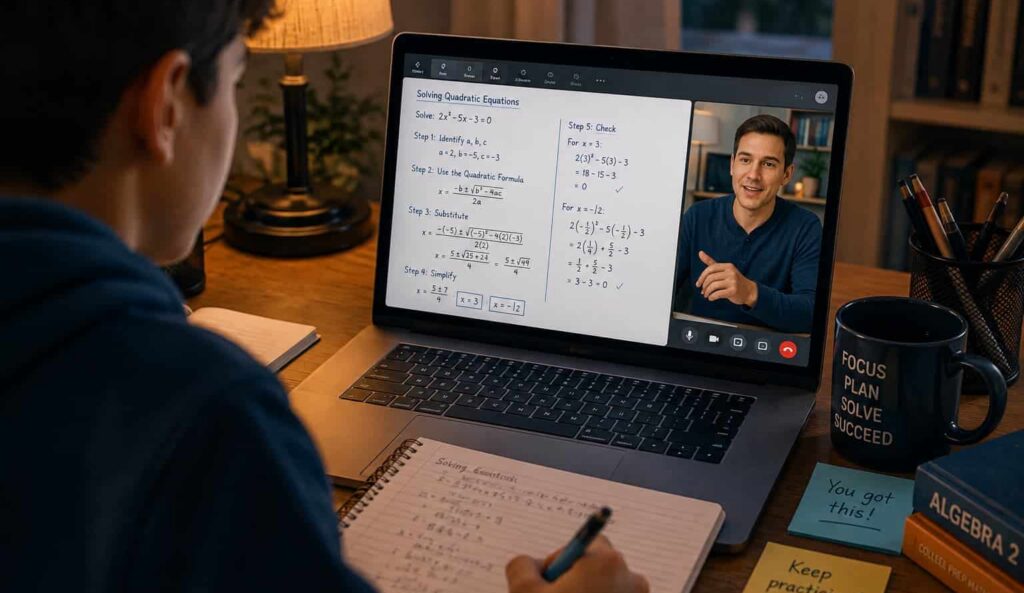
A student works alongside an online math tutor through a video call, using a shared digital whiteboard to solve an algebra problem step by step.
1:1 online tutoring vs. self-study platforms: which gets real results
Apps and videos have a place. They’re fine for a quick refresher or reviewing a formula you half-remember. Self-study platforms can help with review, while 1:1 online tutoring gives students dedicated support when they need help understanding why a particular approach works.
A self-study platform gives the same explanation to everyone. When you get stuck, it can’t ask “why did you set it up that way?” It can’t notice that your real problem isn’t logarithms at all. It’s the exponent rule underneath them. That kind of personalized support in the moment is what live, one-on-one support does that no app can.
Many families assume you can only learn algebra 2 online by watching videos. In reality, quality online algebra 2 tutoring is fully interactive. Student and tutor share a whiteboard, work problems together in real time, and adjust on the spot. Sessions are dynamic, not passive.
The other thing 1:1 delivers is accountability. A platform never notices you skipped a week. A dedicated online Algebra 2 tutor does, and they carry context from one session to the next.
How to choose the right Algebra 2 tutor or program
Not all Algebra 2 online tutoring is built the same. Knowing what to look for saves you months of trial and error. When figuring out how to find a good math tutor, use these filters:
- Expert instruction, not casual help. You want expert-led instruction that teaches concepts, not a peer who just shares answers.
- Same tutor every week. Consistency lets your tutor track progress and plan long-term instead of restarting each session.
- A structured, customized learning plan. Look for a program that assesses first, then tailors the work to your specific learning gaps.
- Focus on understanding, not just finished homework. The goal is conceptual understanding and long-term retention, because you need to understand the concepts well enough to apply them to unfamiliar problems.
- Progress you can see. You’ll receive session notes and clear updates on what improved.
One question is worth asking upfront: does the program teach you to reason through problems, or just finish today’s assignment? Homework help matters, but a good Algebra 2 tutor uses it as a starting point for deeper study strategies. Since a strong program often covers the full sequence of high school math tutoring, your student can keep the same support as they move into more advanced courses. Because tutoring cost and course expectations vary, it also helps to compare tutoring plans and session pricing and confirm the program aligns with your student’s specific curriculum before committing.

A parent and teen explore private math tutoring options together, comparing programs and finding the right fit for their learning goals.
Study strategies that make Algebra 2 finally click
Wondering how to pass Algebra 2 without living at your desk? The trick isn’t more hours; it’s better habits. A few study strategies do most of the heavy lifting:
Work problems, don’t just read them. Watching a solution feels productive but builds almost no skill. Redo it yourself, from a blank page, until the steps come without prompting.
Name the problem type before you solve. Is it a quadratic equation, a rational expression, or a system of linear equations? Half of Algebra 2 mistakes come from applying the wrong method, not from bad arithmetic.
Keep an error log. Write down every problem you miss and why. Patterns show up fast, and they point straight at your real learning gaps.
Space out practice. Twenty minutes daily beats a three-hour cram, because spaced review is how information moves into long-term memory.
Explain it out loud. If you can teach a step to someone else, you understand it. If you can’t, you found the gap. These habits help students move beyond memorizing formulas and toward durable problem-solving skills and conceptual understanding. They’re a big part of passing algebra 2 while actually keeping the material. Real math confidence comes from repetition that sticks.
Getting started with My Math Experts: your next step
If your student has tried apps and videos and still feels stuck, the missing piece is usually structure and consistency. My Math Experts offers consistent, personalized 1:1 online Algebra 2 tutoring built around one idea: fix the actual gap, then build forward. Students work with the same dedicated tutor each week.
Math is the tutors’ sole focus, and instruction is expert-led rather than casual peer help. Sessions run online, so students across the US can attend from home. Online sessions give students dedicated, step-by-step instruction focused on their coursework and learning needs. Whether you need help with tonight’s homework, a full Algebra 2 course refresher, or a long-term plan to rebuild foundational math skills, the goal stays the same: understanding, not just finished worksheets.
My Math Experts works with students nationwide through virtual sessions. It removes math friction from a family’s life and replaces frustration with steady, real progress.

A student finishes a productive online tutoring session with a confident smile, surrounded by completed Algebra 2 work and study materials.
If your student could use more clarity, structure, and one-on-one support in Algebra 2, you can talk to an expert about an assessment to see whether the program is the right fit. Results vary based on participation, consistency, and individual learning needs. The first step is to understand which concepts need extra support and create a clear path forward.
Families interested in expert geometry tutoring can schedule a consultation with My Math Experts to discuss their child's goals, challenges, and learning needs. My Math Experts currently offers a 45-minute consultation for $15, 70% off the introductory rate, for those who wish to discuss the best tutoring method for their child, with flexible tutoring plans available to meet a variety of academic needs and goals.
Ready to Master Math with Confidence?
Don’t let challenges hold you back – our experts are here to guide you every step of the way. Book your personalized consultation today at My Math Experts and start turning confusion into clarity!
FAQs
Q1. How can I get better at Algebra 2 if the concepts aren't clicking?
Start by pinpointing the exact topics tripping you up: logarithms, rational expressions, or complex numbers- then shore up the Algebra 1 skills they depend on, like factoring and exponents. Combining targeted practice on those specific gaps with step-by-step explanations of why each step works tends to produce faster improvement than re-reviewing everything at once.
Q2. Is Algebra 2 really as hard as people say?
Algebra 2 feels harder mostly because it builds on every prior math course and introduces more abstract, symbolic work: functions, logs, exponentials, and complex numbers. It’s less about ability and more about foundation; when earlier skills are solid, the new material becomes manageable rather than overwhelming.
Q3. How do I actually solve Algebra 2 problems instead of just guessing?
Identify what type of problem it is first: equation, function, or expression; then apply the matching method step by step rather than jumping to the answer. Working through the reasoning behind each step builds the pattern recognition you need for tests, where problems rarely look exactly like the examples.
Q4. Is paying for an Algebra 2 tutor worth it when free help exists?
A tutor is worth it when free resources aren’t closing your specific skill gaps or when you struggle with pacing and accountability, since one-on-one instruction targets your exact weak spots. Research on personalized tutoring consistently links it to larger learning gains than generic self-study, though many students do fine with free tools for lighter review.
Q5. What if I keep falling behind in Algebra 2 no matter what I try?
Repeated struggle usually points to unresolved gaps from Algebra 1 rather than a lack of ability, so a diagnostic that identifies those specific weak spots is often the missing step. From there, a structured plan that rebuilds foundations before advancing, through consistent practice and personalized one-on-one support.

Mr. Kemper is the founder and director of My Math Experts. He has taught and tutored thousands of math students in grades 1 - college over the last 20 years, in the classroom and in private education. Algebra is a special passion and Kemper believes that a solid Algebra foundation opens many doors. He has also trained and supported hundreds of teachers and continues to create and innovate in the math education world.