Key Takeaways
- By no means can irrational numbers be represented as a simple fraction or ratio of two integers.
- The decimal expansion is infinite and non-repeating.
- Some of the most well-known irrational numbers like π, √2, and the golden ratio are not only fundamental in geometry and algebra but also in solving real-life problems.
- Grasping the notion of irrational numbers serves as a foundation for advanced mathematical concepts and is essential for further academic progression.
Grasping numbers is among the first stages of developing strong mathematical thinking, however, not all numbers behave as students anticipate. Students, once they understand where irrational numbers are in the whole number system, see that these numbers are not weird at all, but rather, they are the basis of geometry, algebra, and real-life applications.
For many students, the problem is not the definition but rather recognizing the behavior of irrational numbers and their importance. This is the point where guided learning can be beneficial. At My Math Experts, we offer students verified, regular, personalized online math tutoring in a 1-on-1 manner that effectively changes complicated ideas to simple, understandable concepts.
Definition of Irrational Numbers and Their Origins
What Are Irrational Numbers?
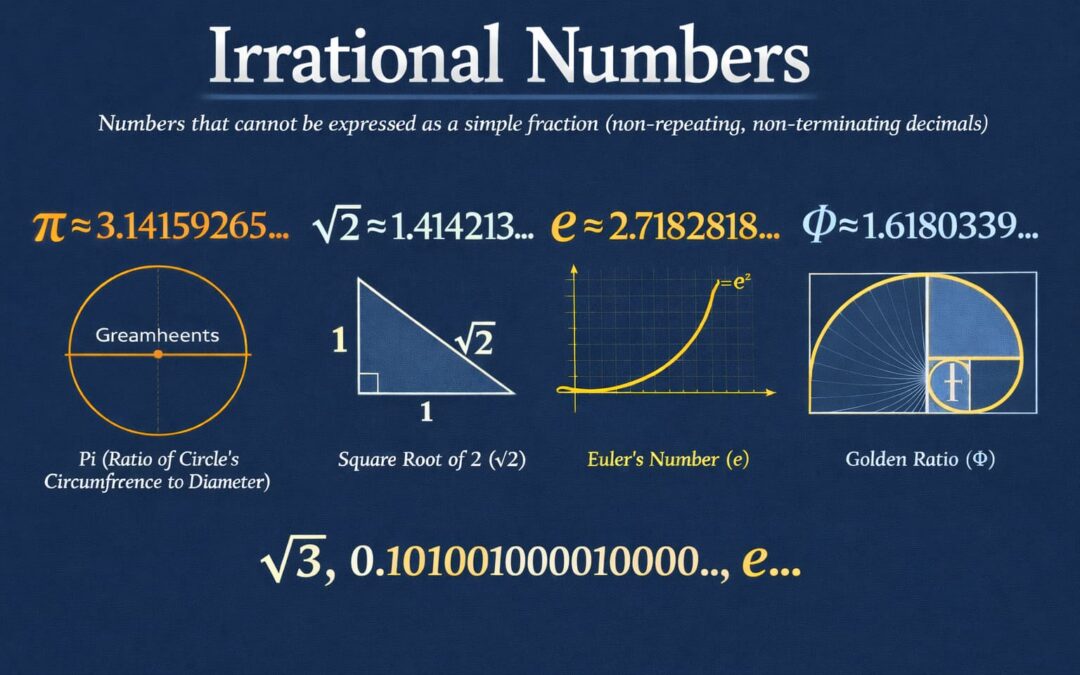
In case one has encountered the situation of trying to express specific numbers as simple fractions and then feeling that something is not quite right, that person is already halfway to the concept of irrational numbers. These numbers are the ones that can’t be written as a ratio of two integers or in the form of a simple fraction. The decimal expansion of such numbers goes on infinitely without repeating any pattern, unlike rational numbers that either terminate or repeat predictably.
Irrational numbers are often thought of as unknowns or enigmas because their decimal representations are non-terminating and non-repeating. However, once students figure out how to distinguish them, this mathematical notion becomes a lot easier.
The Historical Existence of Irrational Numbers
The concept of irrational numbers can be traced back to the 5th century BC. The Pythagorean followers found that the diagonal of a unit square √2 was a number that could not be written as a simple fraction. This finding left the ancient mathematicians, among them the Greek philosophers, quite puzzled. They thought that all numbers had to be perfect ratios.
After a few hundred years, mathematicians such as Richard Dedekind, Leopold Kronecker, and Bhāskara II broadened our understanding of such numbers. They linked them to Number Theory, algebra, geometry, and advanced mathematics.
Where Irrational Numbers Fit in the Number System
Understanding the Number System
The number system has several kinds of numbers, e.g.,
- Natural numbers
- Whole numbers
- The set of rational numbers
- The set of irrational numbers
These four sets are the real numbers, a large category that comprises the rational and the irrational numbers on the number line.
Rational vs. Irrational Numbers
The difference becomes quite obvious when their behavior is analyzed:
- Rational numbers are those that can be expressed as a fraction or a ratio of two integers and also have decimal forms that either terminate or repeat.
- Irrational numbers are those that cannot be expressed as a ratio of two integers, and their decimal representation is infinite without any repeating pattern.
Such a difference is necessary to understand later topics like prime factorization, the fundamental theorem of arithmetic, and the Irrational Number Theorem, which eventually lead to advanced mathematics such as polynomial equations, Algebra, and complex numbers.
Properties and Examples of Irrational Numbers
Properties of Irrational Numbers
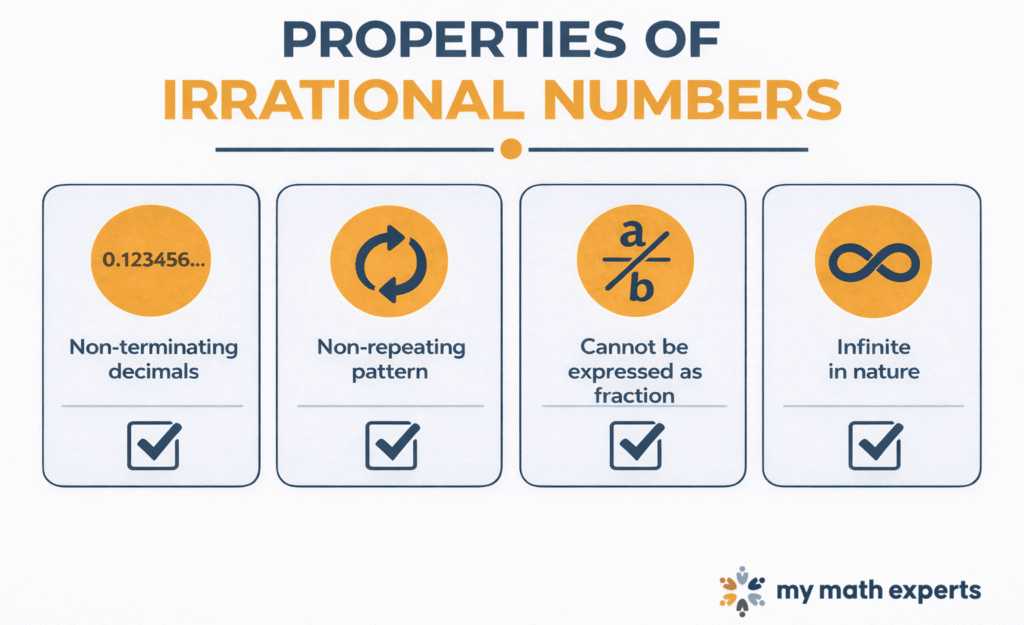
Key properties of irrational numbers: non-terminating, non-repeating, non-fractional, and infinite in nature.
Most notable Properties of Irrational Numbers are:
- Irrational numbers are numbers with non-terminating and non-repeating decimal representations. (They cannot be expressed as a simple fraction.)
- Their representation in fractional form is impossible.
- As examples, sqrt (2) and the 3rd root of 125 are both irrational.
- No matter which definition of irrational numbers you choose, these numbers are unavoidable in nature and also in math.
Such properties make them a fundamental component of the number system and a requirement for advanced problem-solving.
Common Examples of Irrational Numbers
What follows is a list of some typical examples of irrational numbers:
- π (number Pi): The first and foremost irrational number that shows up in formulas for the circumference and the area of the circle.
- √2 (root 2): From the Pythagorean theorem, the diagonal of a square with side one.
- The golden ratio (φ): A number that has strong natural, artistic, and architectural connections.
- Euler’s number e: Popularized by Leonhard Euler, closely related to growth, calculus, and also used in the simple to complex interest formula.
In addition, some irrational numbers can be classified as transcendental numbers, which are the ones that cannot be the roots of any polynomial equations with rational coefficients. At the same time, algebraic numbers are those that come from such equations but still have infinite digits and thus are irrational.
Since there are infinite irrational numbers, pupils come across them quite frequently, even if they do not recognize them instantly.
Real-Life Applications of Irrational Numbers
While they may look like purely theoretical concepts, irrational numbers are, in fact, quite common in the real world.
To illustrate:
- Architects use the golden ratio to make their designs more visually appealing.
- Engineers employ π in the calculation of the circumference of a circle, arcs, or rotational motion.
- Exponent e is trusted by scientists in models of population growth, medicine, and finance.
- Students often use √2, √3, and √5 when solving geometry problems that involve side lengths and root expressions.
These numbers are not just meaningless decimal expansions. They are the very numbers that characterize the infinite occurrences of the same patterns in nature, physics, and human-made systems.
How Students Can Learn Irrational Numbers Effectively
Visual and Conceptual Learning
Students should be able to identify the exact positions of irrational numbers on a number line, verify their decimal representations, and get used to differentiating between repeating and non-repeating decimals.
In case students simplify roots of non-perfect squares or change a decimal number into a fraction, they will be able to find patterns and, in this easy way, decide if the number is rational or irrational.
Individual Support Makes a Big Difference
As this math concept involves algebraic thinking and number sense, many students need one-on-one support to master it, especially as they prepare for more advanced topics.
Math Tutors are at their most effective when they can personalise lessons according to a student’s rhythm, confidence, and knowledge gaps, which is exactly the point here.
With one-on-one guidance tailored to your pace and learning style, you can focus on exactly where you need help and build confidence step by step. Book a consultation with My Math Experts to get personalized support designed just for you.
Why My Math Experts Is the Best Choice for Mastering Irrational Numbers

Learning journey with tutoring: from struggle to clarity, confidence, and academic growth.
Mastering irrational numbers and the whole set of real numbers becomes less complicated when students are consistently engaged with qualified math educators.
My Math Experts, the top academic tutoring company in Arizona, is ranked #1 and supports students everywhere in the U.S. with highly personalized 1:1 online math tutoring.
Why Do Families Rely on My Math Experts?
- Always 1:1 with the Same Tutor: Students can trust, monitor progress, and plan for the future.
- Only Certified Math Teachers: Every tutor is a certified, experienced teacher, not a fellow student.
- Regular Weekly Sessions: The spirit stays vibrant, and advancement becomes tangible.
- 1:1 Expert Test-Prep: A data-driven platform to customize your plan and achieve meaningful score improvements.
- Fully Online and Flexible: The sessions can be scheduled from anywhere, even at the last minute.
- Personalized Success Plan (PSP): A unique individual roadmap with definite goals and selected resources.
- Proprietary Curriculum & Assessment: Personalized worksheets, grade-level tests, and scheduled progress tracking.
- So Much More Than Just Homework Help: Tutors teach conceptually, broaden the student’s foundation, and establish long-term goals.
Ready to Master Math with Confidence?
Don’t let challenges hold you back—our experts are here to guide you every step of the way. Book your personalized consultation today at mymathexperts.com and start turning confusion into clarity!
Book a Consultation
FAQs
Q1. How do I determine that a number is irrational?
A1. Examine its decimal form. If it continues infinitely without a repeating pattern, then the number is irrational.
Q2. Are the roots of all the numbers irrational?
A2. Not all. The roots of non-perfect squares only are irrational (e.g., √2, √7). The roots of perfect squares (e.g., √9 = 3) are rational.
Q3. What purpose do irrational numbers serve?
A3. Irrational numbers can be found in shapes, the process of building, algebra, money, and quite a lot of the real-world equations, for example, the circumference of a circle or compound interest.
Q4. Can students understand irrational numbers in a short time?
A4. Suppose students receive consistent, personalized instruction from professional Math Tutors such as those at My Math Experts. In that case, they will be able to understand better and maintain their confidence for a long time.

Mr. Kemper is the founder and director of My Math Experts. He has taught and tutored thousands of math students in grades 1 - college over the last 20 years, in the classroom and in private education. Algebra is a special passion and Kemper believes that a solid Algebra foundation opens many doors. He has also trained and supported hundreds of teachers and continues to create and innovate in the math education world.